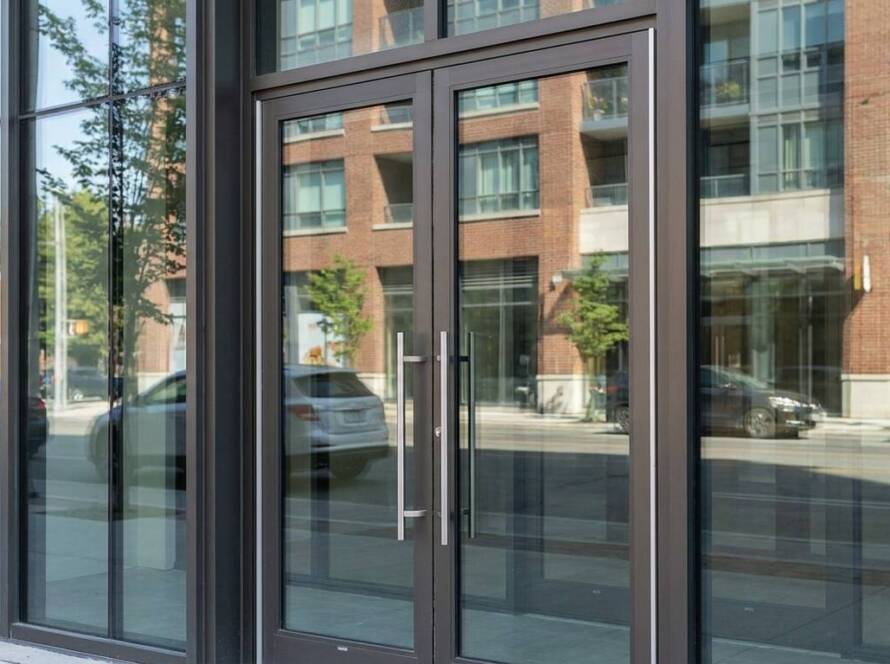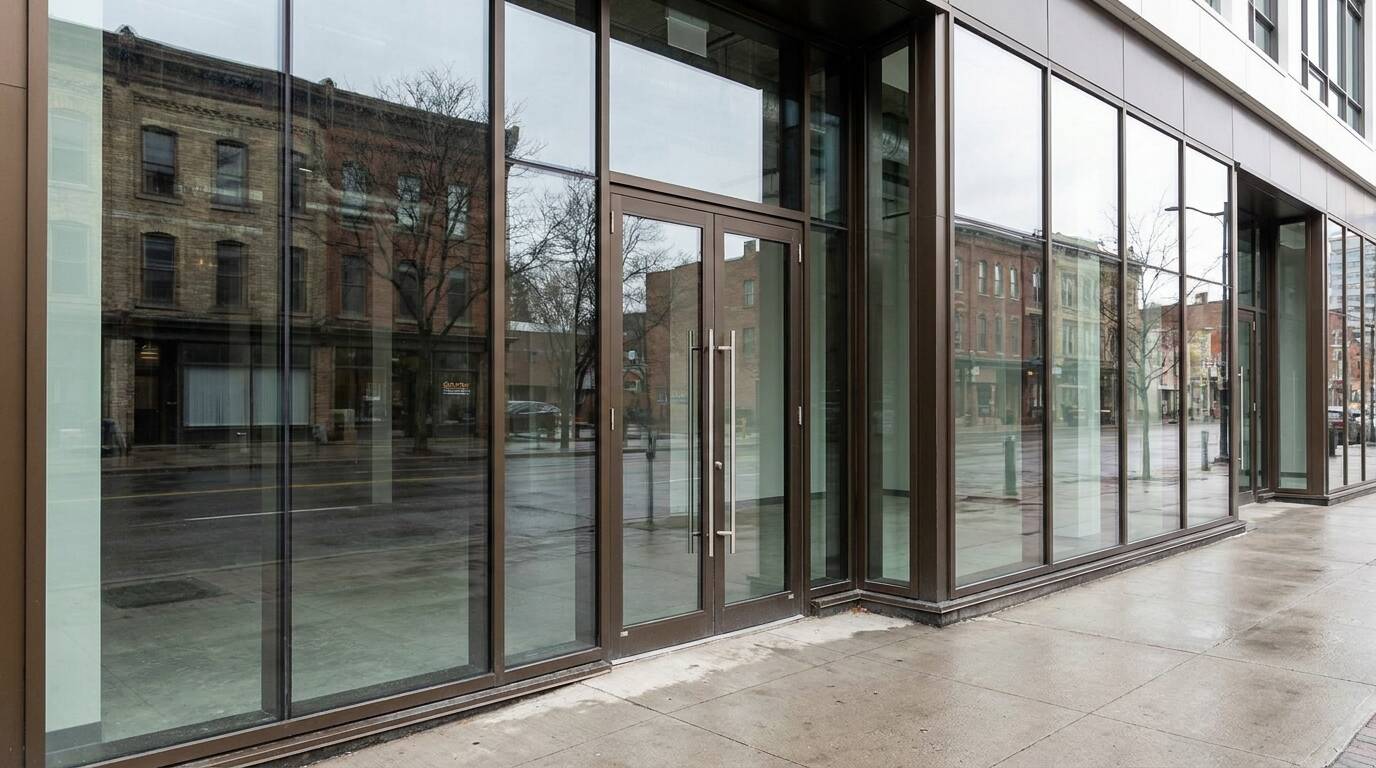
If you are specifying glass for a commercial property in the Greater Toronto Area, the choice between tempered and laminated glass usually comes down to how each one behaves when it breaks. Tempered glass is heat-treated to be roughly four to five times stronger than ordinary annealed glass, and when it finally fails it crumbles into small, blunt granules. Laminated glass is built from two or more panes bonded to a tough plastic interlayer, so when it cracks the fragments stay stuck to that interlayer and the sheet holds its shape in the frame. Both are recognized safety glazing materials in Ontario, and most commercial buildings end up using a mix of the two depending on the opening.
The short version for busy owners and managers
- Tempered glass wins on raw impact and thermal strength and on upfront cost. It is the usual choice for entrance doors, sidelights, low glazing, and shower or partition glass.
- Laminated glass wins on security, sound control, ultraviolet blocking, and staying in the opening after it breaks. It is the usual choice for storefronts that need break-in resistance, overhead glazing, skylights, and many glass guards.
- Strength: tempered is about 4 to 5 times stronger than annealed glass of the same thickness against impact and wind load.
- After breakage: tempered dices into small pieces that fall out of the frame; laminated cracks but the lite stays in place, which buys time against forced entry and weather.
- Cost: tempered is generally the more budget-friendly of the two; laminated costs more because of the extra glass lite and the interlayer.
- You can have both: laminated glass can be made from tempered or heat-strengthened lites, which is common for guards and overhead work.
Quick definitions
- Annealed glass: standard float glass with no strengthening. It breaks into large, sharp shards and is not safety glazing on its own.
- Tempered (toughened) glass: annealed glass reheated and rapidly cooled so the surfaces are in compression. Much stronger, and it breaks into small granular pieces.
- Laminated glass: two or more lites bonded with a polymer interlayer, usually PVB. The interlayer holds broken glass together.
- Safety glazing: glass that meets the impact and breakage requirements set out in the Ontario Building Code and the referenced safety-glass standard. Both tempered and laminated qualify.
The right answer depends on the opening, the hazard you are managing, the sound and energy goals for the space, and the budget. A warehouse man-door, a downtown retail storefront, a mezzanine guard, and a sloped skylight each point toward a different glass even inside the same building. Code requirements also vary by location in the building, so treat the guidance below as a planning framework and confirm the specifics for your project with your designer or the local building department before you order. If you want a second set of eyes on a specification, we at Commercial Door Pros work on exactly these decisions across the GTA.
Key takeaways
- Tempered and laminated glass are both safety glazing, but they solve different problems: tempered is about strength and clean breakage, laminated is about containment, security, and comfort.
- Tempered glass breaks into small blunt granules that leave the opening; laminated glass cracks but stays intact in the frame.
- Laminated glass offers better forced-entry resistance, sound reduction, and roughly 99 percent ultraviolet blocking thanks to its interlayer.
- Tempered glass is usually cheaper upfront and is standard for doors, sidelights, and low or wet-area glazing.
- For overhead glazing and many glass guards, laminated glass is the safer pick because broken glass should not fall on people below.
- Glass can be both laminated and tempered when an opening needs high strength and fragment retention at the same time.
- If your existing glass is cracked or fogged, identifying what you have is the first step toward a correct, code-compliant replacement.
How tempered glass is made and why it is stronger
Tempered glass starts as ordinary annealed float glass. It gets cut to size, edged, and drilled first, because once it is tempered it cannot be modified. The glass then runs through a tempering furnace where it is heated to around 620 degrees Celsius and quickly cooled with jets of air. That rapid quench locks the outer surfaces into compression while the core stays in tension. The result is a pane that resists impact, wind pressure, and thermal stress far better than the annealed glass it started as, on the order of four to five times the strength at the same thickness.
That internal stress is also what gives tempered glass its signature break pattern. When the surface is finally breached, the stored energy releases all at once and the whole pane dices into thousands of small, relatively blunt pieces. Those granules are much less likely to cause deep lacerations than the long daggers you get from annealed glass, which is why tempered glass qualifies as safety glazing. You will find it in most commercial entrance doors, the sidelights beside them, interior partitions, shower enclosures, and glazing set close to the floor. It appears throughout the systems covered in our guide to commercial glass doors and in framed aluminum storefront systems.
Tempered glass does have trade-offs. It cannot be cut, drilled, or edge-worked after tempering, so every hole and notch has to be planned before the glass goes in the furnace. The tempering process can leave slight optical distortion, sometimes called roller wave. And although the body of the pane is strong, the edges and corners are the weak points; a sharp knock there can trigger the whole pane to let go. There is also a rare failure mode we cover further down called spontaneous breakage.
How laminated glass is made and why it stays together
Laminated glass is a sandwich. Two or more lites of glass are bonded under heat and pressure to a thin polymer interlayer, most commonly polyvinyl butyral, known as PVB. Other interlayers exist too, including EVA and stiffer ionoplast films used for structural work. The glass lites themselves can be annealed, heat-strengthened, or fully tempered depending on what the opening needs, which is an important point many comparison articles skip.
The interlayer is the whole story. When laminated glass takes an impact, the glass can crack, but the broken pieces stay bonded to the plastic. The lite holds its shape, stays in the frame, and keeps doing part of its job. For a storefront that has just been hit, that means the opening is still closed against weather and still slows down anyone trying to get through. For overhead glass, it means fragments do not rain down on the people below.
That same interlayer brings a few bonus properties. It dampens vibration, so laminated glass reduces sound transmission better than a single pane of the same thickness, and acoustic interlayers push that further for noisy locations like a cafe on a busy street. It also screens out roughly 99 percent of ultraviolet light, which helps protect merchandise, flooring, and furnishings from fading. The tradeoff is cost and weight. You are paying for two or more lites plus the interlayer, and the assembly is heavier, which affects framing and hardware. Laminated glass also usually needs its exposed edges protected from long-term moisture to avoid interlayer problems at the perimeter.
Tempered vs laminated glass: the side-by-side comparison
Here is the practical rundown most property managers are looking for. Read it as general guidance for commercial glazing, not as a spec for a particular opening.
| Factor | Tempered glass | Laminated glass |
|---|---|---|
| Construction | Single pane, heated and rapidly cooled | Two or more lites bonded to a PVB or similar interlayer |
| Impact and wind strength | High, about 4 to 5 times annealed | Good, and depends on the glass lites used |
| What happens when it breaks | Dices into small blunt granules that leave the frame | Cracks but stays bonded to the interlayer and in the frame |
| Forced-entry resistance | Limited once breached the opening is clear | Strong, the interlayer resists being pushed through |
| Sound reduction | Standard for its thickness | Better, and much better with an acoustic interlayer |
| Ultraviolet blocking | Limited unless coated | Around 99 percent from the interlayer |
| Overhead and sloped use | Generally not allowed alone, pieces can fall | Preferred, broken glass is retained |
| Upfront cost | Lower | Higher |
| Can be cut after manufacture | No | Can be cut before lamination, not after; field cutting is not practical |
| Typical commercial uses | Doors, sidelights, low glazing, partitions, showers | Security storefronts, skylights, guards, acoustic glazing |
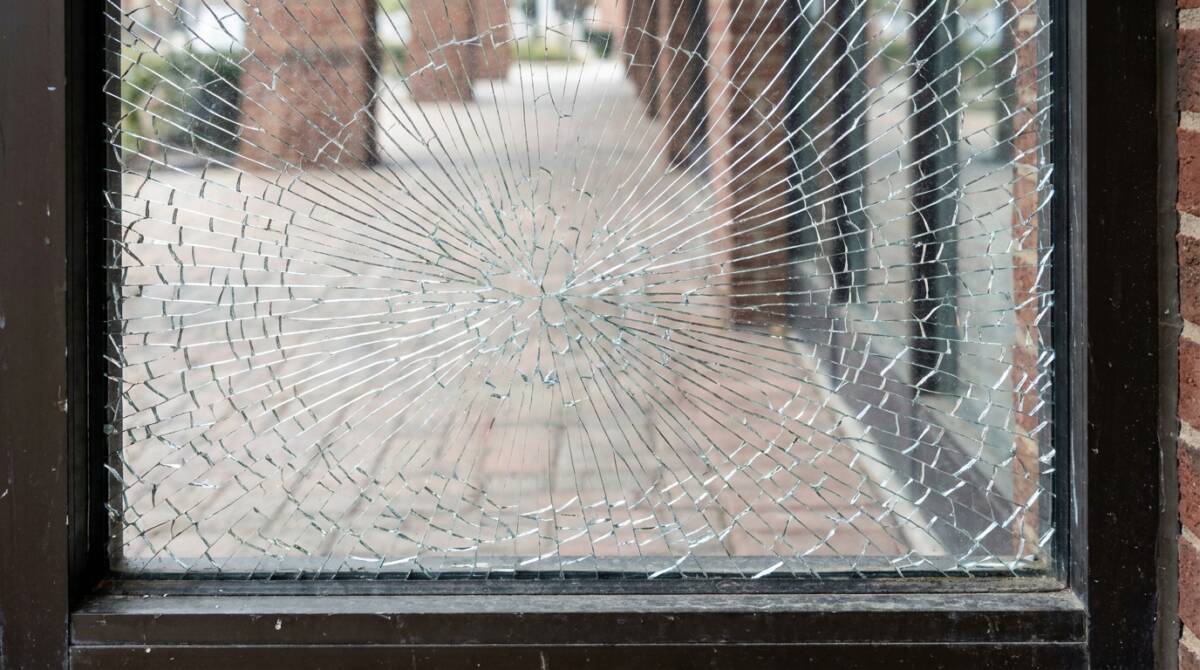
How each type breaks, and why that matters for a business
Breakage behavior is the single most useful way to think about these two products, because it maps directly onto the risk you are trying to manage.
Tempered glass is about reducing injury at the moment of failure. When a tempered entrance door or sidelight gets struck hard enough to break, it turns into a shower of small cubes. People nearby are far less likely to be cut badly than they would be by sharp annealed shards. The downside is that the opening is now wide open. For an after-hours break-in, a single hard strike on tempered glass can clear the whole pane and give someone immediate access. That is why tempered alone is a weak choice where security is the priority.
Laminated glass is about containment. The glass can shatter, but the interlayer keeps the fragments in place and keeps the sheet spanning the opening. A would-be intruder has to work through a tough plastic film that flexes and resists rather than stepping through a cleared frame. The same property is what makes laminated glass the standard for anything overhead, since a broken skylight should never drop glass onto the floor below. The following table lines up the two break behaviors against the outcomes owners care about.
| Scenario | Tempered glass outcome | Laminated glass outcome |
|---|---|---|
| Accidental impact in a busy area | Breaks into blunt granules, low laceration risk | Cracks and holds, low laceration risk and stays in place |
| Attempted after-hours break-in | One hard hit can clear the opening | Resists penetration, slows or deters entry |
| Overhead skylight failure | Fragments can fall on people below | Broken glass stays bonded overhead |
| Storm or flying debris | High strength, but open once breached | Keeps the envelope closed even when cracked |
Security and forced-entry resistance
For retail, pharmacies, cannabis stores, jewellers, and any ground-floor business that has dealt with smash-and-grab attempts, this is often the deciding factor. Tempered glass does not buy you much time. Its strength is in resisting a single large impact, not repeated blows, and once a corner lets go the whole pane is gone.
Laminated glass changes that math. The attacker can break the glass but still faces the interlayer, which stretches and holds. Thicker glass lites and stiffer interlayers increase the delay further, and purpose-built security laminates are rated for forced entry. For a storefront that has been hit before, upgrading to laminated glass is one of the most effective passive security measures available, and it pairs well with good glass door hardware and locks. If your current storefront takes a hit, our emergency commercial glass repair service can board up and replace fast, and we can discuss a laminated upgrade at the same time.
Sound control and ultraviolet protection
Noise is a real problem for GTA businesses on arterial roads, near transit, or under flight paths. Laminated glass helps because the interlayer absorbs vibration that a single pane would simply pass through. Standard laminated glass already outperforms monolithic glass of the same thickness, and acoustic PVB interlayers are tuned specifically to cut mid and high frequency noise, which is the range that makes an office or restaurant feel loud. Tempered glass, by contrast, performs about the same as annealed glass of its thickness for sound.
Where the whole-wall sound rating or the energy performance matters most, the glass usually lives inside a sealed double-glazed unit rather than as a single lite. We cover that in depth in our guide to insulated glass units, and you can combine laminated glass as one lite of that unit for both acoustic and thermal benefit. On ultraviolet, the laminated interlayer screens out close to 99 percent of UV, which matters for shops with merchandise, art, or interior finishes that fade.
Cost: what actually drives the price difference
Tempered glass is almost always the cheaper option for a given size because it is a single pane with one added process. Laminated glass costs more because you are buying two or more lites plus the interlayer, and the assembly is heavier to handle and install. That said, the glass itself is only part of a commercial glazing cost. We never quote prices in a blog because they depend on your exact opening, but the table below lays out the factors that move the number either way.
| Cost driver | Effect on price |
|---|---|
| Glass type | Laminated generally costs more than tempered for the same size |
| Thickness and number of lites | Thicker glass and more lites raise cost and weight |
| Interlayer type | Acoustic, security, or ionoplast interlayers cost more than standard PVB |
| Insulated glass unit | Building the lite into a sealed unit with coatings adds cost |
| Size and handling | Large or heavy lites need more labour and sometimes lifting equipment |
| Access and height | Overhead, upper-floor, or hard-to-reach openings increase labour |
| Frame and hardware changes | Heavier laminated glass can need upgraded framing or hinges |
One more point worth making to a budget-conscious owner. The cheaper glass is not always the cheaper decision. If a tempered storefront keeps getting smashed, the repeated replacements, board-ups, and lost business can cost far more than a laminated upgrade would have. The same logic applies when you weigh any glazing choice, which is the theme of our guide on deciding between repair and replacement.
Which glass belongs where in a commercial building
Most commercial properties use both products, matched to the opening. Here is a practical application matrix for GTA buildings. Always confirm the final specification against the current code and your design documents.
| Application | Usually specified | Why |
|---|---|---|
| Entrance doors and sidelights | Tempered | Impact safety at a high-traffic opening, cost effective |
| Security-focused retail storefront | Laminated | Resists forced entry and keeps the opening closed after a hit |
| Skylights and sloped overhead glazing | Laminated | Broken glass must not fall on occupants |
| Interior partitions and shower glass | Tempered | Safety glazing with clean breakage, lower cost |
| Glass guards and railings | Laminated, often laminated-tempered | A broken guard must still protect the edge |
| Noisy or street-facing offices | Laminated, often acoustic | Interlayer cuts sound transmission |
| Standard vision glazing in windows | Tempered or annealed in a sealed unit | Chosen by load, location, and energy targets |
If you are planning a new build or a renovation and trying to sort out which openings need what, our article on choosing the right commercial door for a new build or renovation walks through the same kind of decision for entrances, and the broader guide to commercial glass types puts tempered and laminated in context with the other glazing you will encounter.
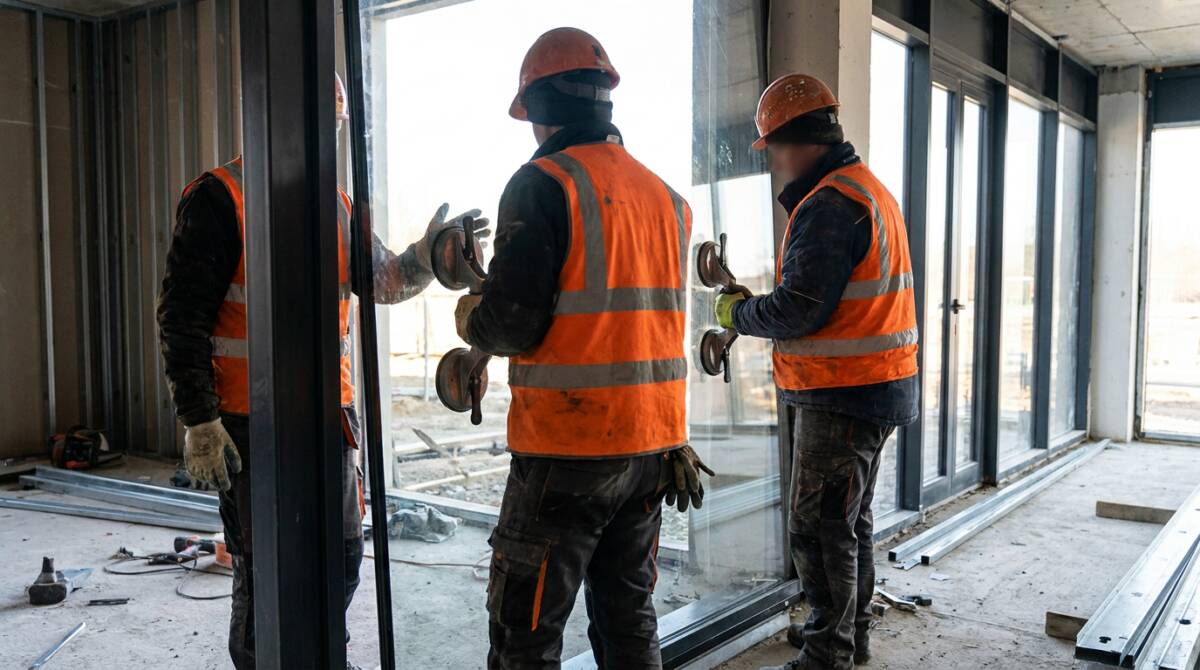
Safety glazing and the Ontario Building Code
In Ontario, you do not get a free choice everywhere. The Ontario Building Code requires safety glazing in what it calls hazardous locations, which include glass in and beside doors, glazing set low to the floor, and glass in wet areas like showers and pools. Both tempered and laminated glass satisfy the safety-glass requirement, and the referenced product standard in Canada is CAN/CGSB-12.1, Tempered or Laminated Safety Glass. You can read the regulation itself through the Government of Ontario at the Ontario Building Code regulation on the Ontario government website.
Two situations push you specifically toward laminated. Overhead and sloped glazing generally has to be laminated, or otherwise protected, so a failure cannot drop glass on people underneath. Glass guards and railings also frequently require laminated construction, especially where there is no continuous top rail or where a fall hazard sits below, because the guard still has to hold the edge even after the glass is broken. These rules change with the building, the occupancy, and the location of the glass, so the practical move is to confirm the requirement with your architect, engineer, or the local building department rather than assuming. Our overview of when Toronto businesses need permits for door, window, and storefront work is a useful companion when code comes into play.
Can one piece of glass be both laminated and tempered?
Yes, and this is where the either-or framing in most comparison articles breaks down. Laminated glass is defined by the interlayer, not by the glass lites. Those lites can be annealed, heat-strengthened, or fully tempered. When an opening needs high impact strength and fragment retention at the same time, the usual answer is laminated glass built from two tempered or heat-strengthened lites.
Frameless glass guards are a good example. They need the strength of tempered glass and the post-breakage retention of laminated glass, so laminated-tempered assemblies are common. The same combination shows up in demanding overhead glazing and in high-security storefronts. The point for an owner is simple: you are not forced to pick one property and lose the other. A good glazing specification matches the build to the hazard, and that often means a hybrid.
Spontaneous breakage, heat-soaking, and other failure modes
Tempered glass has one unusual failure mode that catches owners off guard. Very occasionally, a tempered pane breaks on its own with no obvious impact, sometimes long after installation. The usual cause is a tiny nickel sulfide inclusion trapped in the glass during manufacture. Over time and with temperature changes, that inclusion can expand just enough to release the stored tension and shatter the pane. It is rare, but it is real, and it is more noticeable on large facades with a lot of tempered glass.
The industry answer is heat-soak testing, where tempered glass is held at an elevated temperature to force most unstable panes to fail in the factory rather than on your building. For large or safety-critical tempered installations, it is worth asking whether the glass is heat-soaked. Laminated glass does not share this failure mode, and even when a laminated lite breaks, the interlayer keeps the fragments in place, which is part of why it is favoured overhead. Both products can still be damaged by edge impacts, poor installation, or framing that pinches the glass, so correct installation matters as much as the glass choice.
How to tell what glass you already have
Before you can replace a broken or fogged lite correctly, you need to know what is in the opening now. A few checks help, though a professional can confirm quickly.
| Clue | What it suggests |
|---|---|
| Etched stamp or bug in a corner | Tempered or safety glass, the mark names the fabricator and standard |
| A thin line or seam visible at the edge | Laminated, you are seeing two lites with the interlayer between |
| Faint spots or patterns through polarized sunglasses | Tempered, those are quench marks from the furnace |
| No stamp, sharp large shards if a sample breaks | Likely annealed glass, not safety glazing |
| Fogging or haze sealed between panes | A failed insulated glass unit, a separate issue from tempered versus laminated |
If the glass is cloudy between the panes rather than cracked, you are probably dealing with a sealed-unit failure, not a safety-glass question. That has its own repair path, which we cover in the insulated glass units guide. When a single storefront pane is damaged, you may be able to replace just that lite rather than the whole system, something we explain in replacing a single storefront panel.
Repair, replacement, and keeping the glass in good shape
Neither tempered nor laminated glass can be repaired once it is actually broken; a cracked safety lite gets replaced, not patched. The practical differences show up in how urgent and how involved the replacement is. A shattered tempered pane leaves an open hole that needs a fast board-up and a same-size replacement. A broken laminated lite often stays in place, which gives you a little more breathing room to plan, though it still needs replacing to restore full performance.
Replacing either one correctly means matching the glass type, thickness, and any coatings to the original and to current code, then setting it in sound framing with the right glazing seals. For storefronts and entrances, that is work we handle through commercial glass replacement and aluminum storefront repair, and for the windows themselves through commercial window replacement. Routine care also extends the life of the framing and seals around the glass, which we outline in our guide to cleaning and maintaining aluminum storefront doors, and seasonal movement is worth watching too, as covered in commercial door problems that get worse in summer.
How to choose: a simple decision framework
When you strip away the technical detail, the choice usually comes down to four questions about the opening.
- What is the main risk? If it is injury from accidental impact, tempered covers it. If it is break-ins, falling glass, or keeping the envelope closed after damage, laminated is the stronger answer.
- Where is the glass? Overhead, sloped, or a guard almost always means laminated. A standard door or sidelight is usually tempered.
- Do comfort and protection matter? If you need quieter interiors or ultraviolet control, laminated earns its premium. If not, tempered is fine.
- What is the budget over time? Tempered wins on upfront cost. Laminated can win on total cost where security, downtime, or repeated damage are in play.
For many GTA businesses the real answer is both, assigned opening by opening. If you want help sorting out a specification, we look at the whole picture, including framing, hardware, energy, and code, across commercial windows and storefront systems. You can start a conversation or request an assessment through our contact page.
Not sure which glass your project needs? Commercial Door Pros specifies, supplies, and installs tempered and laminated safety glass for storefronts, entrances, windows, and guards across the Greater Toronto Area. Tell us about your opening and we will recommend the right glass for the hazard, the code, and the budget. For a broken storefront that needs attention now, reach our emergency glass repair service.
Frequently asked questions
What is the difference between tempered and laminated glass?
Tempered glass is a single pane heat-treated for strength that breaks into small blunt granules. Laminated glass is two or more panes bonded to a plastic interlayer that holds the glass together when it breaks. Tempered is about impact strength and clean breakage, while laminated is about containment, security, and sound control.
Which is stronger, tempered or laminated glass?
For resisting a single impact or wind load, tempered glass is stronger, roughly four to five times the strength of ordinary annealed glass. Laminated glass is not measured the same way, since its advantage is staying together after it breaks. Its strength depends on the glass lites used, and it can be made with tempered lites for both benefits.
Which is more expensive, laminated or tempered glass?
Laminated glass is generally more expensive than tempered glass of the same size, because it uses two or more glass lites plus an interlayer and is heavier to handle. Tempered glass is usually the more budget-friendly option, though the total installed cost also depends on size, framing, access, and whether the glass sits in a sealed insulated unit.
What is better for a storefront, tempered or laminated glass?
It depends on the priority. Tempered glass is common and cost effective for standard storefronts and entrance doors. If security against break-ins matters, laminated glass is the better storefront choice because it resists forced entry and keeps the opening closed after a hit. Many storefronts use tempered in the doors and laminated where security is a concern.
Is laminated glass more secure than tempered glass?
Yes. Once tempered glass is breached, the whole pane clears and the opening is open. Laminated glass can crack but the interlayer resists being pushed through, which slows or deters forced entry. Thicker lites and security interlayers increase that resistance further.
Does laminated glass block UV and reduce noise?
Yes to both. The interlayer in laminated glass screens out roughly 99 percent of ultraviolet light, which helps protect merchandise and interior finishes from fading. It also dampens sound better than a single pane of the same thickness, and acoustic interlayers improve that further for noisy locations.
What are the disadvantages of tempered glass?
Tempered glass cannot be cut or drilled after it is made, offers little security once broken, performs only averagely for sound and ultraviolet, and has a rare risk of spontaneous breakage from nickel sulfide inclusions. Its edges are also the weak point and can trigger a full break if struck.
What are the disadvantages of laminated glass?
Laminated glass costs more than tempered, is heavier, which can affect framing and hardware, and usually needs its exposed edges protected from long-term moisture. It is also not field-cut, so sizing has to be right before it is ordered.
Why does tempered glass sometimes shatter on its own?
Spontaneous breakage is usually caused by a microscopic nickel sulfide inclusion left in the glass during manufacture. Temperature changes can make that inclusion expand enough to release the pane’s internal tension and shatter it, sometimes months or years after installation. Heat-soak testing screens out most at-risk panes before they ship.
What is the lifespan of tempered or laminated glass?
Both can last for decades when installed correctly and kept in sound framing. There is no fixed expiry date. What ends a glass unit’s life is usually damage, edge or seal failure in a sealed unit, or a renovation, rather than the safety glass itself wearing out.
Can you cut or drill tempered glass after it is made?
No. Tempered glass must be cut, drilled, and edge-worked before it goes through the tempering furnace. Any attempt to cut or drill it afterward will shatter the pane. Laminated glass is also not practical to field-cut, so both types need accurate sizing before fabrication.
Is laminated glass the same as impact glass?
Impact-resistant glass is a type of laminated glass built to withstand strong impacts, often with thicker lites and stiffer interlayers. All impact glass is laminated, but not all laminated glass is rated for the highest impact ratings. For a specific rating, confirm the product specification rather than assuming.
How can I tell if my glass is tempered, laminated, or annealed?
Look for an etched stamp in a corner, which usually indicates tempered or safety glass. A thin seam visible at the edge points to laminated glass with its interlayer. Faint patterns seen through polarized sunglasses suggest tempered glass. No marking plus large sharp shards on breakage suggests ordinary annealed glass. A glazier can confirm quickly.
Does the Ontario Building Code require tempered or laminated glass?
The Ontario Building Code requires safety glazing in hazardous locations such as doors, sidelights, low glazing, and wet areas, and both tempered and laminated glass meet that requirement under the referenced safety-glass standard. Specific requirements vary by location in the building, so confirm them with your designer or the local building department.
Which glass is required for overhead glazing and skylights?
Overhead and sloped glazing generally has to be laminated or otherwise protected so that broken glass cannot fall on people below. Laminated glass holds fragments on the interlayer, which is why it is the standard choice for skylights and sloped glass. Confirm the requirement for your building with your designer.
Can one piece of glass be both laminated and tempered?
Yes. Laminated glass is defined by its interlayer, and the glass lites inside it can be tempered. Laminated-tempered assemblies give both high impact strength and post-breakage retention, which is why they are common for glass guards, demanding overhead glazing, and high-security storefronts.
Is laminated or tempered glass easier and cheaper to replace?
Tempered glass is usually cheaper to supply, but a shattered tempered pane leaves an open hole that needs an urgent board-up and replacement. A broken laminated lite often stays in the opening, which can reduce the immediate emergency, though it still needs replacing. Either way, the replacement should match the original glass type, thickness, and code.
Either type of safety glass can carry an energy coating, and our guide to low-E glass explains how that works.