

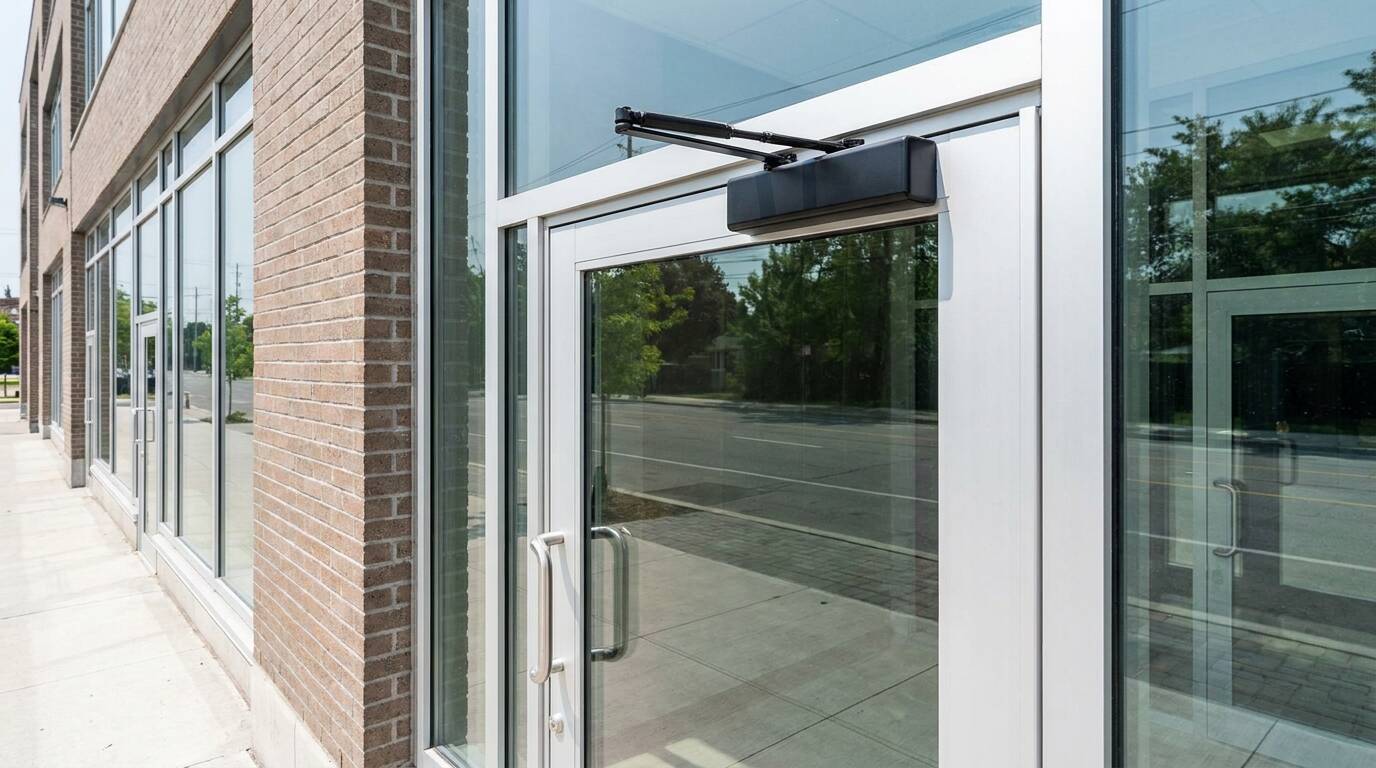
Walk up to almost any commercial entrance in the Greater Toronto Area and there is a small hydraulic device doing quiet work overhead. The door closer is what brings the door back to a controlled stop after every customer, delivery driver, and staff member walks through. When it works, nobody notices it. When it fails, the whole building feels it: a door that slams and rattles the glass, one that drifts open and bleeds heated or cooled air, or a fire door that no longer latches the way the code expects.
For a property manager or business owner, a bad closer is rarely just an annoyance. It drives up energy bills, creates an accessibility barrier, wears out the hinges and frame, and in the case of a rated opening it can put you offside on a fire inspection. This guide walks through how commercial door closers actually work, the main types you will run into across GTA storefronts, offices, warehouses, and institutions, how they are sized and graded, what the common failures look like, and when a closer is worth repairing versus replacing.
What is a commercial door closer?
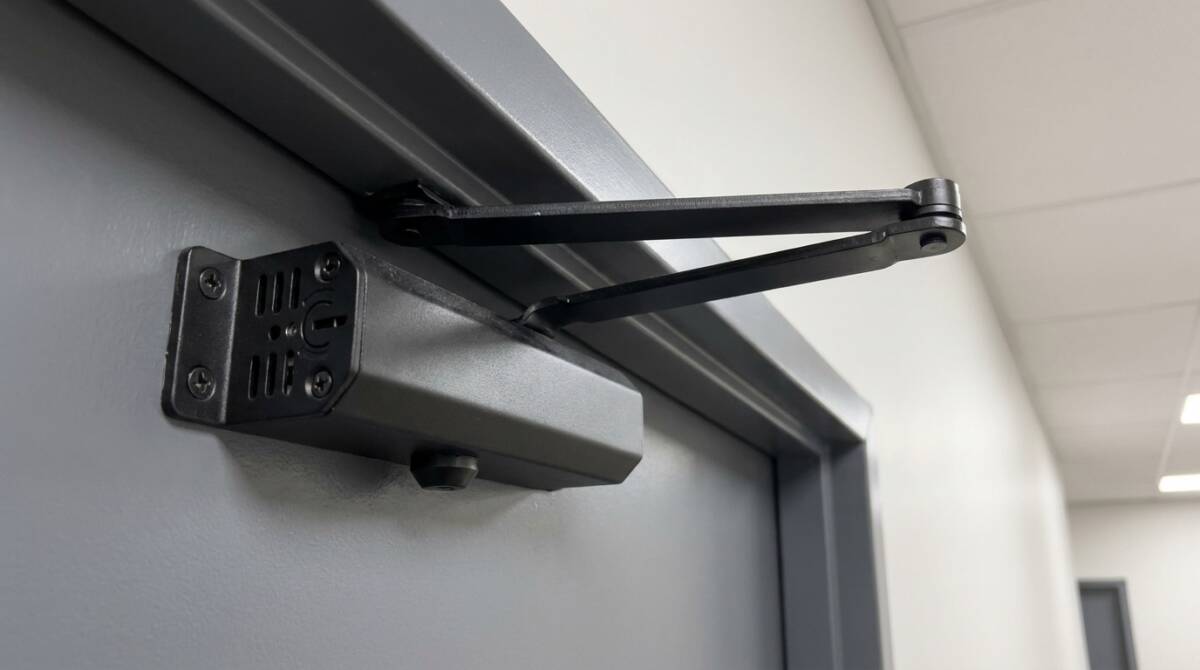
A commercial door closer is a mechanical device, usually mounted at the top of a swing door, that closes the door in a controlled way after someone opens it. It stores energy in a spring when the door is pushed or pulled open, then releases that energy through an oil-filled hydraulic system so the door swings shut at a regulated speed instead of slamming. Most also latch the door firmly against the frame.
That last part matters more than people expect. A closer is not only there to stop a door banging. On a fire-rated opening it is the component that makes the door self-closing and self-latching, which is the entire point of the assembly. On a barrier-free entrance it controls how much effort it takes to open the door and how long the door stays open for someone moving slowly. The closer sits at the intersection of comfort, security, energy performance, and code, which is why it is one of the parts we get called out for most often. It belongs to the broader family of commercial door hardware that keeps an opening working as a system.
How a door closer works
Inside the body of a hydraulic closer is a coil spring and a piston moving through chambers of oil. Opening the door compresses the spring and pushes the piston, forcing oil from one chamber to another. When you let go, the spring pushes back, and the speed of the return is governed by how quickly that oil is allowed to flow past a set of small adjustment valves. Turn a valve a quarter turn and you change how fast the door moves through part of its arc.
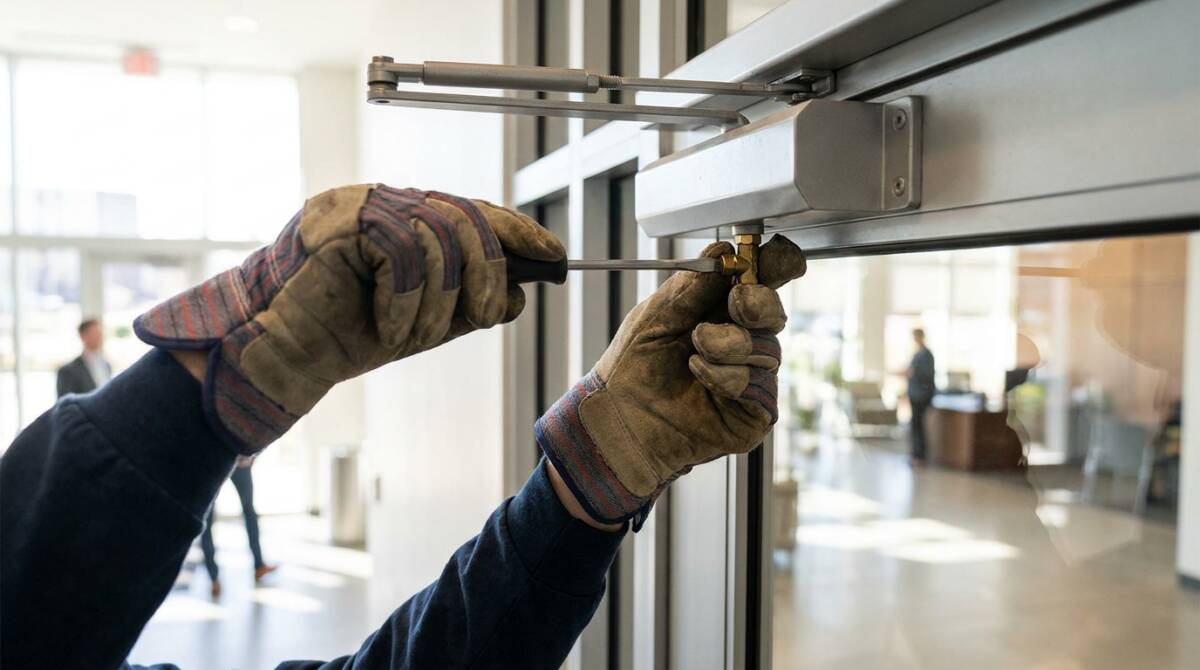
Those valves are the reason a good commercial closer feels so different from a cheap residential one. They let a technician tune the door to the opening rather than accept one fixed behaviour. Here is what each control does.
| Adjustment | What it controls | Why it matters |
|---|---|---|
| Sweep (closing) speed | The main part of the swing, from wide open to a few degrees from the frame | Set too fast and the door slams; too slow and it does not close before the next person arrives |
| Latch speed | The final few degrees as the door meets the frame | A short burst of speed here pushes the door past the weatherstripping and seats the latch |
| Backcheck | Resistance that kicks in when the door is opened quickly or far | Protects the door, hinges, and wall from a gust of wind or an aggressive push |
| Delayed action | Holds the door open longer before the sweep begins | Gives someone with a cart, a mobility aid, or an armful of boxes time to get through |
| Spring power | How much force the closer applies, often adjustable across a range of sizes | Sets the opening effort and whether the door can overcome wind and stack pressure to latch |
Not every closer has all five. Budget units may only offer sweep and latch. Full-feature commercial closers add backcheck and delayed action, and many now use an adjustable spring so one model covers a range of door sizes. If you want to understand the valves on a unit you already own, our step-by-step guide to adjusting a commercial door closer walks through each one with the door in front of you.
Types of commercial door closers
Closers are grouped mostly by where they mount and how visible they are. The right choice depends on the door material, the look you want, how much abuse the opening takes, and what the frame will accept. These are the families you will meet on GTA commercial projects.
Surface-mounted closers
This is the workhorse. The closer body bolts to the face of the door or the frame, with an arm reaching across to the other surface. You see them on steel doors, aluminum storefront doors, and wood doors in offices and schools. They are easy to install, easy to service, and easy to adjust because every valve is right there. The trade-off is that they are visible, and on a storefront entrance some owners find the box and arm less elegant than a concealed option. For most back doors, service doors, and side entrances, a surface closer is the practical answer.
Overhead concealed closers
Here the closer hides inside the door or the head frame above it, so the finished opening looks clean with nothing bolted to the face. These are common on aluminum storefront and commercial glass doors where appearance carries weight, such as a retail front or a lobby. They cost more, and because the mechanism is tucked away, service takes longer and sometimes means pulling the door. When the look of the entrance is part of the brand, the extra cost is usually worth it.
Floor closers (floor springs)
A floor closer lives in the floor at the bottom pivot of the door, out of sight entirely. All-glass entrances and heavy aluminum doors on high-traffic lobbies often ride on them. They handle serious weight and give a very clean look, since there is no hardware up top at all. The catch is installation: the mechanism sits in a cast recess in the slab, so replacing one in an existing floor is a real job rather than a swap. These pair naturally with pivot hardware rather than conventional hinges.
Spring hinges
Spring hinges are not true closers, but they do the related job of pulling a door shut, using a spring built into the hinge barrel instead of a separate device. They are cheaper and nearly invisible. The reason we rarely specify them on commercial swing doors is control: a spring hinge has no latch-speed or backcheck adjustment, so it cannot deliver the consistent, code-friendly closing a hydraulic closer gives. On a fire door in particular, a listed closer is almost always the correct call over spring hinges.
| Type | Where it mounts | Best for | Trade-off |
|---|---|---|---|
| Surface-mounted | Face of door or frame | Most steel, aluminum, and wood commercial doors | Visible box and arm |
| Overhead concealed | Inside the door or head frame | Storefronts and lobbies where looks matter | Higher cost, slower to service |
| Floor closer | Recessed in the floor slab | All-glass and heavy high-traffic doors | Expensive to replace in existing floors |
| Spring hinges | In the hinge barrel | Light interior doors on a budget | No speed or backcheck control; weak fit for rated doors |
Arm configurations and why they matter
A surface closer can be set up with the arm reaching in one of three ways, and the choice changes how the door behaves and how exposed the hardware is. On a swing door, the side you push from and the side you pull from behave differently, so the arm has to suit the situation.
Regular arm (pull side)
The arm projects out from the door toward the frame on the side you pull. It gives the most closing power for the effort, which is useful on heavy or wind-loaded doors. The downside is that the arm sticks out the furthest, so it is the most visible option and the easiest for a cart or a shoulder to catch.
Parallel arm (push side)
The arm folds back nearly flat against the door on the push side. This is the most common setup on commercial openings in the GTA because it keeps the arm tucked in, out of the traffic path, and harder to vandalize or snag. It loses a little efficiency compared with a regular arm, which is why sizing the closer correctly matters more here.
Top jamb (push side)
The closer body mounts on the face of the frame above the door rather than on the door itself. Top jamb mounting shows up where the door leaf cannot take the closer, or on narrow-stile aluminum doors. It behaves much like a regular arm in reverse and is a frequent choice on storefront openings.
Hydraulic versus pneumatic closers
You will see both oil (hydraulic) and air (pneumatic) closers sold, and for commercial work the distinction is simple. Pneumatic closers use a sealed cylinder of air and are the type on most residential screen and storm doors. They are inexpensive and fine for a light door, but they give you crude control, usually just one speed screw, and they cannot reliably latch a heavier door or hold up to constant traffic.
Hydraulic closers use oil, which does not compress, so they deliver the precise, repeatable speed control that separate sweep, latch, and backcheck adjustments depend on. Every serious commercial closer is hydraulic. If a door on your property sees real foot traffic or carries a security or fire function, it needs a hydraulic unit, not a pneumatic one.
Door closer sizing
Closers are rated by size, and getting the size right is the difference between a door that opens easily and latches firmly and one that either slams or never quite shuts. The industry uses a numbered scale, roughly size 1 through 6, where a higher number means a stronger spring for a wider, heavier door. A size 1 suits a narrow interior door; a size 6 is for a wide, exterior, wind-exposed opening.
The table below shows typical sizing guidance by door width. Treat it as a starting point, because exterior exposure, wind, building stack pressure, and the arm type all shift the answer. A parallel-arm closer on a windy north-facing entrance may need to be sized up from what the width alone suggests.
| Closer size | Typical door width | Common use |
|---|---|---|
| Size 1 | Up to about 700 mm (28 in) | Light interior doors |
| Size 2 | Up to about 760 mm (30 in) | Interior offices, closets |
| Size 3 | Up to about 840 mm (33 in) | Interior and lighter exterior doors |
| Size 4 | Up to about 910 mm (36 in) | Standard exterior entrances |
| Size 5 | Up to about 1120 mm (44 in) | Wide, heavy, or exposed doors |
| Size 6 | Up to about 1220 mm (48 in) | Very wide exterior and high-wind openings |
Most modern commercial closers are adjustable rather than fixed, often covering sizes 1 through 6 in one body through a spring-tension screw. That flexibility is handy, but it has a quiet trap: a door set to the lowest power to feel easy on the arm may lack the force to latch against weatherstripping or wind, so it drifts and leaks air. Sizing and spring tension have to be balanced against the opening rather than set to whatever feels lightest on the arm. Picking the right door and hardware together from the start is the subject of our guide on choosing the right commercial door, and door width itself is covered in our standard commercial door sizes guide.
Grades and standards
Commercial closers are tested and graded under ANSI/BHMA A156.4, the North American standard for door controls. The grading sorts closers into performance tiers, with Grade 1 being the heaviest duty and longest lasting, Grade 2 in the middle, and Grade 3 for lighter duty. The tiers reflect cycle testing, so a Grade 1 closer is built and verified to survive far more open-close cycles than a Grade 3.
For a high-traffic GTA entrance, a grocery store, a clinic, a school, or a busy office lobby, Grade 1 is the sensible floor. A low-traffic interior door in a small office can live happily on a lighter grade. Paying for Grade 1 on a door that opens a few hundred times a day is not overkill; it is what keeps you from replacing a worn closer every couple of years. The same grading logic runs through the rest of the opening, which is why our pieces on commercial door locks and commercial door hinges use the same ANSI/BHMA grade language.
Door closers and accessibility
Accessibility is where closer adjustment stops being a comfort question and becomes a compliance one. Building accessibility provisions, including the barrier-free requirements in the Ontario Building Code, limit how much force it should take to open an interior door so that people using wheelchairs, walkers, or canes can get through without a struggle. A closer wound up to its maximum spring tension can quietly push a door past that limit.
Two closer features do the accessibility work. Spring power sets the opening effort, so an interior barrier-free door is usually set as light as it can go while still latching. Delayed action holds the door open for a few extra seconds before it starts to close, which gives someone moving slowly, or pushing a cart, time to clear the opening. On an entrance that needs more than a well-tuned manual closer can give, the next step is a powered operator, which we cover in our guide to commercial automatic doors. Getting the threshold and seals right matters too, which ties into our look at commercial door thresholds.
Closers on fire-rated doors
On a fire-rated opening, the closer is not optional and it is not decorative. A rated door has to be self-closing and self-latching so that, in a fire, it swings shut on its own and the latch holds it against the frame to slow the spread of smoke and flame. That means a listed closer, correctly sized so the door fully latches every time, and no hold-open device that would leave the door propped during an alarm unless it is tied to the fire alarm and releases automatically.
Inspectors check this. A fire door that does not close and latch on its own is one of the more common deficiencies written up during annual inspections, and a disconnected or oil-leaking closer is a frequent cause. If your building has rated openings, the closer is part of what keeps that assembly legal, a point we go deeper on in our guide to fire-rated doors. The exit hardware on those doors has its own rules, covered in our piece on panic bars and exit devices.
Common commercial door closer problems
Most service calls come down to a handful of symptoms. Some are a five-minute valve adjustment; others mean the closer has reached the end of its life. Here is how the usual complaints map to likely causes.
| Symptom | Likely cause | Typical fix |
|---|---|---|
| Door slams hard | Sweep or latch speed set too fast, or spring power too high | Adjust the sweep and latch valves |
| Door will not fully close or latch | Spring power too low, worn closer, binding hinges, or wind pressure | Increase spring tension or replace a worn unit |
| Oil on the door or floor | Failed internal seal; the closer is losing its hydraulic fluid | Replace the closer; a leaking body cannot be refilled |
| Door closes too slowly | Sweep speed too slow, or thickened oil in cold weather | Adjust sweep valve; replace if it cannot keep a setting |
| Door is hard to open | Spring power too high, or backcheck set too aggressive | Reduce spring tension and ease the backcheck |
| Closer will not hold the door open | Hold-open arm worn, or no hold-open feature fitted | Service or replace the arm, or add a hold-open model where code allows |
| Grinding or clunking noise | Worn arm joints, loose mounting screws, or an internal fault | Tighten and lubricate; replace if the body is worn |
Weather plays a bigger role than most owners expect. Oil thickens as the temperature drops, so a closer that behaves in July can crawl in a Toronto January and leave the door hanging open long enough to dump your heat. If your doors act up as the seasons turn, it is worth reading our notes on commercial door problems that get worse in summer and on auditing weatherstripping and door seals, since a closer and the seals it latches against work as a pair.
Repair or replace a door closer
A fair number of closer complaints are solved without buying anything. If the door slams, drags, or opens too hard, and the closer is not leaking, the fix is usually an adjustment. If the body is leaking oil, cannot hold a setting, or the arm is worn to play, the unit is done and should be replaced rather than nursed along. Hydraulic closers are sealed; a leaking one cannot be topped up.
| Lean toward adjusting or servicing | Lean toward replacing |
|---|---|
| Door slams, drags, or opens too hard, with no leak | Oil leaking from the body or arm |
| Valves still respond and hold a setting | Valves no longer hold; speed drifts within days |
| Mounting screws loose or arm needs lubrication | Arm worn with visible play, or body cracked |
| Closer is the correct size for the door | Closer is undersized and cannot latch the door |
There is a cost angle too. Swapping a surface closer on a steel door is quick and inexpensive. Replacing a concealed overhead or a floor closer takes longer and sometimes involves the frame or the slab, so the labour is the larger part of the bill. When several doors on one property are failing at once, it is often the original builder-grade closers all reaching the end of their life together, and planning the replacements as a batch beats emergency calls one at a time. The wider repair-or-replace question across an opening is covered in our guide to repair versus replacement for commercial doors and windows.
What drives the cost of a commercial door closer
We avoid quoting flat prices here because the number swings widely with the door, but it helps to know what moves it. The main cost drivers are the closer grade (a Grade 1 unit costs more than a Grade 3), the type (surface closers are cheapest to buy and fit, concealed and floor closers cost more in both parts and labour), the arm and features (delayed action, hold-open, and backcheck add cost), and the door itself (a heavy exterior or fire-rated door needs a stronger, listed closer). Access matters as well, since a lobby door reached by lift or a floor closer set in a finished slab takes more time on site. For a figure tied to your actual doors, it is quicker to request a free estimate than to guess from a range.
Keeping a closer healthy
Closers are low-maintenance, not no-maintenance. A short seasonal check catches most problems before they become a slamming door or a failed inspection. Twice a year is a sensible rhythm for a busy commercial entrance, with the heavier look before winter.
| Check | What to look for | How often |
|---|---|---|
| Closing and latching | Door closes smoothly and latches fully on its own from any open position | Every few months |
| Leaks | Any oil on the body, arm, door face, or floor | Every few months |
| Mounting | Screws tight, arm firm with no play, bracket solid | Twice a year |
| Cold-weather speed | Door still closes at a safe speed when temperatures drop | Start of winter |
| Fire doors | Self-closes and self-latches with no hold-open blocking it | With annual fire inspection |
The closer rarely fails alone. Sagging hinges throw the door out of alignment and make the closer fight to latch, and a worn steel frame or a tired hollow metal door changes how everything lines up. When a closer keeps needing adjustment, the real culprit is often somewhere else in the opening.
Choosing the right closer for your GTA property
Pulling it together, the decision comes down to a few questions. How wide and heavy is the door, and is it interior or exposed to weather? That sets the size. How much traffic does it see? That sets the grade, with Grade 1 for anything busy. Does appearance matter at this entrance? That pushes you from a surface closer toward a concealed or floor unit. Is the door rated or barrier-free? That brings in self-latching, delayed action, and a listed closer. Answer those and the shortlist gets small quickly.
If you would rather not work through it alone, that is what we are here for. We handle closer adjustment, repair, and replacement across the GTA on storefronts, offices, warehouses, schools, and clinics, as part of our wider commercial door services. For a sticking or slamming door that needs attention today, our emergency commercial door repair line can get us out to you, and for a new build or a batch of tired doors, commercial door installation gets the hardware specified right the first time.
Frequently asked questions about commercial door closers
What are the three types of door closers?
The three most common families are surface-mounted closers that bolt to the door or frame, overhead concealed closers hidden inside the door or head frame, and floor closers recessed into the slab. Surface closers are the most widely used on commercial doors, while concealed and floor units are chosen where a clean look matters.
What size door closer do I need?
Size is set mainly by door width and exposure. As a rough guide, a narrow interior door takes a size 1 or 2, a standard exterior entrance around size 4, and a wide or wind-exposed door a size 5 or 6. Exterior exposure, wind, and arm type can all push the size up, so a professional templating check is worth it on exterior doors.
How much is a commercial door closer?
Cost depends on the grade, the type, and the door. A surface closer on a steel door is the least expensive to buy and fit, while a concealed overhead or floor closer costs more in both parts and labour. A fire-rated or heavy exterior door needs a stronger listed unit. The most reliable way to get a figure is a quick site estimate for your specific doors.
What are the different grades of commercial door closers?
Closers are graded under ANSI/BHMA A156.4 into performance tiers. Grade 1 is the heaviest duty with the longest cycle life, Grade 2 is mid-range, and Grade 3 is for lighter duty. High-traffic commercial entrances should use Grade 1, while a low-traffic interior door can use a lighter grade.
Which is better, a hydraulic or pneumatic door closer?
For commercial use, hydraulic is the clear choice. Oil-filled hydraulic closers give precise control over closing speed, latching, and backcheck, and they hold up to heavy traffic. Pneumatic air closers are cheaper and suit light residential screen and storm doors, but they lack the control and durability a commercial door needs.
Why does my commercial door slam?
A slamming door almost always means the sweep or latch speed is set too fast, or the spring power is wound too high. Both are adjustment-screw fixes on a healthy closer. If adjusting the valves does nothing, or the closer is leaking oil, the unit has likely failed and needs replacing.
Why will my door not close all the way?
A door that stops short or does not latch usually has too little spring power for the opening, a worn closer, binding hinges, or wind pressure working against it. Start by increasing the spring tension and checking the hinges. If the closer still cannot latch the door, it may be undersized or worn out.
Can I adjust a door closer myself?
Minor speed adjustments are within reach for a handy person, since they are small turns of labelled valves. Make quarter-turn changes and test between each one. Spring-power changes, fire-door closers, and any closer that leaks or will not hold a setting are better left to a technician, because an over-tightened valve can damage the unit or push the door out of code.
What is backcheck on a door closer?
Backcheck is a cushioning resistance that kicks in when the door is opened quickly or thrown wide, often by wind or a hard push. It slows the door before it can hit the wall or strain the hinges. Not every closer has it, but it is worth having on exterior and high-traffic doors.
What is delayed action on a door closer?
Delayed action holds the door open longer before the closing sweep begins, giving extra time to pass through. It is useful on accessible entrances and on doors where people carry loads or push carts. It is a separate adjustment from the normal closing speed.
How long does a commercial door closer last?
A quality Grade 1 closer on a well-aligned door can run for many years and a high number of cycles before it wears out. Life is shortened by an undersized unit, a sagging door that makes the closer fight, cold weather, and skipped maintenance. A closer that starts leaking oil has reached the end regardless of age.
Do fire doors need a door closer?
Yes. A fire-rated door must be self-closing and self-latching, and the closer is what delivers that. It has to be a listed closer, sized so the door latches every time, with no hold-open device unless that device releases automatically on a fire alarm. A fire door that does not self-close is a common inspection failure.
Why is my door closer leaking oil?
An internal seal has failed and the closer is losing its hydraulic fluid. Once it leaks, it cannot hold speed settings and will eventually stop controlling the door. Hydraulic closers are sealed units and cannot be refilled, so a leaking closer should be replaced, not repaired.
Can a door closer be repaired, or does it have to be replaced?
It depends on the fault. Slamming, dragging, and hard-to-open doors are usually adjustment fixes on a closer that is otherwise fine. Leaks, worn arms, and valves that no longer hold a setting mean replacement. A quick inspection tells you which camp a given closer is in.
What is a hold-open door closer?
A hold-open closer can keep the door propped at a set angle rather than closing it every time, which suits a door that needs to stay open during deliveries or busy periods. On fire-rated openings a plain mechanical hold-open is not allowed; any hold-open there must release the door automatically when the fire alarm sounds.
Why is my door suddenly hard to open?
The usual causes are spring power set too high or a backcheck adjusted too aggressively, both of which make the door feel heavy. On a barrier-free door that can also push the opening force past the accessible limit. Easing the spring tension and the backcheck normally brings it back, as long as the hinges and frame are sound.
Talk to a GTA commercial door closer specialist
A door closer is a small part with an outsized effect on comfort, security, energy cost, and code compliance. Whether a door on your property slams, sags, leaks, or no longer latches on a rated opening, the fix is often faster and cheaper than owners expect once the right size, grade, and type are in place. To have us adjust, repair, or replace a closer on your GTA property, contact us for a free assessment, and for after-hours trouble our emergency commercial door repair service is a phone call away.
A closer controls how the door shuts, and a commercial door sweep seals the gap at the bottom once the door is closed.
A door closer is not the same as a powered operator; for the motorized alternative, read our guide to commercial automatic door operators.
A door closer lasts longer when the door stays square, which is where a continuous hinge helps on high-traffic entrances by preventing the sag that fights the closer.


