


If you manage a storefront, office, clinic, or warehouse in the Greater Toronto Area, there is a good chance you have walked up to a glass entrance that clicked open the moment a staff member tapped a fob. Behind that quiet click is often a magnetic door lock, a device that holds a door shut with an electromagnet instead of a bolt or a latch. Maglocks are the backbone of a lot of commercial access control, and they are also one of the most misunderstood pieces of hardware on a building, especially when it comes to how they behave in a fire or a power outage.
This guide walks through what a magnetic door lock actually is, how holding force works, why every maglock is fail-safe by design, and the life-safety rules that decide whether you can legally put one on an exit door in Ontario. It is written for business owners, property managers, and facility teams who want to make a sound decision before they buy, install, or repair one.
What is a magnetic door lock?
A magnetic door lock, often called a maglock or an electromagnetic lock, is a locking device that uses an electric current to create a strong magnetic field. That field bonds a metal plate on the door to an electromagnet on the frame, and the bond is what keeps the door closed. There is no bolt, no latch, and no moving part inside the lock body.
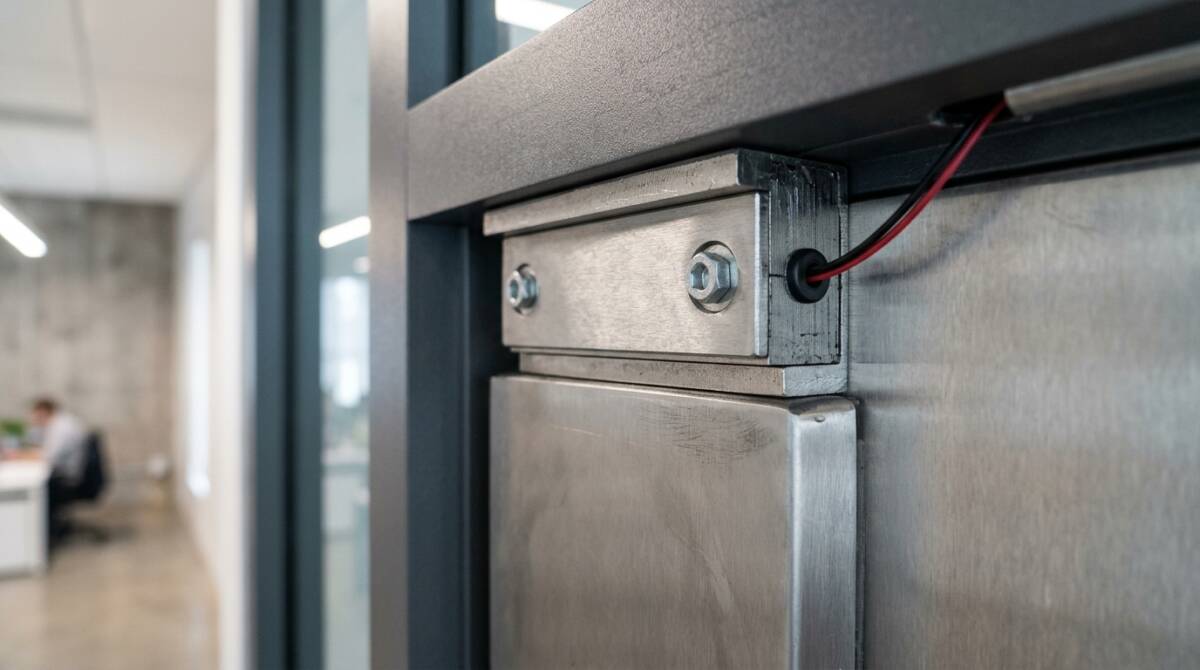
A maglock has two pieces. The electromagnet is a sealed block of coiled wire and steel that mounts to the door frame or header. The armature plate, sometimes called the strike plate, is a flat steel plate that mounts to the door leaf so it lines up with the magnet when the door closes. Send power to the coil and the two faces clamp together. Cut the power and they separate freely. Because the lock relies on contact between two flat faces, it works best on doors that close cleanly against a stop, which is why you see maglocks so often on commercial glass doors and aluminum entrances.
This is a different animal from a mechanical lockset or from an electric strike. A strike still uses the door’s own latch and simply releases it on command. A maglock removes the latch from the equation and holds the whole door with magnetism. Both belong to the broader family of commercial door hardware, but they solve the problem in opposite ways.
How a maglock works
The physics is simple. Electricity runs through the coil inside the magnet body and turns it into an electromagnet. When the armature plate on the door touches the energized magnet, the magnetic circuit closes and produces a clamping force measured in pounds. A person pulling on the door is fighting that clamp, not a latch or a deadbolt.
Most commercial maglocks run on low-voltage DC power, usually 12 or 24 volts, and they draw a small, steady current the entire time the door is locked. That continuous draw matters for two reasons. It means the lock needs a reliable power supply, and it means the lock releases the instant power stops. Quality units are built with circuitry that prevents residual magnetism, so the door lets go cleanly rather than staying tacky for a second after the current cuts.
Because the magnet holds the door rather than grabbing a latch, alignment is everything. The magnet face and the armature plate have to meet flush with only a hair of gap. If a door sags on its hinges or the frame shifts, the faces stop meeting squarely and the holding force drops off fast. That is one reason a maglock install is as much about the condition of the door and frame as it is about the lock itself.
Fail-safe by design: what that means for your building
Every magnetic lock is fail-safe. That is not a feature you choose, it is a consequence of the physics. A maglock needs power to hold, so the moment power is lost the door unlocks. In the trade, a device that unlocks on power loss is called fail-safe, and a device that stays locked on power loss is called fail-secure.
Fail-safe is the right behaviour for most doors that people use to get out of a building, because nobody should be trapped inside when the power goes down. It is also a security trade-off you need to understand. If an intruder kills the power to the lock, the door opens. That is why maglocks on exterior doors are paired with a battery backup power supply and, on higher-security openings, with monitoring that alerts you when the lock loses its hold.
| Behaviour | On power loss | Typical use | Main trade-off |
|---|---|---|---|
| Fail-safe (all maglocks) | Door unlocks | Egress doors, interior access control, barrier-free entrances | Power outage leaves the door open unless there is battery backup |
| Fail-secure (strikes, some electric locks) | Door stays locked | Storerooms, server rooms, doors that must never free-open | People can still exit from the inside by the latch, but outside access is blocked |
If you need a door that holds during an outage, a maglock is the wrong tool and a fail-secure commercial lock or electric strike fits better. Matching the failure mode to the door’s job is the single most important decision in the whole process.
Holding force: how strong does a maglock need to be?
Holding force is the headline spec on any maglock, quoted in pounds. It is the straight pull a locked door can resist before the magnet bond breaks. Common commercial sizes are 600 pounds and 1,200 pounds, with smaller 300-pound units for light interior and cabinet work and larger 1,500-pound units for high-security openings.
More is not always better. An oversized magnet on a light interior door wastes power and money, while an undersized magnet on a busy exterior entrance gets defeated by a hard yank. The right number depends on the door’s weight, its traffic, and how much security the opening really needs. A single leaf gets one magnet; a pair of doors usually gets a double unit with two magnet heads.
| Holding force | Typical application | Door examples |
|---|---|---|
| 300 lb | Light interior and cabinet security | Interior office doors, display cases, light wood doors |
| 600 lb | Standard commercial interior access control | Office suite entrances, stockroom doors, clinic interior doors |
| 1,200 lb | Perimeter and higher-security openings | Storefront entrances, exterior staff doors, main building entries |
| 1,500 lb and up | High-security and heavy traffic | Institutional entrances, secure corridors, heavy glass doors |
Maglocks and your means of egress: the life-safety rules
This is the part that gets buildings into trouble. A door people rely on to leave in an emergency is called a means of egress, and you cannot simply bolt a maglock onto one and wire it to a card reader. Fire and building codes treat an electromagnetically locked egress door as a special case with strict conditions, because a locked exit in a fire is a serious hazard.
The governing documents in Ontario are the Ontario Building Code and the Ontario Fire Code, and designers often reference the life-safety provisions in NFPA standards published by the National Fire Protection Association. The exact article that applies depends on the building’s occupancy and the type of egress-locking arrangement, so the authority having jurisdiction, usually your municipal building department or fire official, has the final say. The principles below are the common thread across those rules.
An electromagnetically locked egress door generally has to release under all of these conditions:
- On loss of power to the lock, so the door is never held during an outage.
- On activation of the building fire alarm or sprinkler system, so the lock drops the moment an alarm sounds.
- By a manual release the person leaving can operate, which depending on the arrangement is a motion sensor that reads someone approaching, a clearly marked push button beside the door, or the hardware on a panic bar or exit device itself.
There are two broad arrangements worth knowing by name. An access-controlled egress door releases automatically when a sensor detects a person approaching from the inside, so leaving feels normal. A delayed-egress door holds for a short, code-limited interval after someone pushes on it, which buys time to respond to theft or wandering, and it still has to drop on alarm and power loss. Both are legitimate, both are regulated, and both have to be designed for the specific opening rather than copied from another site.
If your doors tie into a fire-rated assembly, the interaction with the rated hardware matters too. Our guide to Ontario Building Code fire door requirements and the fire-rated doors overview explain where maglocks can and cannot go on a rated opening. When in doubt, the safe move is to ask whether your current doors are up to the Ontario Building Code before any locking hardware is added.
Accessibility and barrier-free entrances
Access control and accessibility have to work together, not against each other. Ontario businesses fall under the accessibility rules set out under the AODA, and the Building Code sets barrier-free requirements for entrances. A maglock on a barrier-free door should not make the door harder to open for someone using a mobility device.
In practice that often means pairing the maglock with an automatic door operator and an accessible actuator, so a push of the wall button releases the lock and swings the door in one motion. The maglock and the operator have to be sequenced correctly, the lock releasing before the operator pushes, or the operator strains against a door that is still held. Our overview of commercial automatic doors covers how those pieces fit, and the article on compliance rules for accessible door width rounds out the barrier-free picture.
Where a maglock fits in an access control system
A maglock almost never works alone. It is the muscle of an access control system, and it needs a few other parts to behave safely and conveniently. Understanding the supporting cast helps you spec a system that actually works on day one.
- Power supply: a regulated low-voltage supply, ideally with a battery backup so the lock behaves predictably during a brief outage and interfaces cleanly with the fire alarm relay.
- Entry device: a keypad, card reader, fob reader, or mobile credential that tells the system who is allowed in.
- Request-to-exit (REX): a motion sensor or push button that releases the lock for people leaving, so the inside of the door stays easy to use.
- Door position switch: a sensor that tells the system whether the door is open or closed, useful for alerts on a propped door.
- Bond sensor: built into better maglocks, it reports whether the magnet is actually holding, which is how you monitor a door that looks shut but is not secured.
- Fire alarm interface: a relay that drops the lock when the alarm activates, wired so it cannot be bypassed.
If you are weighing a maglock against a latch-based option for a given opening, the choice usually comes down to the door type and the failure mode you need. A glass storefront with no good place for a strike leans toward a maglock; a rated door that must stay secure in an outage leans toward a fail-secure electric strike or lock. For a wider look at hardening an entrance, see our notes on commercial property door security upgrades in the GTA.
Maglocks for different door types
Not every door takes a maglock the same way. The magnet body has to mount to something rigid on the frame, and the armature plate needs a flat, solid spot on the door. The door material drives the brackets and the install approach.
| Door type | How the maglock mounts | Notes |
|---|---|---|
| Aluminum storefront | Magnet on the header, armature on the top rail, often with a header filler or spacer | Very common; pairs well with aluminum storefront systems |
| Frameless or framed glass | Magnet on the header, armature on a glass-door bracket or patch fitting | Needs a mini maglock or a bracket kit made for glass |
| Hollow metal and steel | Surface mount on the frame with a Z or L bracket on an inswing door | Rigid and ideal; see hollow metal doors and steel door frames |
| Double doors | A double maglock with two heads, or a unit on each leaf | Each leaf has to hold on its own |
| Gates and exterior barriers | Weatherproof maglock rated for outdoor use | Must tolerate moisture, temperature swings, and movement |
Mounting styles: surface, concealed, and mini
Maglocks come in a few form factors, and the right one depends on how much the lock can show and what the door can accept.
| Style | Where it sits | Best for |
|---|---|---|
| Surface mount | Visible on the header and door face | Most retrofits; quick to install and service |
| Concealed or mortise | Recessed into the frame and door edge | Clean look on new builds where the opening is prepped for it |
| Mini maglock | Compact body on narrow frames | Glass doors and slim aluminum stiles with little room |
| Shear lock | Concealed, holding with interlocking faces | Openings that need a hidden lock but still have to meet egress rules |
Common maglock problems and how we fix them
When a maglock acts up, the symptom usually points to a short list of causes. Here is how we triage the calls we get most often across the GTA.
| Symptom | Likely cause | Typical fix |
|---|---|---|
| Door will not hold or feels weak | Magnet and plate not meeting flush, or a sagging door | Realign the plate, adjust the door, correct the hinges or frame |
| Door will not release | Residual magnetism, stuck relay, or a REX sensor that is not triggering | Test the release devices, check the suppression diode, replace a faulty board |
| Lock hums or buzzes | Loose mounting or a face that is not seating cleanly | Retighten the hardware, clean the faces, reseat the plate |
| Lock drops at random | Undersized or failing power supply, loose wiring | Test voltage under load, repair connections, replace the supply |
| Faces are scratched or rusty | Moisture, grit, or an outdoor unit past its life | Clean and protect the faces, or replace with a weatherproof model |
A maglock that will not let go is the call we treat as urgent, because a held exit is a life-safety problem that needs attention the same day. If you are dealing with a stuck door right now, our emergency commercial door repair service can get the opening safe and working again.
Installing or retrofitting a maglock
A clean install starts with the door and frame, not the lock. The faces have to meet square, the frame has to be rigid enough to hold the magnet without flexing, and the wiring has to reach a proper power supply and the fire alarm panel. On an aluminum or glass opening, the right brackets are what keep the install both strong and tidy.
Retrofits are common, and they are where a lot of problems creep in. A door that already sags, a frame that racks, or a closer that slams the leaf can all undercut a maglock. It is worth having the opening looked at as a system, since a tired door closer or worn hinges will keep a new lock from holding the way it should. For a fresh opening, our commercial door installation service sizes the hardware to the door from the start.
One more install note that saves grief later: depending on the arrangement, adding a maglock to an egress door can trigger the need for a permit and an inspection. Our rundown on when Toronto businesses need permits for door work is a good gut check before the hardware goes up.

Keeping a maglock healthy
Maglocks have no moving parts, so maintenance is light, but it is not zero. The two things that quietly degrade are alignment and the power system. A quick seasonal check keeps both in line.
- Wipe the magnet and armature faces so grit does not sit between them and weaken the bond.
- Check that the plate still floats slightly on its mount and meets the magnet square.
- Test the release on a fire alarm activation and on a power-down, so you know the fail-safe path works.
- Confirm the REX sensor and any exit button release the door promptly.
- Measure the voltage at the lock under load, since a weak supply shows up as random drops.
Rolling these checks into a broader preventative routine for the opening, including the weatherseals and weatherstripping that keep an exterior door closing properly, is the cheapest way to avoid an after-hours lockout.
What a maglock costs
There is no single price, because a maglock is a system and the lock body is only part of it. A standalone 600-pound surface maglock is an inexpensive piece of hardware, but the installed cost reflects the power supply, the release devices, the brackets, the wiring, and the fire alarm interface. The drivers below move the number the most.
| Cost driver | Why it matters |
|---|---|
| Holding force and size | Higher force and double-door units cost more than a single 600-pound head |
| Door type and brackets | Glass and aluminum openings need special brackets and more labour |
| Access control added | Card readers, keypads, and REX sensors add hardware and wiring |
| Power and backup | A regulated supply with battery backup and a fire alarm relay adds cost |
| Egress compliance work | Delayed egress, signage, and inspection sign-off take time to do right |
| Condition of the opening | A door or frame that needs repair first raises the total |
If you are weighing a lock upgrade against replacing a worn opening outright, our guide on repair versus replacement helps you draw the line, and the replacement timeline sets expectations if you go that way.
Maglock vs electric strike vs electrified lock
Maglocks are one of three common ways to put a door under electronic control, and they are not always the best of the three. The quick comparison below is the one we walk clients through.
| Option | How it locks | Failure mode | Best fit |
|---|---|---|---|
| Magnetic lock | Electromagnet holds the whole door | Always fail-safe | Glass and aluminum doors, egress openings, no latch to work with |
| Electric strike | Releases the existing latch on command | Fail-safe or fail-secure, your choice | Doors with a good latch that should stay secure in an outage |
| Electrified lockset | Motorized lock inside the door hardware | Fail-safe or fail-secure, your choice | Openings that need mechanical key override plus electronic control |
None of the three is a default. The door, the failure mode you need, and the egress rules decide it, which is exactly the kind of call we make every week through our commercial door services.
When to bring in a professional
You can wire a maglock to a doorbell transformer and make it clamp, but a commercial access control install is not a doorbell. Getting the egress release, the fire alarm interface, the holding force, and the brackets right is the difference between a system that passes inspection and one that quietly breaks the fire code. On any door people use to leave the building, this is work to have done properly.
If you are planning an upgrade, retrofitting an existing entrance, or dealing with a lock that will not hold or will not let go, reach out for a free assessment. We install, service, and repair magnetic locks and the access control around them across the Greater Toronto Area, and we will tell you straight whether a maglock is even the right tool for your opening. Call Commercial Door Pros or request a quote to get started.
Frequently asked questions about magnetic door locks
Are magnetic door locks safe?
Yes, when they are installed to code. Every maglock is fail-safe, so it unlocks on power loss, and on an egress door it also has to release on the fire alarm and through a manual device. The safety risk comes from a bad install that skips those releases, not from the lock itself.
Do magnetic door locks require power?
Yes. A maglock holds only while current runs through it, usually 12 or 24 volts DC drawn continuously. Cut the power and the door unlocks at once, which is why exterior maglocks are paired with a battery backup supply.
How strong are magnetic door locks?
Holding force runs from about 300 pounds on light interior doors to 1,200 pounds on commercial entrances, with 1,500-pound and larger units for high-security openings. A 1,200-pound maglock resists a very hard pull, well beyond what a person can manage by hand.
What is the purpose of a magnetic door lock?
A maglock secures a door under electronic control without using a latch or bolt. It lets a card reader, keypad, or button lock and unlock the door, which makes it the common choice for access control on glass and aluminum entrances that have nowhere to fit a strike.
How do I unlock a magnetic door lock?
Through whatever release the system uses: a valid credential at the reader, a request-to-exit motion sensor or push button on the way out, or the loss of power that drops the lock. On an egress door there is always a manual way to release it from the inside.
Are magnetic locks any good?
For the right door, yes. They shine on frameless glass and aluminum storefronts, on high-cycle entrances, and on egress doors where fail-safe behaviour is wanted. They are a poor fit where a door must stay locked during a power outage, which calls for a fail-secure strike or lock instead.
Can a maglock hold a door during a power outage?
No. Because a maglock needs power to hold, it releases when power is lost. If you need a door that stays secured during an outage, you want a fail-secure electric strike or electrified lockset, not a maglock.
What is a request-to-exit device?
A request-to-exit, or REX, is the sensor or button that releases the maglock for people leaving. It is usually a motion detector over the door or a push button beside it, and it keeps the inside of a controlled door easy to use without a credential.
Do magnetic locks work on glass doors?
Yes, with the right hardware. A mini maglock or a glass-door bracket kit mounts the magnet to the header and the armature to a patch fitting or top rail, which is why maglocks are so common on frameless and framed glass entrances.
Will a maglock pass a fire inspection?
Only if it is set up as a compliant egress-locking arrangement, releasing on power loss, on the fire alarm, and through a manual device, with the signage and sequencing the code calls for. The authority having jurisdiction makes the final decision, so the install has to be designed for that opening.
What is the difference between a maglock and an electric strike?
A maglock holds the whole door with a magnet and is always fail-safe. An electric strike releases the door’s existing latch and can be ordered fail-safe or fail-secure. Strikes suit doors with a good latch; maglocks suit glass and aluminum doors with no latch to work with.
Why does my maglock not release?
Common causes are a stuck relay, a REX sensor that is not triggering, residual magnetism in a lower-quality unit, or a wiring fault. A held exit is a safety issue, so it is worth a prompt service call rather than a wait-and-see.
How much does a magnetic door lock cost to install?
The lock body is inexpensive, but the installed price reflects the power supply, release devices, brackets, wiring, and fire alarm interface, plus any work the door or frame needs first. A simple interior opening costs far less than a code-compliant egress entrance with access control.
Can I install a maglock myself?
You can mount one on an interior door for light duty, but any door in a means of egress ties into fire alarm and life-safety rules that a do-it-yourself install usually gets wrong. On exit doors, use a professional so the opening stays legal and safe.
What holding force do I need?
Match it to the door. Light interior doors are fine at 300 to 600 pounds, standard commercial entrances usually want 600 to 1,200 pounds, and heavy or high-security doors go to 1,200 pounds and up. An opening assessment is the reliable way to size it.
Do maglocks damage the door?
No. With no latch grinding in and no bolt throwing against a strike, a maglock is gentle on the door. The main wear points are the mounting hardware and the faces, which is why keeping the magnet and plate clean and aligned is the whole of the maintenance.
Secure your doors the right way
A magnetic door lock is a clean, reliable way to put a commercial door under access control, as long as the holding force fits the opening and the egress releases are done to code. Get those two things right and a maglock quietly does its job for years; get them wrong and you have a security gap or a fire-code violation waiting to surface. If you want a straight answer on the best locking approach for a specific door, we serve businesses across the GTA and are ready to help. Get in touch for a free assessment.
n


