

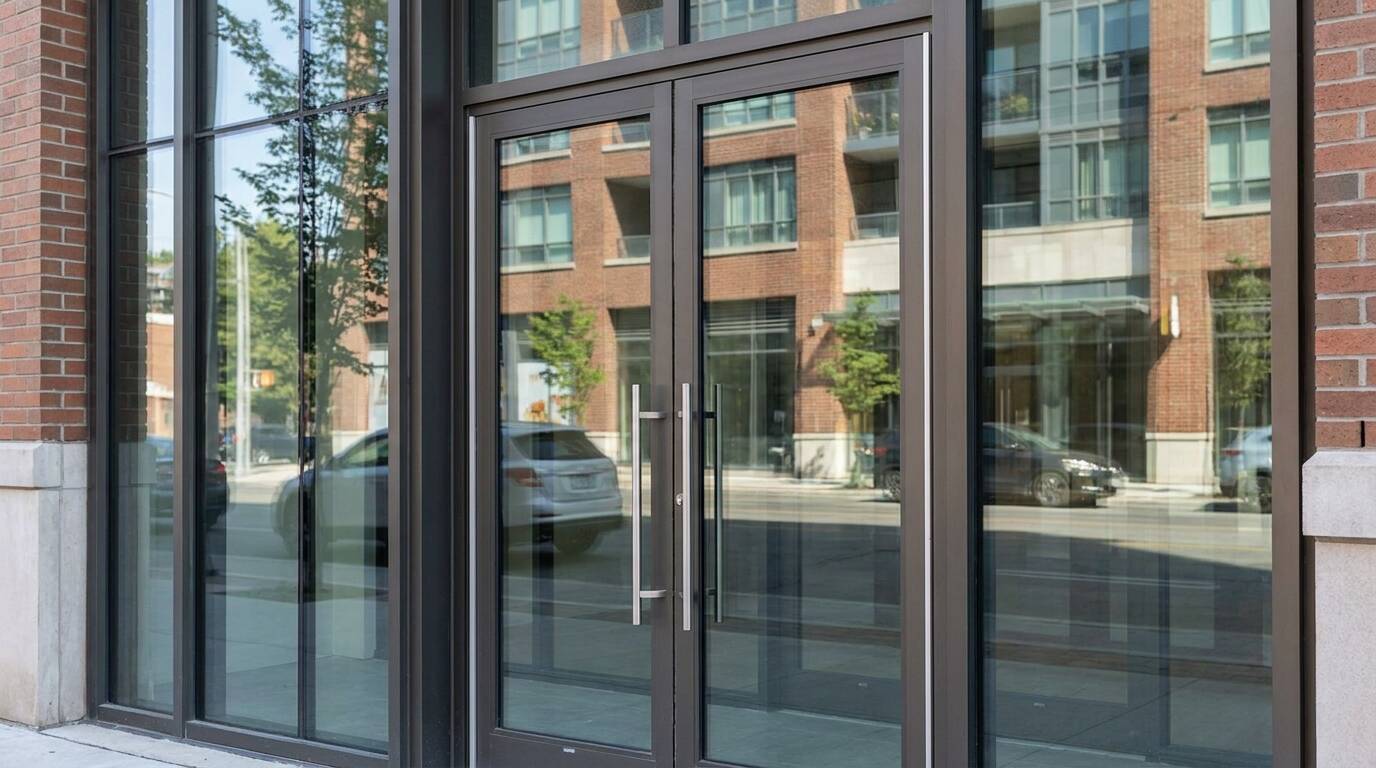
Walk down any busy GTA retail strip and most of the storefronts greet you the same way: a wide pane of glass set in a slim metal frame, swinging open on a hardware package you never notice until the day it stops working. A commercial glass door is the hardest working part of that entrance. It takes thousands of pulls a week, holds up to Ontario winters, carries your security and accessibility obligations, and still has to look sharp to the next customer walking in.
This guide is written for the people who actually have to make decisions about these doors: business owners, property and facility managers, retailers, restaurateurs, and the contractors and architects who spec them. We’ll cover the real door types, the glass and hardware inside them, what the Ontario Building Code expects, how to tell a repair from a replacement, and how to keep a glass entrance running through a Toronto February. One quick note on scope, because search engines blur it: this is about glass entrance and storefront doors, not the glass-door coolers and refrigerators you see in a grocery aisle. Different product, different guide.
What is a commercial glass door?
A commercial glass door is a high-traffic entrance door whose main panel is tempered or laminated safety glass, either held in a metal frame (usually aluminum) or built as an all-glass leaf with rails top and bottom. It carries heavier use, larger sizes, and stricter code and hardware requirements than a residential door, and it’s engineered for security, accessibility, and daily abuse.
That definition hides a lot of variety. The glass door on a boutique is a different animal from the one on a hospital vestibule or a warehouse office. The frame, the glass make-up, the hinge or pivot, and the closer all change with the building, the traffic, and the budget. Understanding those pieces is what keeps you from overpaying for the wrong system or patching a door that should be replaced.
The main types of commercial glass doors
Most GTA entrances fall into one of a handful of families. They look similar from the sidewalk, but they behave very differently when it comes to repair, security, and cost.
Framed aluminum storefront glass doors
This is the workhorse. A rectangular aluminum frame holds a single large light of glass, and the door hangs in a matching aluminum storefront frame. It’s the default for retail, offices, clinics, and restaurants because it’s affordable, repairable, and easy to fit with standard hardware. These doors are part of the larger aluminum storefront systems that frame most commercial entrances, so the door and the surrounding framing are usually specified together.
All-glass (frameless) doors
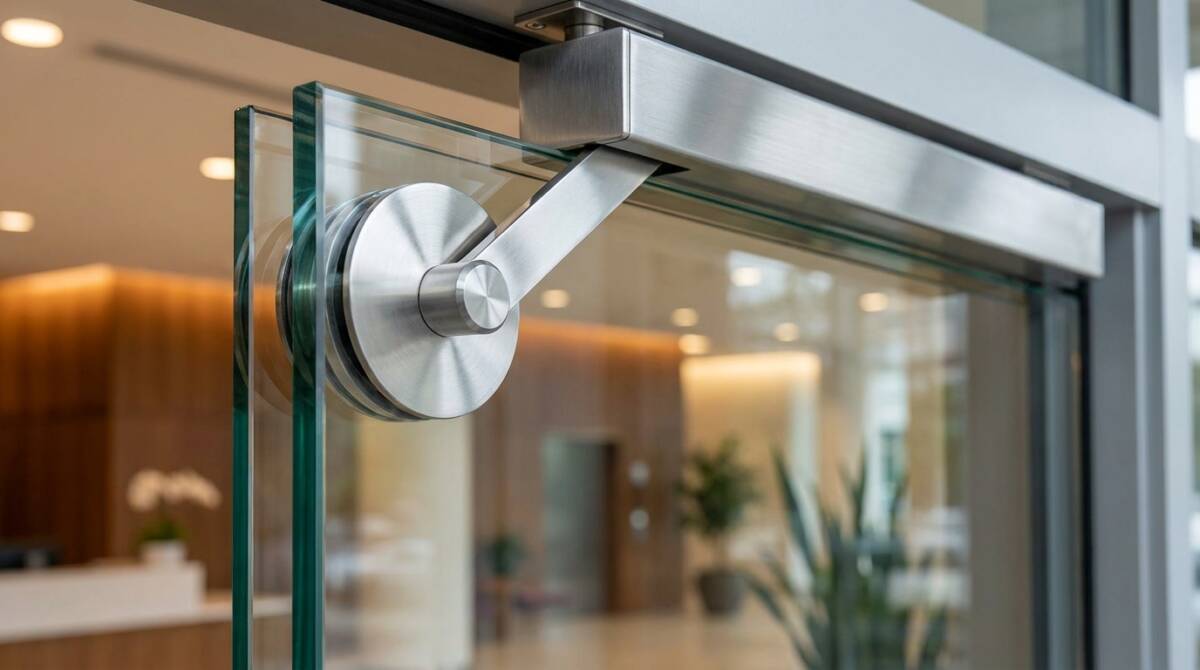
Also called herculite doors after a well-known brand of the style, these use a thick tempered glass leaf with only a narrow metal rail at the top and bottom, or sometimes patch fittings at the corners instead of full rails. There’s no vertical framing, so the look is clean and modern. The trade-off is that the glass itself is structural, repairs mean swapping the whole leaf, and the hardware (pivots, patch fittings, floor closers) is more specialized.
Full-vision and half-glass metal doors
Some entrances use a hollow metal or aluminum door with a large glass vision panel set into it rather than a full glass leaf. You get more frame and less glass, which can mean better insulation and a tougher door for back-of-house or mixed retail and service use. These overlap with the territory covered in our guide to hollow metal doors, where the glazing is one feature rather than the whole leaf.
Sliding and automatic glass doors
Sliding glass doors and automatic sliding or swing systems are common at grocery stores, pharmacies, hospitals, and anywhere hands-free access matters. The door is still glass, but an operator and sensors drive it. If a powered entrance is on your list, our guide to commercial automatic doors covers operators, sensors, and the accessibility rules in detail.
| Door type | Best for | Strengths | Watch-outs |
|---|---|---|---|
| Framed aluminum glass door | Retail, office, clinic, restaurant | Affordable, repairable, standard hardware | Thermal breaks matter in Ontario cold |
| All-glass / frameless (herculite) | Upscale retail, lobbies, showrooms | Clean modern look, wide clear views | Whole leaf replaced if glass breaks; specialized hardware |
| Full-vision / half-glass metal | Mixed retail and service, side entries | Tougher, better insulated, glass is replaceable in the frame | Heavier, less glass area |
| Sliding / automatic glass | Grocery, pharmacy, healthcare, high traffic | Hands-free, accessible, high throughput | Operator and sensors add service needs |
The anatomy of a glass door
When a technician looks at your door, they see parts, not a single object. Knowing the vocabulary helps you describe a problem over the phone and understand a quote.
| Component | What it does |
|---|---|
| Glass infill | The vision panel, almost always tempered or laminated safety glass |
| Stiles | The vertical frame members on the hinge and lock sides |
| Top and bottom rails | The horizontal members; the bottom rail often houses the lock or a floor closer spindle |
| Patch fittings | Metal corner clamps used on frameless doors in place of full rails |
| Pivots or hinges | How the door swings; offset pivots, center-hung pivots, continuous hinges, or butt hinges |
| Closer | Controls the swing and self-closing; surface, concealed overhead, or in the floor |
| Lock and exit hardware | Deadlatch, mortise lock, panic device, or electric strike |
| Pull and push bar | The handles customers actually touch |
| Weatherstripping and sweep | Seals the gaps against air, water, and drafts |
The glass inside the door
The single most important thing to understand about a commercial glass door is that the glass is not ordinary window glass. Doors sit in what the safety glazing standards call a hazardous location, which means a person can walk into them, so the glass has to be a safety type that breaks safely or resists breaking.
Two materials do most of the work. Tempered glass is heat-treated so it’s much stronger than regular glass and shatters into small, relatively blunt pieces instead of long shards. Laminated glass bonds two lites together with a plastic interlayer, so when it breaks the fragments stay stuck to the interlayer and the opening holds together, which is why it’s favoured where security and forced-entry resistance matter. Many doors use one or the other, and some high-security entrances use laminated over tempered. We go deep on the differences in our full guide to commercial glass types, including insulated units and Low-E coatings.
In Canada, safety glazing used in doors is expected to meet the CAN/CGSB-12.1 standard for safety glazing, and door assemblies in the GTA fall under the Ontario Building Code requirements for glazing in and around doors. If your existing door has plain annealed glass in the leaf or a sidelite right next to it, that’s a flag worth raising with a glazier, both for safety and for code.
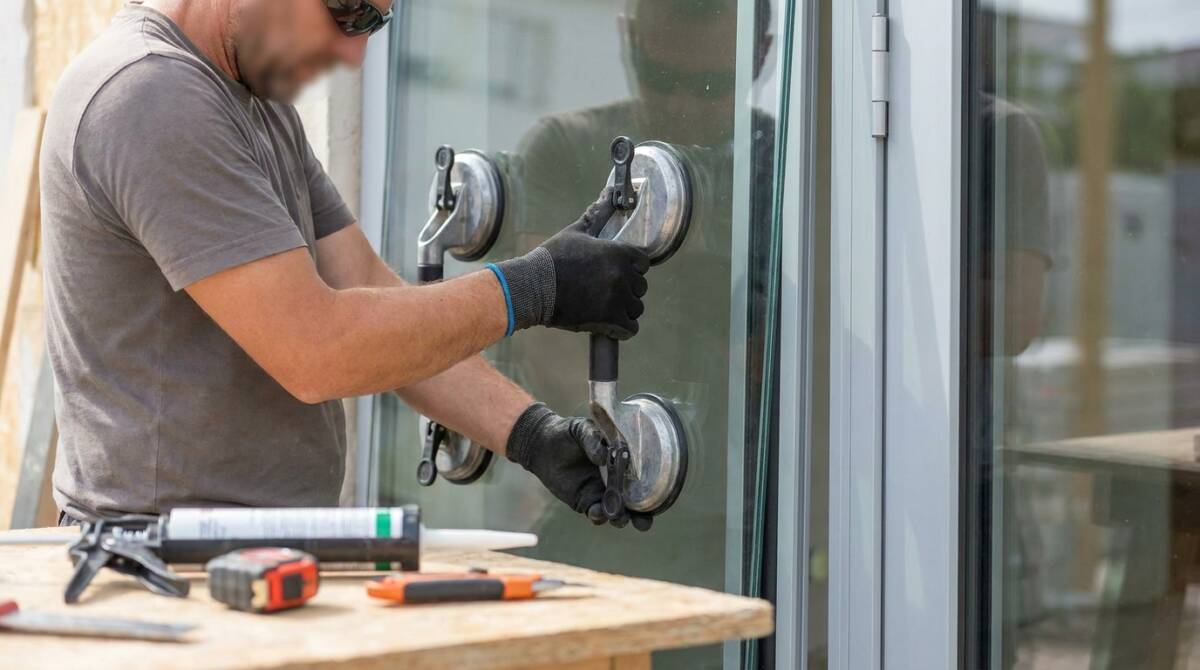
Framed versus frameless: how to choose
This is the decision most owners wrestle with, so it’s worth laying out plainly. Neither is better in the abstract. They suit different buildings and budgets.
| Factor | Framed aluminum glass door | All-glass / frameless door |
|---|---|---|
| Look | Visible metal frame on all four sides | Minimal metal, open and modern |
| Upfront cost | Lower | Higher |
| If the glass breaks | Often reglaze within the existing frame | Usually replace the whole tempered leaf |
| Insulation | Better, especially with thermal breaks and insulated glass | Single thick lite, less thermal control |
| Hardware | Standard storefront hardware, widely stocked | Specialized pivots, patch fittings, floor closers |
| Typical setting | Most GTA retail, offices, clinics | Showrooms, lobbies, upscale retail |
For most businesses, a framed aluminum door is the practical pick: cheaper to buy, cheaper to fix, and the glass can often be reglazed in place rather than scrapping the leaf. Frameless makes sense when the entrance is part of your brand and you’re willing to pay for the look and the specialized service that comes with it.
Hardware: the parts that actually fail
Glass rarely breaks on its own. What wears out is the hardware, and that’s where most service calls come from. A glass door is a hardware package first and a pane of glass second.
Hinges and pivots
Lighter framed doors can run on heavy-duty butt hinges or a continuous (geared) hinge that spreads the load along the full height. Heavier glass doors, and most frameless ones, swing on pivots instead: offset pivots mounted top and bottom, or center-hung pivots that let the door swing both ways. Pivots and continuous hinges handle weight and traffic far better than standard hinges, which is why they dominate entrances. Our guide to commercial door hinges breaks down when each one belongs on a door.
Closers
The closer is the device that pulls the door shut and controls how fast. Surface closers mount on the frame or door and are the easiest to service. Concealed overhead closers hide in the frame header. Floor closers (floor springs) sit in a box set into the floor and are the standard for heavy frameless doors. When a glass door slams, won’t latch, or hangs open, the closer is usually the culprit, and many issues can be dialed out. Our walkthrough on how to adjust a commercial door closer covers the sweep and latch adjustments that fix the common complaints.
Locks, exit devices, and access control
Glass doors use deadlatches, mortise locks, and hook bolts sized to the narrow stiles. Any door that serves as an exit from an assembly or high-occupancy space may need panic hardware so people can get out under pressure without a key or a twist of the wrist. For a deeper look, see our guides to commercial door locks and to panic bars and exit devices. If you’re moving to fobs or buzzer entry, electric strikes and access control integrate into most storefront frames, and the whole package is covered in our overview of commercial door hardware.
Stile widths
Framed glass doors come in narrow, medium, and wide stile versions, and the stile width decides what hardware fits. A narrow stile keeps the metal slim for a lighter look but limits your lock and panic options. A wide stile gives room for mortise locks and heavier-duty panic devices.
| Stile | Approx. width | Hardware room | Typical use |
|---|---|---|---|
| Narrow stile | About 2 to 2.5 in | Limited; deadlatch, slim panic | Boutique retail, light traffic |
| Medium stile | About 3.5 in | Moderate; most locks and panics | General commercial, the common pick |
| Wide stile | About 5 in | Generous; mortise locks, heavy panic | High traffic, security-sensitive |
Accessibility and the Ontario Building Code
A commercial entrance isn’t just a design choice. It’s a regulated opening. In Ontario, barrier-free access is governed by Section 3.8 of the Building Code, and public-facing businesses also sit under the Accessibility for Ontarians with Disabilities Act (AODA). The details matter because an entrance that doesn’t meet them can fail an inspection or, worse, shut people out.
The usual pressure points on a glass entrance are the clear opening width when the door is open, the force needed to pull it (which the closer controls), the hardware being operable without tight grasping or twisting, the threshold height, and vision glazing so someone in a wheelchair is visible from the other side. You can read the Province’s own text in the Ontario Building Code regulation on barrier-free design and glazing, which is the primary source for these requirements.
For the practical side, our guides on accessible door width and on accessibility requirements for storefront doors translate the code into what a GTA entrance actually needs. If you’re not sure where your door stands, the Ontario Building Code door checklist is a good self-audit.
| Accessibility factor | Why it matters on a glass door |
|---|---|
| Clear opening width | The door must open wide enough for a wheelchair; narrow stiles and double doors affect the clear pass |
| Opening force | A closer set too strong makes the door hard to pull; this is a common barrier |
| Operable hardware | Pulls and lever operation should work without a tight grip or twisting |
| Threshold height | A low, bevelled threshold keeps the entry trip-safe and rollable |
| Vision glazing | Clear glass lets people on both sides see each other to avoid collisions |
| Safety glazing | Doors and sidelites are hazardous locations and need a safety glass type |
Security and glass doors
Owners worry that a glass door is a weak point, and it can be if it’s specced wrong. The fix is usually the glass make-up and the hardware, not abandoning glass. Laminated glass resists forced entry because the interlayer holds the pane together even after it cracks, which buys time and keeps the opening sealed. Pair that with a proper deadlatch or mortise lock and, where it fits, a multi-point lock, and a glass entrance can be as secure as a solid one while keeping the sightline a retail business wants. Many GTA owners upgrade the lock and glass together when they’re already planning a commercial glass replacement.
Common glass door problems and what causes them
Here’s what actually brings a glass door down, and the usual root cause. Most of these are hardware, not glass.
| Symptom | Likely cause | Typical fix |
|---|---|---|
| Door slams or won’t latch | Closer out of adjustment or failing | Adjust or replace the closer |
| Door sags or drags | Worn pivots or hinges, loose glass in the rail | Replace pivots, reset the glass bite |
| Hard to pull open | Closer set too strong, binding hardware | Reduce opening force, service hardware |
| Cracked or chipped glass | Impact, thermal stress, old annealed glass | Reglaze or replace the leaf with safety glass |
| Foggy or cloudy glass | Failed seal in an insulated unit | Replace the insulated glass unit |
| Drafts and high energy bills | Worn weatherstripping and sweeps | Replace seals and the bottom sweep |
| Lock sticks or won’t throw | Misaligned strike, worn deadlatch | Realign strike, replace lock |
Two of these deserve a pointer. If drafts and bills are the problem, worn door weatherstripping and seals are cheap to replace and pay for themselves, and a tired threshold often rides along with them. If the glass itself is cracked and the frame is sound, you may only need to replace a single glass panel rather than the whole door.
Repair or replace: how to decide
The honest answer is that it depends on what failed and how old the door is. A broken pane in a solid frame is a repair. A door that’s racked, corroded, failing inspection, and eating service calls is a replacement. Here’s the quick logic.
| Lean toward repair when | Lean toward replacement when |
|---|---|
| Only the glass broke and the frame is straight | The frame is bent, corroded, or racked |
| Hardware is worn but parts are available | Hardware is obsolete and parts are gone |
| The door still meets code and accessibility | The door fails code, safety glazing, or accessibility |
| It’s an isolated, one-off fault | You’re calling for the same door repeatedly |
| The door is reasonably young | The door is old and the entrance is outdated |
We walk through this trade-off for any entrance in our guide to repair versus replacement for commercial doors and windows. When it is clearly time for a new door, matching it to the building is its own decision, and our piece on choosing the right commercial door helps you spec it.
What drives the cost
Owners always want a number, and no honest guide can give a firm one without seeing the door, because the spread is wide. What we can do is tell you what moves the price so you can read a quote with open eyes. Glass doors cost more than you’d guess because the glass is a safety type, the hardware is commercial-grade, the frame is often custom-cut to the opening, and installation has to be precise for the door to swing true and pass code.
| Cost driver | How it moves the price |
|---|---|
| Glass type | Laminated and insulated units cost more than single tempered |
| Door style | Frameless and automatic cost more than a framed swing door |
| Hardware package | Panic devices, floor closers, and access control add up |
| Size and custom fit | Oversized or non-standard openings need custom fabrication |
| Site conditions | Access, removal of the old door, and frame repair affect labour |
| Emergency timing | After-hours break-glass service costs more than a scheduled visit |
For real ranges on specific jobs, see what shapes commercial door installation costs in Toronto and how after-hours repair costs differ from a planned appointment.
Installation, permits, and timelines
Swapping a glass door is more than lifting out the old one. The opening has to be measured, the frame checked for square, the new door hung so it swings freely and seals, and the hardware set so the door latches and meets opening-force limits. On a full storefront or structural change, you may need a permit. Our guide on when Toronto businesses need permits sorts out which jobs trigger one, and our replacement timeline guide sets expectations on how long a job takes, since custom glass and hardware can carry a lead time.
When glass breaks: emergency service and downtime
A broken entrance door is not a problem you can leave until Monday. An open storefront is a security and safety risk, and in an Ontario winter it’s a heating disaster. When a pane fails after hours, the first job is to secure the opening, often with a temporary board-up, then schedule the proper glass and hardware. GTA businesses dealing with a smashed or cracked entrance can reach emergency commercial glass repair, and if the frame or hardware took the hit rather than the glass, emergency commercial door repair covers that side. Minimizing downtime is the whole point: get it secure first, get it right second.
Keeping a glass door running: maintenance
Most glass door failures are preventable. The hardware gives you warning signs long before it quits, and a short seasonal routine catches them. Glass doors in the GTA take a beating from road salt, grit, and the freeze-thaw swing, so the maintenance calendar matters more here than in a milder climate.
| How often | Task |
|---|---|
| Monthly | Check the closer speed and latching; make sure the door shuts fully |
| Monthly | Clean glass and wipe tracks and sills of grit and salt |
| Quarterly | Inspect pivots and hinges for play; tighten fasteners |
| Quarterly | Check weatherstripping and the bottom sweep for wear |
| Seasonally | Before winter, confirm seals and opening force; after winter, flush salt from hardware |
| Annually | Full hardware service; test locks, exit devices, and any access control |
The same habits that keep an aluminum storefront looking good apply here, and our notes on cleaning and maintaining aluminum storefront doors cover the products and steps that won’t harm the finish. Watch especially for the faults our piece on door problems that get worse with heat and heavy use flags, since many of them start small.
Choosing a glass door for your building
Pulling it together, the decision comes down to a few honest questions. How much traffic does the entrance take, and does that push you toward pivots and a floor closer? Does the look matter enough to pay for frameless, or is a framed aluminum door the sensible choice? What does security demand, laminated glass or a heavier lock? And what does the Ontario Building Code require for width, force, and safety glazing at your opening? Answer those and the right door usually picks itself. When a powered entrance is on the table, our overview of automatic doors and the detail on automatic door operators round out the choice.
Talk to a GTA commercial glass door specialist
Whether you’re repairing a door that won’t latch, replacing a cracked pane, upgrading to a secure laminated entrance, or planning a full storefront, it helps to work with a team that handles commercial glass doors every day across Toronto and the GTA. Commercial Door Pros can assess your entrance, sort out the glass and hardware, and keep you code-compliant. For a cracked or failed pane, start with commercial glass door repair. For a new or upgraded entrance, see commercial door installation, or contact us to book an assessment or request a free estimate.
Frequently asked questions
What are the different types of glass doors?
Commercial glass doors come in a few main types: framed aluminum storefront doors, all-glass or frameless (herculite) doors, full-vision or half-glass metal doors, and sliding or automatic glass doors. Framed aluminum is the most common because it’s affordable and easy to repair, while frameless suits upscale lobbies and showrooms.
Do commercial doors have to be 7 feet tall?
Seven feet (84 inches) is the most common commercial door height, which is why hardware and frames are built around it, but it isn’t a universal rule. Taller openings exist, and the real requirement is meeting code for clear height and accessibility. Our guide to standard commercial door sizes covers the common dimensions.
How much does it cost to replace a commercial glass door?
Cost varies widely with the door style, glass type, hardware, size, and whether it’s an emergency call. A simple reglaze in an existing frame sits at the low end, while a frameless or automatic door with a full hardware package costs much more. The only accurate figure comes from an on-site assessment of your specific opening.
What is the standard size of a commercial glass door?
A single commercial glass door is commonly about 3 feet wide by 7 feet tall (36 by 84 inches), and pairs run about 6 feet wide. Storefront openings are often custom, so the door is cut to the frame. Accessibility rules set a minimum clear opening width when the door is open.
Why are commercial glass doors so expensive?
The glass is a safety type (tempered or laminated), not ordinary glass, the hardware is commercial-grade and rated for heavy traffic, the frame is frequently custom-sized, and installation has to be precise to pass code and swing correctly. Each of those adds cost compared with a residential door.
What is the labour cost to install a commercial door?
Labour depends on the door type, site access, whether the old door and frame need removal or repair, and the hardware being set. A straightforward framed door install is quicker than a frameless door on a floor closer. A site visit is the only way to quote labour accurately for your entrance.
Is frameless glass stronger than a framed glass door?
Not necessarily. A frameless door uses thick tempered glass that is strong, but if it breaks you replace the whole leaf. A framed door’s glass is protected by the frame and can often be reglazed. Strength is more about the glass make-up and hardware than about having a frame or not.
What kind of glass is used in commercial glass doors?
Doors use safety glazing, almost always tempered or laminated glass, because a door is a hazardous location where people can walk into the glass. Tempered breaks into small blunt pieces, while laminated holds together on its interlayer. Our guide to commercial glass types explains the differences.
Can you replace just the glass in a commercial door?
Often yes, if the frame is straight and sound. A framed aluminum door can usually be reglazed in place with new safety glass. An all-glass door is different, since the glass is the leaf, so a break means replacing the whole door. A glazier can confirm which applies to yours.
Why is my glass door foggy between the panes?
A foggy or cloudy look between layers means the seal in an insulated glass unit has failed and moisture got in. The glass isn’t dirty, and cleaning won’t fix it. The repair is to replace the insulated unit. It’s worth doing because a failed seal also hurts the door’s insulation value.
What holds up a frameless glass door?
Frameless doors hang on pivots, usually offset or center-hung top and bottom, with the bottom pivot often running into a floor closer set into the floor. Narrow metal rails or corner patch fittings grip the glass and carry the hardware. The glass itself is structural, which is why it has to be thick tempered glass.
How long does it take to replace a commercial glass door?
A stock framed door or a reglaze can sometimes be done in a single visit. A custom door, frameless leaf, or automatic entrance carries a lead time because the glass and hardware are made to order. Securing a broken opening happens the same day; the permanent fix follows once parts arrive.
Are glass doors secure for a commercial property?
They can be very secure when specced right. Laminated glass resists forced entry by holding together after impact, and a proper deadlatch or mortise lock, plus a multi-point lock where it fits, makes a glass entrance as tough as a solid door while keeping the sightline retail wants.
Does a glass entrance door need to meet accessibility rules?
Yes. Public-facing entrances in Ontario fall under Section 3.8 of the Building Code and the AODA, which govern clear width, opening force, operable hardware, threshold height, and vision glazing. A glass door that’s hard to pull or too narrow when open can fail those requirements.
What causes a commercial glass door to stop closing properly?
Almost always the closer. A surface, concealed, or floor closer that’s out of adjustment or worn will let a door slam, hang open, or fail to latch. Many cases are fixed by adjusting the sweep and latch speed rather than replacing anything. Worn pivots can also let the door drag.
How often should a commercial glass door be serviced?
Check the closer and latching monthly, inspect pivots and seals quarterly, and book a full hardware service once a year. In the GTA, add a seasonal check before and after winter, since road salt and freeze-thaw are hard on hardware and seals. Catching small faults early prevents emergency calls.
On taller buildings these glass entrances sit within much larger facades. Our guide to curtain wall vs window wall breaks down the systems that make up those walls.
Not sure which safety glass belongs in your entrance? Our guide to tempered vs laminated glass walks through the trade-offs.


