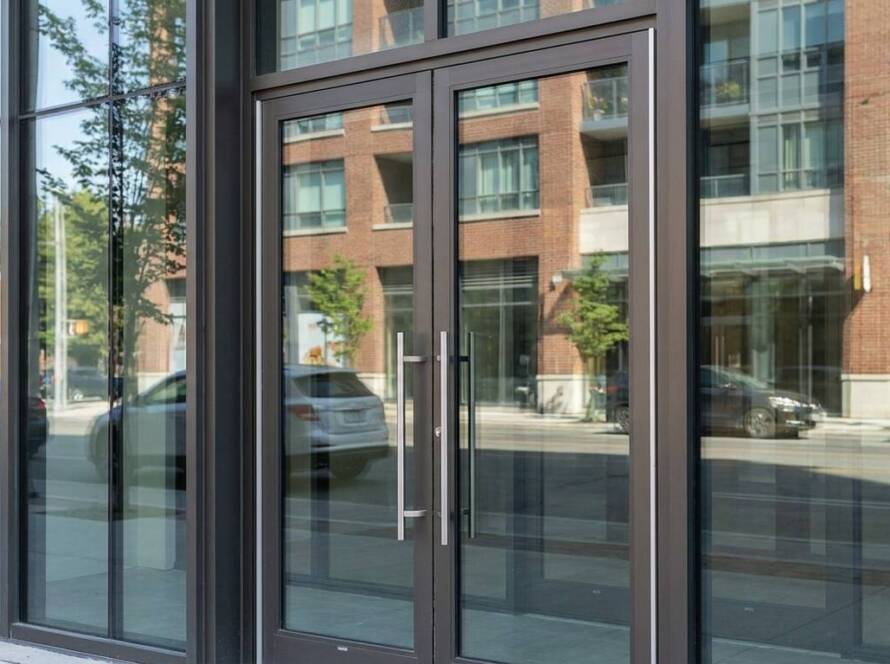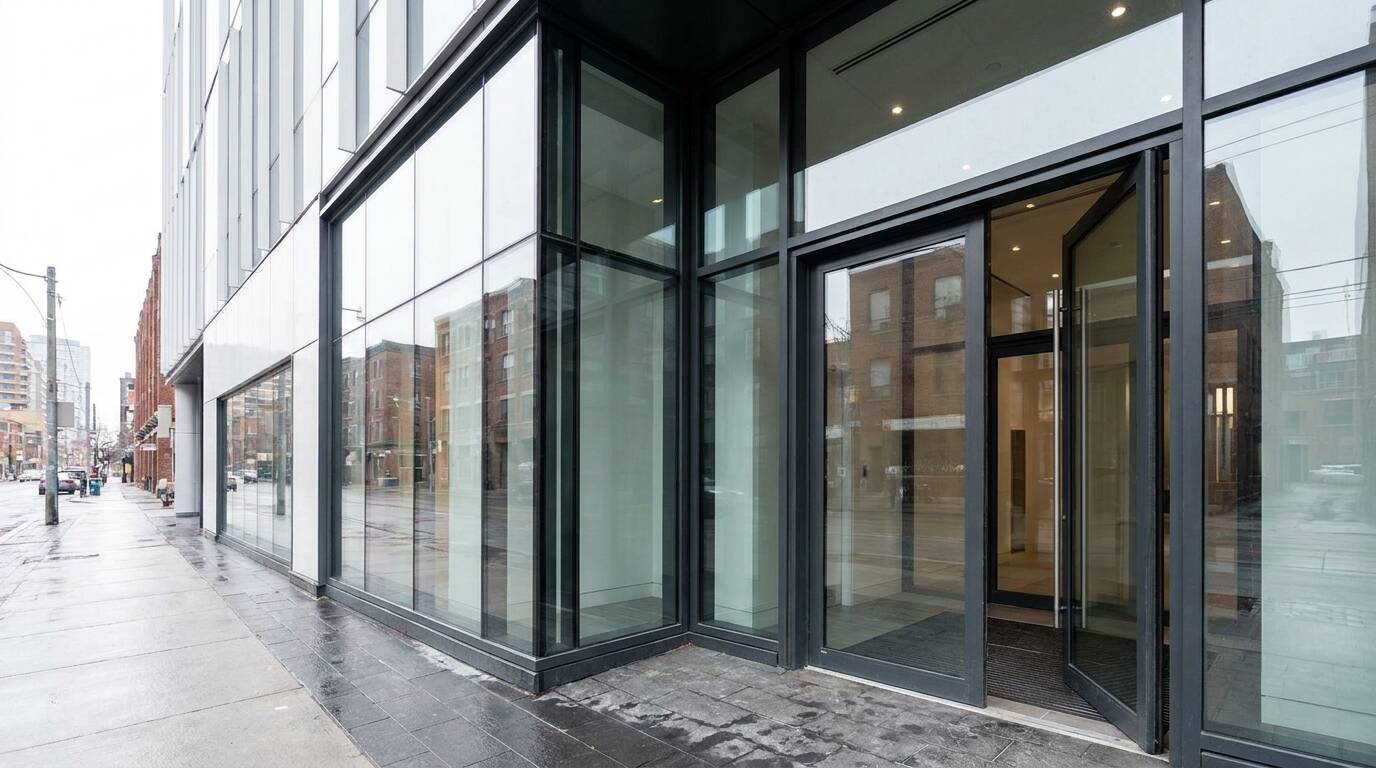
If you own or manage a commercial property in the Greater Toronto Area, the glass in your storefront, entrance doors, and windows does more work than almost anything else on the building. It keeps heat in during a Toronto January, holds up to the daily pounding of foot traffic, meets safety and fire rules, and shapes the first impression a customer forms before they ever reach the counter. When a pane fogs up, cracks, or shatters, the question that follows is almost always the same: what kind of glass was that, and what has to go back in its place?
The honest answer is that “glass” is a family of very different products. A tempered storefront lite, a laminated security panel, and a sealed double-glazed unit look similar from the sidewalk, but they are made differently, they fail differently, and they are priced very differently. This guide walks through the glass types used in commercial buildings across Ontario, what each one is good at, where the building code requires a specific kind, and how to decide between a repair and a full replacement when something goes wrong.
What counts as commercial glass?
Commercial glass is flat architectural glazing manufactured and processed for use in non-residential buildings, including storefronts, entrance systems, curtain walls, interior partitions, and windows. It starts as ordinary float glass and is then heat-treated, laminated, coated, or sealed into insulating units depending on the strength, safety, energy, and security the opening needs. The processing is what separates a commercial lite from a pane of household window glass.
In practice, most of what goes into a GTA commercial building falls into a handful of categories: annealed glass, heat-strengthened glass, fully tempered glass, laminated glass, and insulated glass units, often combined with a Low-E coating. The rest of this guide takes them one at a time, then shows how they get combined for real openings.
The starting point: annealed (float) glass
Nearly all modern architectural glass begins as float glass, made by floating molten glass on a bed of liquid tin to produce a flat, distortion-free sheet. In its raw state, after controlled slow cooling, it is called annealed glass.
Annealed glass is clear and inexpensive, and it can be cut, drilled, and edged on site. The drawback is how it breaks. When annealed glass fails, it shatters into large, sharp shards that can cause serious cuts, which is why building codes do not allow plain annealed glass in most doors, sidelights, or other locations where people are likely to walk into it. Annealed glass still has its place in interior lites and picture windows that sit well away from traffic, but for the high-use openings on a commercial building, it is almost always processed further.
Heat-treated glass: heat-strengthened versus fully tempered
Heat-treating takes annealed glass, reheats it to around 620 degrees Celsius, and then cools it in a controlled way. That cooling locks the outer surfaces into compression and the core into tension, which makes the glass stronger and changes how it breaks. There are two grades, and the difference matters.
Heat-strengthened glass
Heat-strengthened glass has a surface compression of roughly 3,500 to 7,500 psi, which makes it about twice as strong as annealed glass. When it does break, the fragments are similar in size and shape to annealed glass and tend to stay in the opening longer. Because it does not break into the small, relatively safe pieces that a safety standard calls for, heat-strengthened glass is not classified as safety glazing. It is used mostly to resist thermal stress, for example in spandrel panels and in large tinted or coated units that heat up unevenly in the sun.
Fully tempered glass
Fully tempered glass is the workhorse of commercial storefronts and glass doors. Under ASTM C1048, the standard that governs heat-treated flat glass, fully tempered glass must reach a minimum surface compression of 69 MPa (10,000 psi), or an edge compression of at least 67 MPa (9,700 psi). That makes it four to five times stronger than annealed glass of the same thickness.
Just as important is how it fails. Tempered glass breaks into small, relatively dull pieces rather than long shards, which is why it qualifies as safety glazing and why you see it in entrance doors, sidelights, and low glazing. One catch worth knowing: tempered glass has to be cut, drilled, and edged before it goes through the oven. You cannot trim or drill a piece of tempered glass afterward without shattering it, so every tempered lite is made to a final size. That is a big reason a broken tempered panel is almost always a replacement rather than a patch.
Tempered glass carries one rare but real quirk. Tiny nickel sulfide inclusions left over from manufacturing can sit in the tension zone of the glass and, over months or years, trigger what looks like a spontaneous break with no impact at all. The National Glass Association notes that these inclusions “may cause a spontaneous break if it is located in the tension region.” The industry answer is heat soak testing, where the finished glass is held in an oven at roughly 260 degrees Celsius for about two hours to force unstable inclusions to break the glass in the factory instead of in your storefront. It is worth asking for on large overhead or high-risk tempered installations, though the same association is clear that heat soaking “may reduce the risk, but will not eliminate the potential of a spontaneous break.”
Laminated glass
Laminated glass is made by bonding two or more plies of glass to a tough plastic interlayer, usually polyvinyl butyral (PVB) or a stiffer ionoplast, under heat and pressure. The glass can still crack, but the interlayer holds the broken pieces in place rather than letting them fall out of the frame. That single property is why laminated glass does so many jobs at once.
As a safety product, it stays in the opening when struck, which protects people below and keeps the weather out until a crew arrives. As a security product, the interlayer slows down a forced entry because even a smashed panel stays in the frame, and thicker multi-ply laminates move into burglary-resistant and even bullet-resistant territory. The interlayer also blocks most ultraviolet light, which protects merchandise and interior finishes from fading, and it damps sound, which is why you find laminated glass on buildings near highways, rail lines, and flight paths. Car windshields are the laminated glass most people already know.
Because it holds together when broken, laminated glass is recognized as safety glazing in Canada alongside tempered glass, and it is often the better choice where security, sound, or staying weather-tight after a break are priorities. The trade-off is cost and lead time, since a laminated makeup is a more involved product than a single tempered lite.
Insulated glass units (IGUs)
An insulated glass unit, sometimes called double or triple glazing, is two or three panes separated by a spacer and sealed around the perimeter to trap a still cavity of air or inert gas. That sealed cavity is what slows heat from moving through the glass, and in a climate that swings from humid summers to deep winter cold, it is the single biggest reason a modern commercial window outperforms old single glazing.
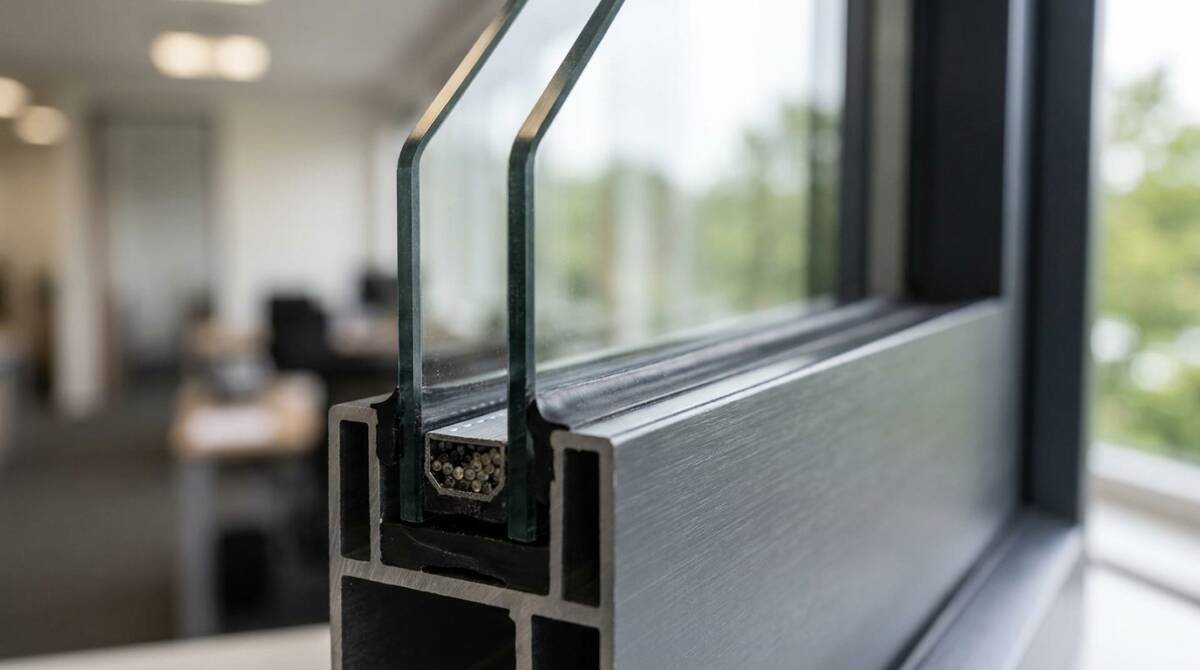
Several details inside the unit do the real work. The cavity is often filled with argon, a dense inert gas that conducts heat less readily than air. The spacer that holds the panes apart has moved from plain aluminum to warm-edge designs that cut the cold bridge around the edge of the glass and reduce condensation. A desiccant inside the spacer keeps the sealed cavity dry. When those pieces are intact, the unit insulates well and stays optically clear.
The classic IGU failure is seal failure. When the perimeter seal breaks down, moist air works its way into the cavity, the desiccant eventually saturates, and you get that hazy fog or trapped condensation between the panes that no amount of cleaning will touch. A fogged unit has not simply gotten dirty, it has lost its seal, and the fix is to replace the sealed unit rather than the frame around it. If you are seeing that haze between the panes, it is a seal problem rather than a cleaning problem, and a straight look at how to decide between a repair and a replacement helps you plan the fix.
Low-E coatings and energy performance
A Low-E, or low-emissivity, coating is a microscopically thin layer of metallic oxide applied to the glass surface. It lets visible light through while reflecting much of the invisible infrared heat, so it keeps interior warmth inside during winter and pushes solar heat back out during summer. On a commercial building with large areas of glazing, the coating has a direct effect on heating and cooling loads.
There are two broad families. Hard-coat (pyrolytic) Low-E is baked onto the glass during manufacturing, so it is durable and can be handled and even used in a single pane. Soft-coat (sputtered) Low-E is applied in a vacuum chamber and performs better, but it is more delicate and has to live inside a sealed insulated unit to be protected. Most high-performance commercial glazing uses a soft-coat Low-E inside an argon-filled IGU.
Glass performance is described with a few numbers you will see on spec sheets. U-factor measures how well the unit resists heat flow, and a lower number is better insulation. Solar heat gain coefficient (SHGC) measures how much solar heat passes through, where a lower number means less summer heat. Visible transmittance (VT) is how much daylight comes through. ENERGY STAR, administered in Canada by Natural Resources Canada, uses these ratings to certify windows for Canadian climate zones, and they are the right things to compare when you are specifying replacement glazing for a GTA property.
Tinted, reflective, and specialty glass
Beyond the structural categories, several finishes and specialty products show up on commercial jobs.
Tinted and reflective glass
Tinting adds color through the body of the glass to cut glare and solar heat, while reflective coatings add a mirrored exterior that reduces heat gain and gives daytime privacy. Both are common on office and retail facades. Because dark tints absorb more heat, they are often heat-strengthened or tempered to handle the thermal stress.
Spandrel glass
Spandrel glass is the opaque glass that hides floor slabs, columns, and mechanical spaces between the vision areas of a curtain wall. It is usually heat-treated and back-painted or ceramic-coated so the building reads as a continuous glass skin from outside.
Frosted, patterned, and switchable glass
Acid-etched or sandblasted glass gives a frosted, private surface for partitions and washrooms. Switchable or “smart” glass can turn from clear to opaque on demand, which some offices and clinics use for conference rooms. These are finishes applied to the base products above rather than separate structural categories.
Security and fire-rated glazing
Where protection is the priority, thick laminated makeups provide forced-entry and ballistic resistance. Fire-rated glazing is a separate specialty, engineered and labelled to hold back flame and, in some products, radiant heat for a rated period. Traditional wired glass used to serve this role, but it no longer qualifies as safety glazing in Canada, a point worth remembering if you manage an older building. Fire-rated openings are their own discipline, and our overview of fire rated doors and assemblies covers how glazing fits into a rated opening.
Safety glazing and the Ontario code
Safety glazing is not a marketing term, it is a code requirement in defined locations. In Canada, the governing standard is CAN/CGSB-12.1, titled Safety Glazing. The 2017 edition replaced the older 1990 version and recognizes tempered and laminated glass as compliant safety glazing materials. In the same update, the Canadian General Standards Board withdrew the old wired safety glass standard, so traditional wired glass no longer meets the mark.
The reason comes back to how glass breaks. Safety glazing has to either come apart into small, relatively harmless pieces, as tempered glass does, or stay bonded in the frame, as laminated glass does. Plain annealed and heat-strengthened glass do neither, so they are not permitted in the openings where someone is most likely to walk into, fall against, or be cut by the glass.
The Ontario Building Code requires safety glazing in those hazardous locations, which generally include glass in doors, the sidelights right beside doors, and large panels close to walking surfaces or floors. If you are replacing glass in or around an entrance, the replacement has to meet the safety standard even if the original did not, and a reputable glazier will flag that before the job starts. For the bigger compliance picture on entrances, our pieces on accessibility requirements for storefront doors and whether your current doors meet the Ontario Building Code are good next reads.
| Typical hazardous location | Why safety glazing is needed | Usual glass choice |
|---|---|---|
| Glass in entrance and interior doors | High-impact, high-traffic opening people push through | Tempered or laminated |
| Sidelights next to a door | Easily mistaken for an opening, walk-into risk | Tempered or laminated |
| Low glazing near floors and walkways | Fall and impact risk at body height | Tempered or laminated |
| Glass guards and railings | Structural and fall protection | Laminated (often over tempered) |
| Interior vision lites away from traffic | Lower risk, check local requirements | Annealed may be allowed |
Glass types at a glance
Before getting into which glass goes where, here is a quick comparison of the main products and what each one is really for.
| Glass type | Relative strength | Breakage behavior | Safety glazing? | Best used for |
|---|---|---|---|---|
| Annealed (float) | Baseline | Large sharp shards | No | Interior lites away from traffic |
| Heat-strengthened | About 2x annealed | Larger fragments, stay in opening | No | Spandrel, tinted and coated panels |
| Fully tempered | 4 to 5x annealed | Small dull pieces | Yes | Doors, sidelights, storefront lites |
| Laminated | Varies by makeup | Cracks but stays bonded in frame | Yes | Security, sound, UV, overhead glazing |
| Insulated unit (IGU) | Depends on the lites used | Per the glass inside the unit | If made with safety glass | Windows and insulated storefronts |
Which glass goes where
Most openings end up with a combination rather than a single product. A modern storefront window might be an argon-filled IGU built from two tempered lites with a soft-coat Low-E, which gives you safety glazing, insulation, and solar control in one unit. The right makeup depends on what the opening has to do, and it is worth deciding on the glass alongside the system during a commercial window installation or a storefront build rather than after.
| Application | What it needs most | Common glass makeup |
|---|---|---|
| Retail storefront windows | Safety, energy, clarity | Tempered IGU with Low-E, argon fill |
| Glass entrance doors | Impact safety, durability | Fully tempered (often in an aluminum frame) |
| High-security or ground-floor openings | Forced-entry resistance | Thick laminated, or laminated over tempered |
| Office and institutional windows | Insulation, comfort, cost | Low-E IGU, safety glass where required |
| Interior partitions | Privacy, light, safety | Tempered, frosted or switchable finishes |
| Overhead and sloped glazing | Fall-out protection | Laminated (so broken glass stays up) |
If you are weighing a whole new storefront or entrance rather than a single lite, it helps to think about the frame and the glass together. Our guides to aluminum storefront replacement and commercial window replacement walk through how the glazing specification ties into the system around it.
Glass thickness and sizing
Thickness is driven by the size of the lite, the wind and snow loads it has to carry, and the job it does. Common commercial thicknesses run from about 6 mm for smaller tempered lites up to 10 mm, 12 mm, and thicker for large storefront panels, doors, and structural applications. Bigger panes and higher loads call for thicker glass, and laminated or insulated makeups add their own build-up.
The practical takeaway for an owner or property manager is that glass is engineered to the opening. A replacement lite has to match the original thickness, makeup, and coating to fit the frame and meet the code, which is why a precise field measurement and a check of the existing makeup come before any order. That is also why you cannot simply grab a stock pane for a custom storefront opening. The same thinking applies when you are choosing the right glass and door for a new build or renovation, where the glazing is specified with the frame from the start.
Common commercial glass problems and what they mean
Glass gives you signals before and after it fails. Reading them correctly saves money and avoids repeat visits.
| Symptom | Likely cause | What it usually means |
|---|---|---|
| Haze or fog between two panes | Failed perimeter seal on an IGU | Replace the sealed unit, not the frame |
| Long crack with no impact point | Thermal stress or edge damage | Replace the lite, review shading and edges |
| Sudden shatter into small cubes, no impact | Nickel sulfide inclusion in tempered glass | Rare, replace the panel; heat-soaked glass lowers the odds |
| Chip or surface scratch | Impact or cleaning damage | Monitor; a chip at the edge can grow into a crack |
| Condensation on the room side in winter | Indoor humidity and cold glass edges | Often a ventilation issue, not a failed unit |
| Draft or cold spot near the glass | Failed seal, worn gaskets, or poor frame | Check glass and frame together |
A crack that appears with no obvious impact is worth taking seriously, because thermal stress cracks tend to repeat if the underlying cause is not addressed. Our look at the problems that get worse with heat, humidity, and heavy use covers why Toronto’s temperature swings are hard on glass and frames.
Repair or replace: how to decide
With most commercial glass, the realistic choice is to replace the affected lite or unit rather than repair the glass itself. Glass does not heal, and safety glazing in particular cannot be patched. There are a few narrow exceptions, and knowing them keeps expectations realistic.
| Situation | Repair possible? | Usual path |
|---|---|---|
| Cracked or shattered tempered lite | No | Replace the full lite |
| Fogged insulated unit | No | Replace the sealed unit, keep the frame |
| Tiny surface chip, away from edge | Sometimes | Minor polishing; monitor for spread |
| Failed gaskets or seals in the frame | Yes | Reglaze or re-seal, glass may be fine |
| Scratched surface on single glazing | Sometimes | Light scratch removal if shallow |
One common question is whether a single broken panel in a larger storefront means replacing everything. Usually it does not, since a glazier can replace one lite in a framed system, and we cover that in detail in whether you can replace just one panel of a storefront door. For broken glass in a swing door specifically, our commercial glass door repair page lays out the options.
What glass replacement involves, and keeping downtime short
A straightforward glass replacement follows a predictable path. A technician confirms the glass type and makeup, measures the opening precisely, orders the matching lite or sealed unit, and returns to remove the old glass and set the new one with fresh glazing materials. Stock clear tempered sizes can turn around quickly, while custom sizes, laminated makeups, and coated IGUs take longer because they are fabricated to order.
When a pane is broken out entirely, a storefront is exposed, which is a security and weather problem on top of a glass problem. That is where emergency board-up and temporary glazing matter. A crew can secure the opening the same day with a board-up or temporary pane, keep you trading, and then install the permanent glass once the fabricated unit arrives. If you are dealing with broken glass right now, the fastest route is our emergency commercial glass repair service, and our walk-through of the four-step emergency action plan for shattered storefront glass is worth reading before the next incident.
What drives the cost of commercial glass
Glass pricing is not a single number, and anyone quoting a flat figure without seeing the opening is guessing. A few factors move the cost more than the rest.
The glass type and makeup is the biggest lever, since a single tempered lite costs far less than a laminated security panel or a coated, argon-filled insulated unit. Size and thickness matter, because larger and thicker lites use more material and are heavier to handle. Coatings, tints, and special interlayers add cost and lead time. The opening itself plays a role too, since ground-floor work is simpler than glazing several storeys up, which may need lifts or hoisting. Finally, timing counts, as after-hours emergency work to secure a broken storefront is priced differently from a scheduled replacement, something we unpack in what to expect from after-hours storefront repair costs.
The way to get an accurate number is a site assessment where the existing glass is identified and the opening is measured, which is exactly what a commercial glass replacement quote should be built on.
Maintenance and inspection
Glass is low-maintenance, but the systems around it are not, and a little attention prevents the failures that force an emergency call. Energy loss through tired seals is a slow, expensive leak, and our piece on auditing storefront door seals for energy loss pairs well with the checklist below.
| Interval | What to check |
|---|---|
| Monthly | Clean glass, scan for new chips, cracks, or edge damage |
| Quarterly | Inspect gaskets, glazing beads, and perimeter sealant for gaps |
| Seasonally | Watch for fogging or condensation inside IGUs as temperatures swing |
| Annually | Full assessment of frames, seals, hardware, and any failed units |
Use a pH-neutral cleaner and a soft cloth or squeegee, and keep abrasive pads and metal scrapers away from coated surfaces, which can scratch. Addressing an edge chip early is far cheaper than replacing a lite that has cracked across because the chip was left to grow.
Working with a GTA commercial glass specialist
Commercial glass sits at the intersection of safety code, energy performance, security, and appearance, and getting the makeup right the first time is what keeps a building compliant and a storefront working. A specialist identifies the existing glass, recommends a replacement that meets the code for that opening, measures and fabricates to fit, and secures the opening fast when something breaks.
Commercial Door Pros works with business owners, property managers, and facility teams across Toronto and the surrounding GTA on storefronts, entrances, windows, and glass doors. If you have a broken pane, a fogged unit, or a project where you are choosing glass for a new build or renovation, you can reach our team for an assessment or learn more about our full range of commercial window and glass services. For a broken storefront that needs attention today, call for emergency glass service and we will secure the opening first, then handle the permanent glass.
Frequently asked questions
What are the main types of commercial glass?
The core types are annealed (float) glass, heat-strengthened glass, fully tempered glass, laminated glass, and insulated glass units, often combined with a Low-E coating. Tempered and laminated are the two recognized safety glazing products in Canada, and most storefront openings use a combination such as a tempered Low-E insulated unit.
What type of glass is most commonly used in commercial buildings?
Fully tempered glass is the most common choice for storefronts, entrance doors, and sidelights because it is four to five times stronger than annealed glass and breaks into small, relatively safe pieces. For windows, an insulated glass unit built with tempered lites and a Low-E coating is the usual commercial standard.
What is the difference between tempered and laminated glass?
Tempered glass is heat-treated so it is much stronger and shatters into small granular pieces, which makes it ideal for doors and storefronts. Laminated glass bonds plies together with an interlayer so it cracks but stays in the frame, which makes it better for security, sound control, and overhead glazing. Both qualify as safety glazing.
Is tempered glass or laminated glass safer?
Both are recognized safety glazing, so the better choice depends on the risk. Tempered glass protects against cuts by breaking into dull pieces and suits high-traffic doors. Laminated glass stays intact in the opening when broken, which is safer for overhead glazing, forced-entry resistance, and keeping a storefront weather-tight after a break.
Why does the glass in my window look foggy or cloudy?
A haze trapped between two panes means the perimeter seal on the insulated glass unit has failed and moisture has entered the sealed cavity. It cannot be cleaned because the fog is inside the unit. The fix is to replace the sealed glass unit while keeping the existing frame.
Can a foggy insulated glass unit be repaired?
In practical commercial terms, no. Once an IGU loses its seal, the right fix is to replace the sealed unit. Defogging services exist but they do not restore the original insulating performance or the warranty, so most property managers replace the unit, especially where energy performance matters.
Can you repair cracked commercial glass instead of replacing it?
Cracked or shattered architectural glass is replaced rather than repaired, and tempered safety glass cannot be patched at all. Only very minor surface chips or shallow scratches away from the edge can sometimes be polished. A cracked lite in a framed storefront can usually be swapped on its own without replacing the whole system.
What is safety glazing and where is it required?
Safety glazing is glass that either breaks into small harmless pieces (tempered) or stays bonded in the frame (laminated), meeting CAN/CGSB-12.1. Ontario’s building code requires it in hazardous locations such as glass in doors, sidelights beside doors, and large panels near walking surfaces.
Is wired glass still allowed as safety glass in Canada?
No. When CAN/CGSB-12.1 was updated in 2017, the Canadian General Standards Board withdrew the old wired safety glass standard, and traditional wired glass no longer qualifies as safety glazing. Many older buildings still have it, so it is worth checking during renovations and door replacements.
What does Low-E glass do?
A Low-E coating is a microscopic metallic layer that lets daylight through while reflecting infrared heat. It keeps interior warmth in during winter and blocks solar heat in summer, which lowers heating and cooling costs. It is why modern commercial windows outperform older single or uncoated glazing.
What is an insulated glass unit?
An insulated glass unit is two or three panes sealed around a spacer with a trapped cavity of air or argon gas between them. The sealed cavity slows heat transfer, so the unit insulates far better than single glazing. Most commercial windows and insulated storefronts use IGUs.
Why did my tempered glass shatter for no reason?
A rare spontaneous break in tempered glass is usually caused by a tiny nickel sulfide inclusion in the tension zone of the glass that grows over time. It is uncommon. Heat soak testing, which holds the glass at about 260 degrees Celsius for roughly two hours, reduces the odds but does not eliminate them.
How thick is commercial glass?
Commercial glass commonly runs from about 6 mm for smaller tempered lites up to 10 mm, 12 mm, or thicker for large storefront panels, doors, and structural work. Thickness depends on the lite size, the wind and snow loads, and the application, so replacement glass has to match the original specification.
How long does commercial glass replacement take?
Stock clear tempered sizes can often be turned around quickly, while custom sizes, laminated makeups, and coated insulated units are fabricated to order and take longer. When a pane is broken out, a crew can board up or temporarily glaze the opening the same day to keep you secure, then install the permanent glass when it arrives.
Is tinted or reflective glass worth it for a commercial building?
For buildings with large glazed areas or heavy afternoon sun, tinted and reflective glass can cut glare and solar heat gain and improve comfort, often paired with a Low-E coating. Because dark tints absorb heat, they are usually heat-treated to resist thermal stress, so the specification should be matched to the exposure.
Do I need a permit to replace commercial storefront glass?
Like-for-like glass replacement in an existing opening usually does not, but changing the opening, the structure, or the storefront system can. Requirements vary by municipality, so confirm before a larger project. Our guide on when Toronto businesses need permits for door, window, and storefront work covers the specifics.
Editor note (images on this post):
1. Cover / hero (featured image): commercial-glass-storefront-toronto.jpg, 1376×768, JPEG, approx 126 KB. Title: “Commercial glass storefront entrance in Toronto”. ALT: “Modern commercial glass storefront with aluminum-framed glass entrance in Toronto”. Caption: “A modern aluminum-framed commercial glass storefront entrance in the GTA.” Higgsfield (marketing_studio_image, 16:9) prompt: “Professional architectural photograph of a modern commercial glass storefront entrance on a city street in Toronto, large aluminum-framed floor-to-ceiling glass panels and a glass entry door, clean reflective daytime glazing, bright overcast sky, realistic high-end commercial real estate photography, sharp detail, no text, no logos, no people”. Placement: featured image.
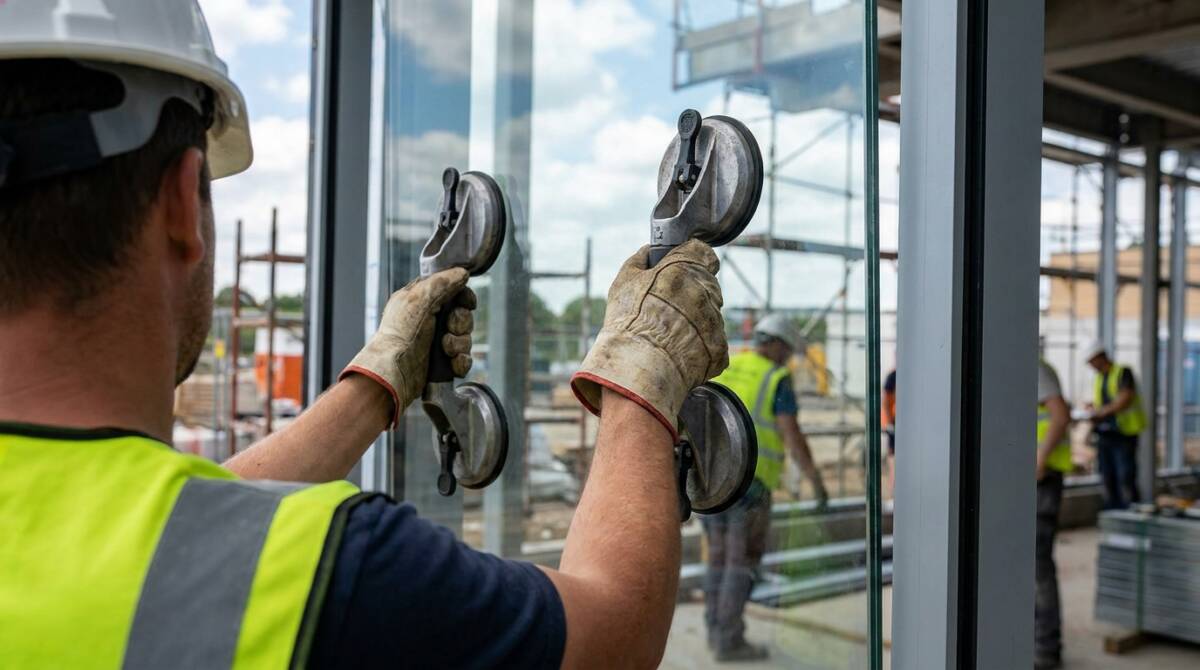
2. Inline (Heat-treated glass section): tempered-commercial-glass-storefront-installation.jpg, 1200×670, JPEG, approx 75 KB. Title: “Glazier installing tempered commercial glass”. ALT: “Glazier using suction cups to set a large pane of tempered commercial glass into a storefront frame”. Caption as shown. Higgsfield (marketing_studio_image, 16:9) prompt: “Professional photograph of a glazier technician wearing safety gloves using suction cup handles to carry and set a large pane of tempered commercial glass into an aluminum storefront frame, worksite on a commercial building, realistic skilled-trade photography, natural daylight, sharp focus, no text, no logos, no visible faces”. Placement: after the fully tempered subsection.
3. Inline (Low-E / insulated section): insulated-glass-unit-spacer-edge.jpg, 1200×670, JPEG, approx 47 KB. Title: “Insulated glass unit edge and spacer”. ALT: “Close-up of an insulated commercial glass unit edge showing the spacer between two sealed panes”. Caption as shown. Higgsfield (marketing_studio_image, 16:9) prompt: “Close-up professional photograph of the edge of a double-glazed insulated commercial glass unit showing the spacer bar and sealed cavity between two panes, installed in a modern aluminum window frame, soft natural light, shallow depth of field, realistic technical detail, no text, no logos, no people”. Placement: after the Low-E coatings section.
Designer suggestions (AI image models are unreliable for labelled technical graphics): a labelled cross-section diagram of an insulated glass unit (lite, spacer, desiccant, sealant, argon fill); a tempered-vs-laminated breakage comparison graphic; a “safety glazing required here” building elevation callout; and a glass-type selection flowchart by application. Build these as proper designed graphics rather than generated images.
The same tempered, laminated, and insulated glass goes into large facade systems. For how it is framed on taller buildings, see our guide to curtain wall vs window wall.
For a closer look at the energy coating that sits on modern commercial glazing, see our guide to low-E glass for GTA commercial buildings.
Much of this glass goes into aluminum storefront framing, which we cover in our guide to aluminum storefront systems.
For the doors themselves rather than the glazing, see our companion guide to commercial glass doors, which covers framed and frameless types, hardware, and repair.
Glass is only half the story. For how the full window system works, from frame materials to glazing and repair, read our guide to commercial windows.
If your commercial panes have gone cloudy or hazy, that points to the sealed glass itself, which our guide to insulated glass units and seal failure covers in detail.
For a focused head-to-head on the two most common safety glazing materials, see our guide to tempered vs laminated glass for commercial buildings.