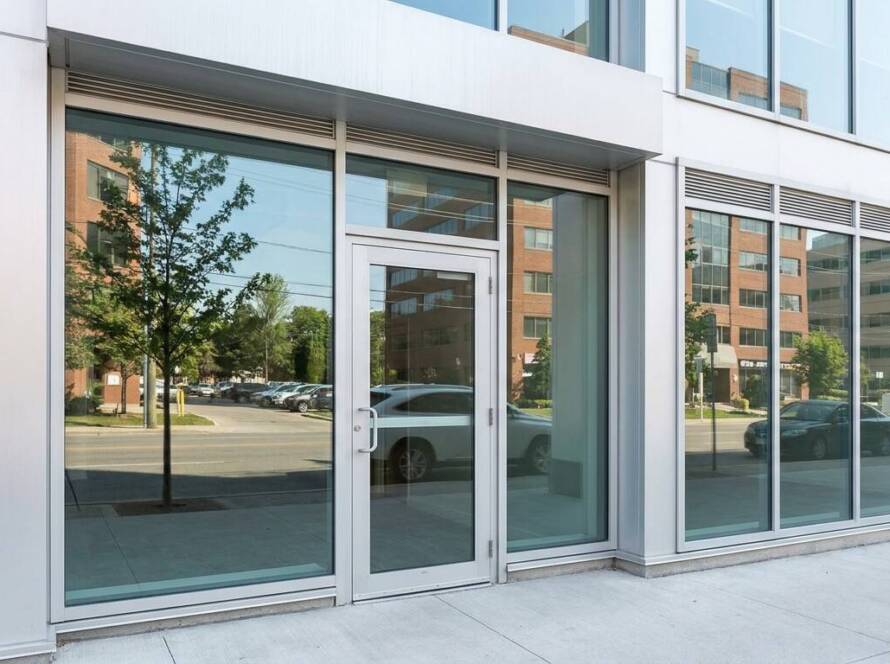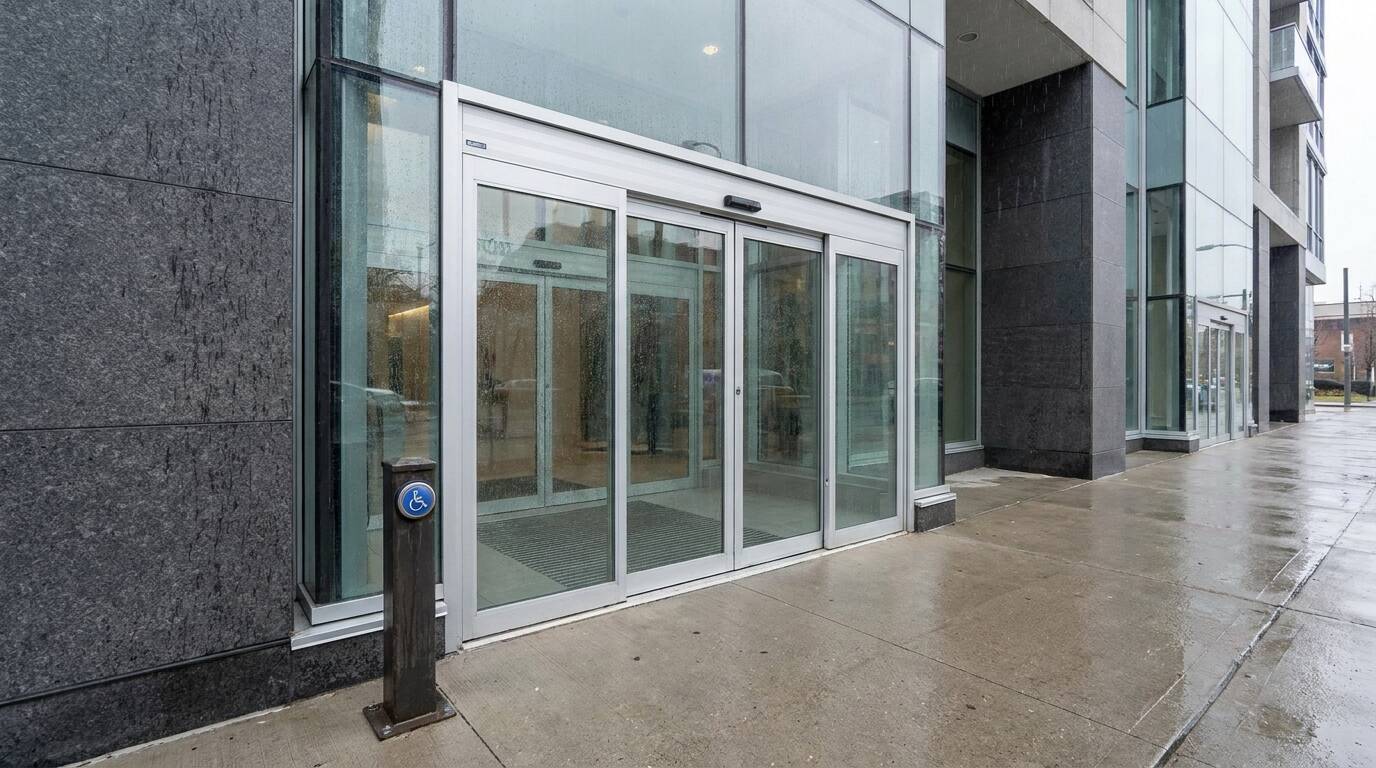
If a customer in a wheelchair cannot pull your front door open, or your busy entrance keeps jamming during the morning rush, the part doing the real work is the automatic door operator. It is the powered unit that swings or slides the door for the person walking up to it. Business owners and property managers across the Greater Toronto Area ask us about operators constantly, usually when one stops working or when an accessibility complaint lands on their desk. This guide walks through how operators work, the types available, what the Ontario rules expect, how to choose one, and what to do when the one you have starts acting up.
Commercial Door Pros installs, repairs, and services automatic operators on swing and sliding doors throughout Toronto and the GTA, so the examples here come from doors we work on every week, not a catalogue.
What is an automatic door operator?
An automatic door operator is the motorized mechanism that opens and closes a door without a person pulling or pushing it by hand. A sensor or a button tells the operator to run, the motor drives the door open, holds it for a set time, then returns it to the closed and latched position. The door leaf, frame, and glass stay the same. The operator is the powered brain and muscle bolted to them.
People use a lot of overlapping names for this. Some call it an automatic door opener, a handicap door opener, a power operator, or a push-button door. They all point at the same thing: a device that takes over the job your arm used to do. If you want the wider view of powered entrances, our guide to commercial automatic doors covers the whole system, while this article stays focused on the operator itself.
Operator, closer, and opener: sorting out the terms
An operator is not the same as a door closer. A commercial door closer is a mechanical device that controls a door as it shuts after someone opens it by hand. It has no motor and cannot open the door for you. An operator, by contrast, provides the opening force. Many low-energy operators actually include a spring that acts as the closer, so the operator both opens the door under power and closes it under spring tension. Knowing the difference matters when you call for service, because a shop that only adjusts closers cannot fix a failed motor. If your door swings shut too hard or too fast but opens fine by hand, you likely have a closer problem, and our walkthrough on adjusting a commercial door closer is the better starting point.
How a commercial automatic door operator works
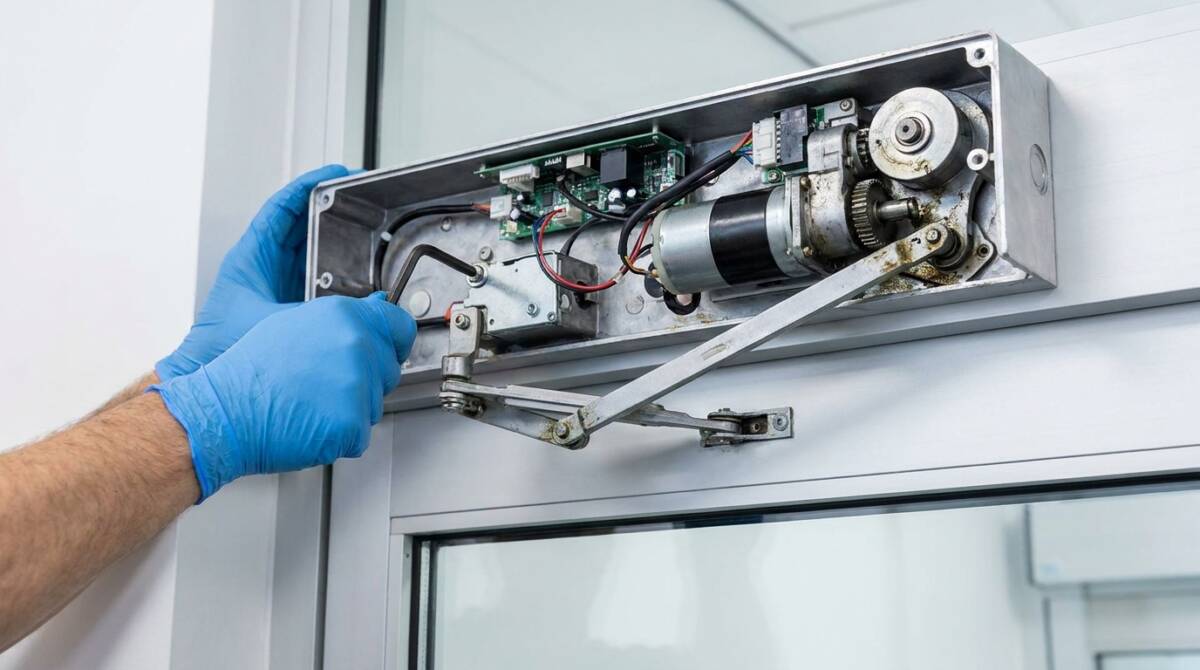
Strip away the housing and an operator is a motor, a drive train, a spring, a control board, and a set of sensors. The control board watches for an activation signal. When it gets one, it powers the motor, the motor turns a drive that pushes or pulls the door through an arm or a belt, and the door swings or slides open. A timer holds the door for a few seconds, then the board either reverses the motor or releases the spring to bring the door back. Safety sensors watch the opening the entire time so the door does not close on someone standing in the way.
Electromechanical operators
Most commercial operators sold today are electromechanical. An electric motor drives the door through a gear train and, on swing doors, a push or pull arm. These units are compact, quiet when maintained, and easy to adjust through the control board. They dominate the GTA market for storefronts, offices, clinics, and institutional buildings because they handle everyday pedestrian traffic well and sip power when idle.
Electro-hydraulic operators
Some heavy or high-cycle doors use an electro-hydraulic operator, where an electric pump moves hydraulic fluid to drive the door. These are built for serious abuse, think a hospital entrance or an industrial door that cycles thousands of times a day. They cost more and are less common in small-business settings, but they earn their place where a standard electromechanical unit would wear out quickly.
The control board and sensors
The control board is where the operator’s behavior gets set: opening speed, hold-open time, closing speed, and how the unit responds to its sensors. Two sensor jobs matter most. Activation sensors tell the door to open. Safety sensors tell the door not to close on a person or object. A door that opens but will not close, or one that reverses for no reason, is often a sensor or control-board fault rather than a dead motor. That distinction saves money, because swapping a sensor is far cheaper than replacing the whole operator.
Types of automatic door operators
Operators divide first by the kind of door they move, then by how much power and safety hardware they carry. Here is how the main families compare.
| Operator type | Where it fits | Mounting | Notes |
|---|---|---|---|
| Surface swing operator | Storefronts, offices, clinics, washrooms | Header above the door, visible housing | Most common, easiest to retrofit and service |
| Concealed swing operator | High-end lobbies, design-driven entrances | Hidden in the header or the floor | Clean look, higher cost, harder to access for repair |
| Sliding door operator | Supermarkets, pharmacies, high-traffic retail | In the header track above a sliding panel | Handles heavy two-way flow, needs more opening width |
| Low-energy operator | Accessible entrances, washrooms, interior doors | Surface header, button or sensor activated | Opens slowly on purpose, fewer guard rails required |
| Full-energy operator | Main entrances with steady automatic traffic | Surface or concealed header | Opens faster, requires guide rails and extra sensors |
Swing door operators
A swing operator mounts in the header above a hinged door and moves the leaf through an arm. A push arm reaches out over the door and pushes it open away from the operator. A pull arm, used when the operator sits on the pull side, draws the door toward it. Swing operators are the workhorse of the GTA. You see them on single doors, on pairs, and on existing manual doors that got upgraded for accessibility. They retrofit onto most aluminum storefront and hollow metal doors, which is a big part of why they are everywhere.
Sliding door operators
A sliding operator lives in a header track and slides one or two panels sideways. Grocery stores, pharmacies, and busy retail entrances favour sliding doors because they move a lot of people in both directions without a swinging leaf getting in the way. Sliding operators need a wider opening to house the track and the stacked panels, so they usually come into play during a renovation or a new build rather than a quick retrofit.
Low-energy versus full-energy operators
This is the split that confuses most owners, and it is the one that matters most for safety and cost. A low-energy operator opens the door slowly and gently, typically after someone presses a button or waves at a sensor. Because it moves slowly, it does not need the full set of guide rails and presence sensors that a faster door requires. A full-energy, or full-automatic, operator opens faster and is built for continuous sensor-triggered traffic, so it carries more safety hardware to protect people in the doorway. We will compare the two in detail in the next section, because picking the wrong one is a common and expensive mistake.
Low-energy versus full-energy: which does your business need?
Think of it in terms of who is pushing the door and how fast it moves. A low-energy operator suits an accessible side entrance, a washroom door, or any door where a person presses a button and is willing to wait a couple of seconds. A full-energy operator suits a main entrance where people stream through without touching anything, triggered by motion. The faster door opens, the more it can hurt someone, so the safety requirements climb with the speed.
| Factor | Low-energy operator | Full-energy operator |
|---|---|---|
| Typical activation | Push plate or wave sensor, a knowing act | Motion sensor, hands-free |
| Opening speed | Slow and deliberate | Faster, tuned to traffic |
| Guide rails and guards | Usually not required | Generally required |
| Presence sensors | Fewer | More, covering swing and approach zones |
| Best use | Accessible and interior doors | Busy main entrances |
| Relative cost | Lower to buy and install | Higher, more hardware |
These door categories map to recognized industry standards. The ANSI/BHMA A156.19 standard covers low-energy and power-assist operators, and ANSI/BHMA A156.10 covers full power-operated pedestrian doors with their heavier safety requirements. You do not need to memorize the numbers. What you need is an installer who knows which category your door falls into and builds it to that standard, because a fast door set up like a slow one is a real hazard.
For most small and mid-size GTA businesses adding an accessible entrance, a low-energy operator on a button is the right call. It is simpler, safer for a doorway that people also walk through manually, and friendlier to the budget.
How people trigger the door: activation methods
The operator does nothing until something tells it to open. How you activate the door shapes the experience, the cost, and whether it meets accessibility expectations. The main options break down like this.
| Activation method | How it works | Good for |
|---|---|---|
| Push plate or wall button | Person presses a plate to open the door | Accessible entrances, controlled opening |
| Wave or no-touch sensor | Person waves a hand near a sensor | Clinics and hygiene-sensitive sites |
| Motion sensor | Door opens as a person approaches | High-traffic main entrances |
| Access control integration | Card, fob, or keypad releases and opens | Secured entrances, after-hours control |
Push plates and wall buttons
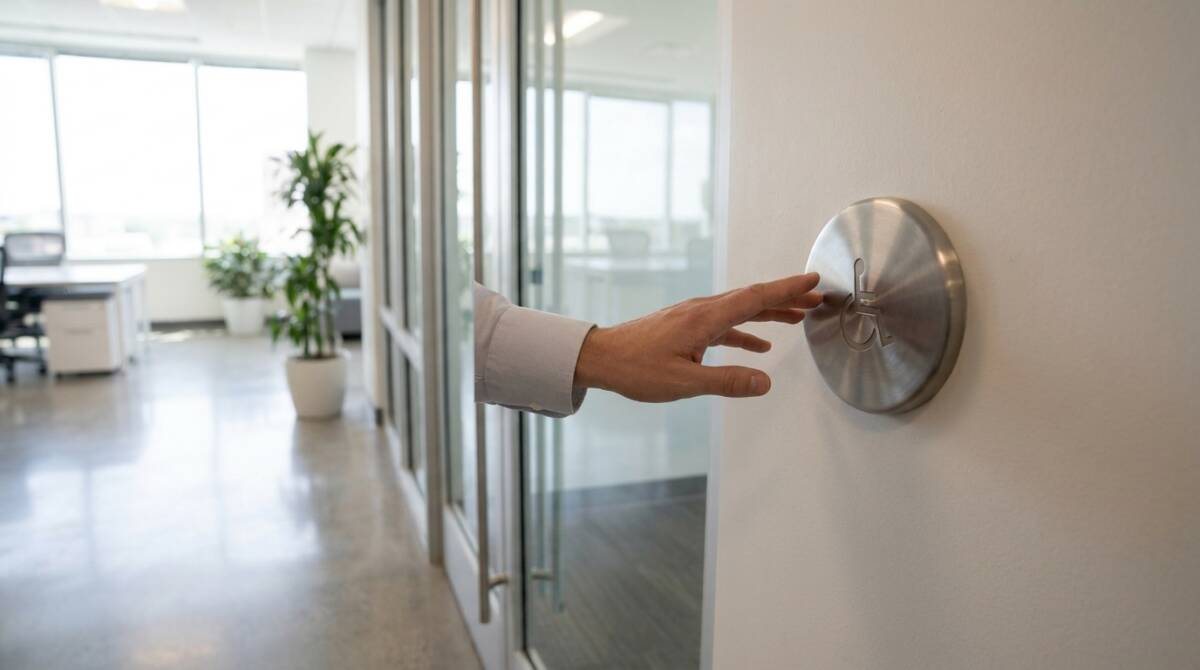
A push plate is the round or square button you see beside accessible doors, often marked with a wheelchair symbol. Pressing it is what the standards call a knowing act, meaning the person deliberately chooses to open the door. Push plates pair naturally with low-energy operators and are the backbone of barrier-free access in the GTA. They can be hardwired or wireless, mounted on the wall, on a bollard, or on a post, and placed at a height and distance that a person using a mobility device can reach.
Wave-to-open and no-touch sensors
No-touch sensors took off during the last few years and stuck around for good reason. The user waves a hand a few inches from the sensor and the door opens, with no surface to touch. Medical clinics, dental offices, and food businesses like them because they cut down on shared contact points. They work with low-energy operators the same way a push plate does.
Motion and presence sensors
Overhead motion sensors open the door automatically as someone walks up, which is what you expect at a supermarket. Presence sensors do the opposite job on the safety side: they hold the door open while a person is still in its path. A full-energy entrance leans on both, one set to invite people in and another set to keep the door from closing on them. When a busy automatic door starts closing too soon or opening on passing foot traffic, the sensors are usually where the problem lives.
Access control integration
An operator can tie into a building’s security so the door only opens for an authorized card, fob, or code. This is where operators meet electric strikes and the rest of your commercial door hardware. The sequence matters: the lock has to release before the operator drives the door, or the motor will fight a locked leaf and wear itself out. A proper integration coordinates the lock, the strike, and the operator so they act as one system. If your door is also a fire or exit door, the activation and locking have to respect egress rules, which our pages on panic bars and exit devices and fire rated doors get into.
Automatic operators and accessibility in Ontario
For most GTA businesses, the reason an operator goes in is accessibility. A heavy manual door is a barrier for people using wheelchairs, walkers, canes, or simply carrying a lot. A push-button operator removes that barrier. This is often what people are searching for when they type handicap door opener or accessible door button.
Two layers of Ontario rules sit behind this. Barrier-free design in new construction and major renovations is governed by the Ontario Building Code, which sets requirements for accessible entrances and the force needed to open doors along a barrier-free path. You can read the regulation itself on the Ontario Building Code page. Separately, the Accessibility for Ontarians with Disabilities Act sets broader accessibility obligations for organizations, summarized on the province’s accessibility laws page. The practical takeaway is that when you build or renovate, accessible entrances are expected, and a power operator on a button is the standard way to deliver one.
The details that trip people up are the reach and clearance around the button and door, and the door width itself. An operator does not fix a doorway that is too narrow. If your clear opening is undersized, you may need door or frame work before the operator makes sense, which is the subject of our piece on handicap access door width compliance. It also helps to confirm your door size and threshold work for barrier-free travel, since a high threshold is its own obstacle. We always verify the specific requirements against the current code edition for your project rather than quoting a number that may not apply to your building.
Retrofitting a manual door with an automatic operator
Most operators we install in the GTA go onto doors that already exist. A retrofit is usually straightforward, but a few things decide whether it goes smoothly. The door and frame have to be sound enough to carry the operator and take the repeated cycling. There needs to be power at the header, or a path to run it. The door swing has to have clearance for an arm. And the existing hardware, the hinges, the closer, the lock, has to be in good shape, because the operator will expose any weakness in it.
We often replace tired hinges or a worn lock during an operator retrofit, since a motor that cycles a door hundreds of times a day will quickly find a loose hinge or a sticky latch. On a glass entrance, we also check that the glass door and its rails can handle powered operation. If you are weighing whether to automate at all, our comparison of automatic versus manual doors lays out the trade-offs for a typical business.
Choosing the right automatic door operator
The right operator comes down to a handful of questions about the door and the traffic it carries. Work through these before you buy anything.
| Decision factor | What to consider |
|---|---|
| Door type | Swing or slide decides the operator family |
| Traffic volume | Occasional accessible use points to low-energy; steady flow points to full-energy |
| Door weight and size | Heavy or oversized leaves need a stronger operator |
| Indoor or outdoor | Exterior doors face wind load and weather, which affects sizing |
| Security needs | Access control integration adds locks, strikes, and wiring |
| Activation preference | Button, wave, motion, or credential changes the parts list |
| Budget and lifecycle | A better operator costs more upfront and fails less often |
Wind is the factor outsiders underestimate. An exterior door on an exposed GTA corner catches gusts that a quiet interior door never sees, and an underpowered operator will struggle against that wind, strain its motor, and fail early. Sizing the operator to the real conditions at your entrance is the difference between a unit that lasts years and one that is back in for service every season.
If you want a hand matching an operator to your entrance, that is exactly what our automatic door operator services are for. We look at the door, the traffic, and the code expectations together.
Common automatic door operator problems and causes
When an operator acts up, the symptom usually points at the cause. Here are the ones we see most across GTA businesses, and what tends to be behind them.
| Symptom | Likely cause | Typical fix |
|---|---|---|
| Door will not open at all | Power loss, dead control board, failed motor, or locked leaf | Check power and lock release, then test board and motor |
| Opens slowly or weakly | Worn motor or gears, binding hinges, wind load | Service the drive, free the hardware, resize if needed |
| Will not close | Stuck presence sensor or fault signal | Clean or realign the sensor, clear the fault |
| Closes too soon on people | Short hold-open time or sensor blind spot | Adjust timing and sensor coverage |
| Opens on its own | Oversensitive motion sensor or passing traffic | Retune sensor range and direction |
| Noisy or grinding | Worn gears, dry pivots, loose arm | Lubricate, tighten, replace worn parts |
| Reverses mid-open | Obstruction detection tripping, binding door | Find the bind, recalibrate force settings |
A door that will not open feels like a dead motor, but it often is not. The most common reason an operator on a secured entrance refuses to open is that the lock never released, so the motor senses resistance and stops. That is a sign of an access control coordination problem, not a broken operator. A quick diagnosis checks the simple causes first, which is why calling a technician who understands both the operator and the locking hardware saves time and money.
Repair or replace the operator?
Not every operator fault is worth fixing, and not every aging unit needs replacing. The call depends on the operator’s age, how often it fails, and whether parts are still available.
| Lean toward repair when | Lean toward replacement when |
|---|---|
| The unit is relatively new and one part failed | The operator is old and failing often |
| A sensor, board, or arm needs service | The motor or gearbox is worn out |
| Parts are still available | The model is discontinued and parts are scarce |
| The door and frame are in good shape | You are upgrading the whole entrance anyway |
| It still meets current safety expectations | It no longer meets current safety standards |
A single sensor or board fault on a healthy operator almost always favours repair. Repeated failures on an old unit, or a model whose parts are no longer made, tip the scale toward replacement. The same logic we apply across repair versus replacement decisions applies here: weigh the cost of the fix against the remaining life and reliability of the unit.
Maintenance and safety inspection
An automatic operator is a safety device as much as a convenience. It moves a heavy object near people, so it deserves a maintenance routine rather than a run-to-failure approach. A neglected operator does not just break, it can become a hazard if its sensors or force settings drift out of adjustment.
| Interval | What to check |
|---|---|
| Daily walk-through | Door opens and closes smoothly, sensors react, nothing in the path |
| Monthly | Push plates and sensors respond, hold-open time is reasonable, signage is intact |
| Quarterly | Hardware is tight, hinges and arm move freely, no new noises |
| Annual professional | Full safety inspection, force and speed verified, worn parts replaced |
The daily walk-through takes a staff member about thirty seconds and catches most emerging problems before they strand you. The annual professional inspection is the one that protects you, because a trained technician checks the opening and closing forces, the sensor coverage, and the safety behavior against the standard the door was built to. Industry practice is to have power-operated doors inspected by a qualified technician at least once a year, and it is a smart record to keep on file. Pairing operator service with the rest of your commercial door maintenance keeps the whole entrance dependable.
What drives the cost
Owners always want a price, and the honest answer is that it depends on the entrance. Rather than quote a figure that will not match your building, here is what actually moves the number. The operator type, low-energy or full-energy, sets the baseline. Swing is generally simpler than slide. Activation hardware adds up, especially when access control, wiring, and multiple sensors come into play. A retrofit onto a door that needs new hinges, a new closer, or frame work costs more than a clean install. Exterior doors facing wind need stronger, pricier units. And a pair of doors is more than a single. A proper quote looks at all of this on site, which is why we assess the entrance before giving a number.
Frequently asked questions
What is an automatic door operator?
An automatic door operator is the motorized unit that opens and closes a door without anyone pulling or pushing it. A sensor or button signals the operator, the motor drives the door open, holds it briefly, then returns it to the closed position. The door and frame stay the same, the operator supplies the power.
What is the difference between an operator and a door closer?
A door closer controls a door as it shuts after a person opens it by hand, with no motor and no power opening. An operator supplies the opening force under power. Many low-energy operators also close the door with a built-in spring, so one unit does both jobs.
What is the difference between a low-energy and a full-energy operator?
A low-energy operator opens slowly after a knowing act such as a button press and needs less safety hardware. A full-energy operator opens faster for hands-free motion-triggered traffic and requires more guards and sensors. Low-energy suits accessible side doors; full-energy suits busy main entrances.
Do I need an automatic door operator for accessibility in Ontario?
When you build or substantially renovate, the Ontario Building Code expects accessible entrances along a barrier-free path, and a power operator on a button is the standard way to provide one. Requirements depend on the project and the current code edition, so confirm the specifics for your building before you plan the work.
What is a handicap door opener?
A handicap door opener is the everyday name for a low-energy automatic operator paired with an accessible push button or wave sensor. Pressing the button opens the door slowly so a person using a wheelchair, walker, or cane can enter without pulling a heavy door. It is the most common accessibility upgrade we install.
Can I add an automatic operator to my existing manual door?
In most cases, yes. A retrofit needs a sound door and frame, power at the header, clearance for the operator arm, and hardware in good condition. Worn hinges or a sticky lock are often replaced at the same time, since powered cycling exposes any weak part quickly.
How does the door know when to open?
An activation device tells it. That can be a push plate, a wave sensor, an overhead motion sensor, or an access control reader. The choice depends on the entrance: buttons and wave sensors suit accessible and interior doors, motion sensors suit high-traffic main entrances, and readers suit secured doors.
Why will my automatic door not close?
The usual cause is a safety sensor that is dirty, misaligned, or stuck, which keeps telling the operator that something is in the path. A control-board fault can do the same. Cleaning or realigning the sensor and clearing the fault typically restores normal closing.
Why does my automatic door open when no one is there?
An overly sensitive motion sensor is the common reason. It may be picking up passing foot traffic, nearby vehicles, or even blowing debris. Narrowing the sensor’s range and aiming it at the actual approach zone usually stops the phantom opening.
Why does my automatic door open slowly or strain?
A worn motor or gear train, binding hinges, or wind load on an exterior door can all sap opening power. On an exposed entrance, an underpowered operator fighting the wind is a frequent culprit. Servicing the drive, freeing the hardware, or resizing the unit addresses it.
How often should an automatic door operator be serviced?
Run a quick daily walk-through, do light monthly and quarterly checks, and have a qualified technician perform a full safety inspection at least once a year. The annual inspection verifies opening and closing forces, sensor coverage, and safe operation, and it is worth keeping on record.
Are automatic door operators safe to walk through?
They are when set up and maintained correctly. Full-energy doors use presence sensors and guards to keep the leaf from closing on someone, and low-energy doors move slowly by design. Problems arise when sensors drift out of adjustment or force settings are wrong, which is what the annual inspection catches.
Can an automatic operator work with a locked or secured door?
Yes, through access control integration. The lock or electric strike releases first, then the operator drives the door. The sequence has to be coordinated, because an operator trying to open a leaf that is still locked will strain and fail. On exit doors, the setup also has to respect egress rules.
Do sliding and swing doors use different operators?
Yes. Swing operators mount in the header and move a hinged leaf through an arm. Sliding operators sit in a header track and slide panels sideways. Swing units retrofit easily onto existing doors, while sliding systems usually come with a renovation or new build because they need more opening width.
What does an automatic door operator cost?
Cost depends on the operator type, swing versus slide, activation hardware, any door or frame work a retrofit needs, exterior wind exposure, and whether it is a single or a pair. Because those vary so much by entrance, a reliable price comes from an on-site assessment rather than a flat quote.
How long does an automatic door operator last?
A quality operator that is sized correctly and maintained can serve for many years of regular use. Lifespan drops when a unit is undersized for its traffic or wind exposure, when the door hardware around it is neglected, or when routine service is skipped. Matching the operator to the real conditions is what extends its life.
Who do I call to repair an automatic door operator in the GTA?
Call a commercial door company that services both the operator and the hardware around it. Commercial Door Pros repairs, replaces, and installs automatic operators on swing and sliding doors across Toronto and the Greater Toronto Area, and we handle the locks, strikes, and sensors that work alongside them.
Keep your entrance moving
An automatic door operator is one of those parts nobody notices until it stops, and then everybody does. Picking the right type, setting it up to the correct standard, and keeping it maintained is what keeps your entrance accessible, safe, and open for business. If your operator is failing, if you need an accessible entrance, or if you are planning a new install, contact Commercial Door Pros for an assessment. For urgent faults that leave an entrance stuck open or shut, our emergency commercial door repair service can help, and when the job calls for a full new unit, our commercial door installation service handles it end to end.