

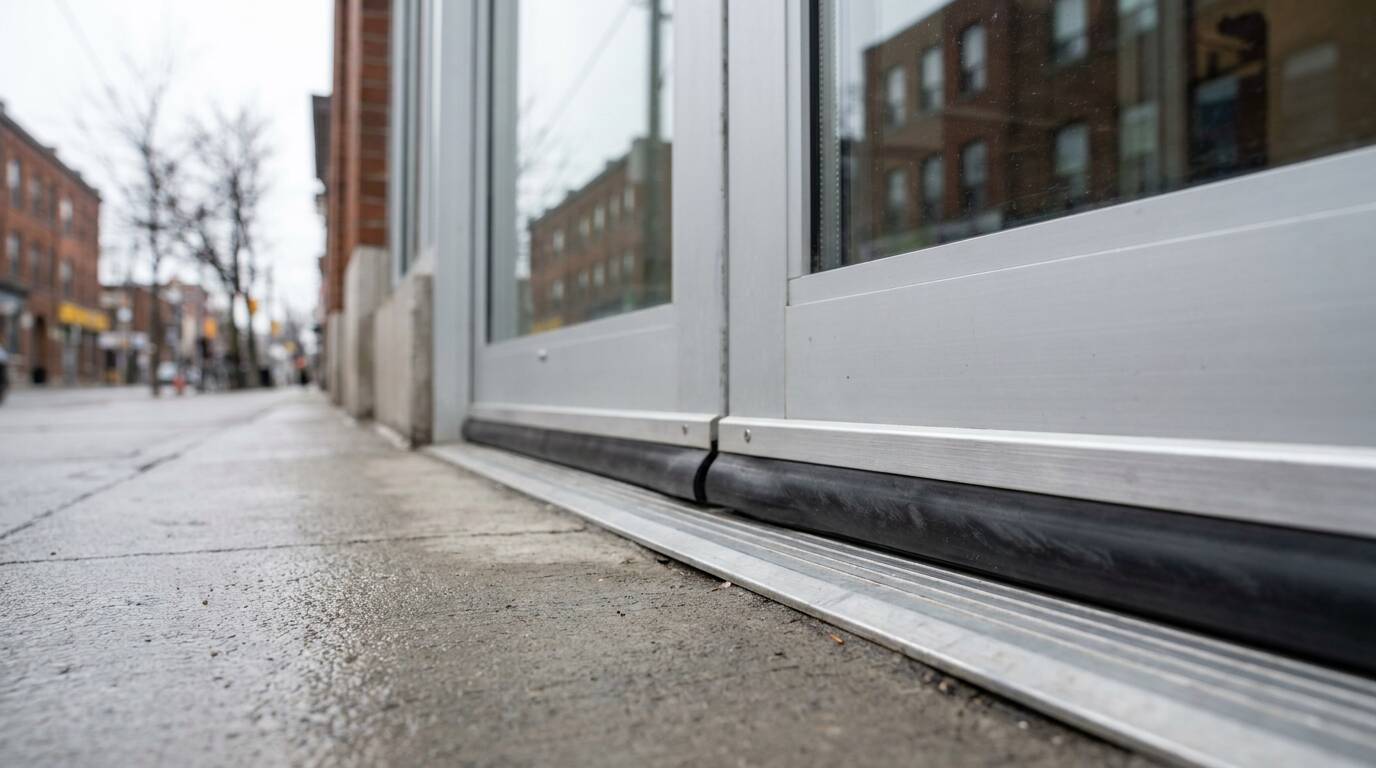
Stand inside almost any commercial building on a cold GTA morning and you can often feel the problem before you see it. A thin line of cold air runs across the floor near the main entrance, the welcome mat is damp after a storm, and the heating bill keeps creeping up no matter how the thermostat is set. Most of the time the culprit is the smallest piece of hardware on the whole door: the sweep along the bottom edge.
A worn or missing door sweep leaves a gap between the bottom of the door and the floor. That gap lets in drafts, rain, snowmelt, dust, insects, rodents, and street noise, and it quietly drains conditioned air all year. For a storefront, a restaurant, a warehouse, or an office lobby, that one strip of rubber or brush does real work. This guide walks through what commercial door sweeps are, the types available, how to size and install them, the fire and accessibility rules that apply in Ontario, and how to tell when a sweep needs replacing rather than another round of tape and hope.
Commercial Door Pros installs and repairs door bottom seals across the Greater Toronto Area, so the advice here comes from the kind of service calls we handle week to week. If you would rather skip the reading and have someone look at your entrance, you can reach us directly.
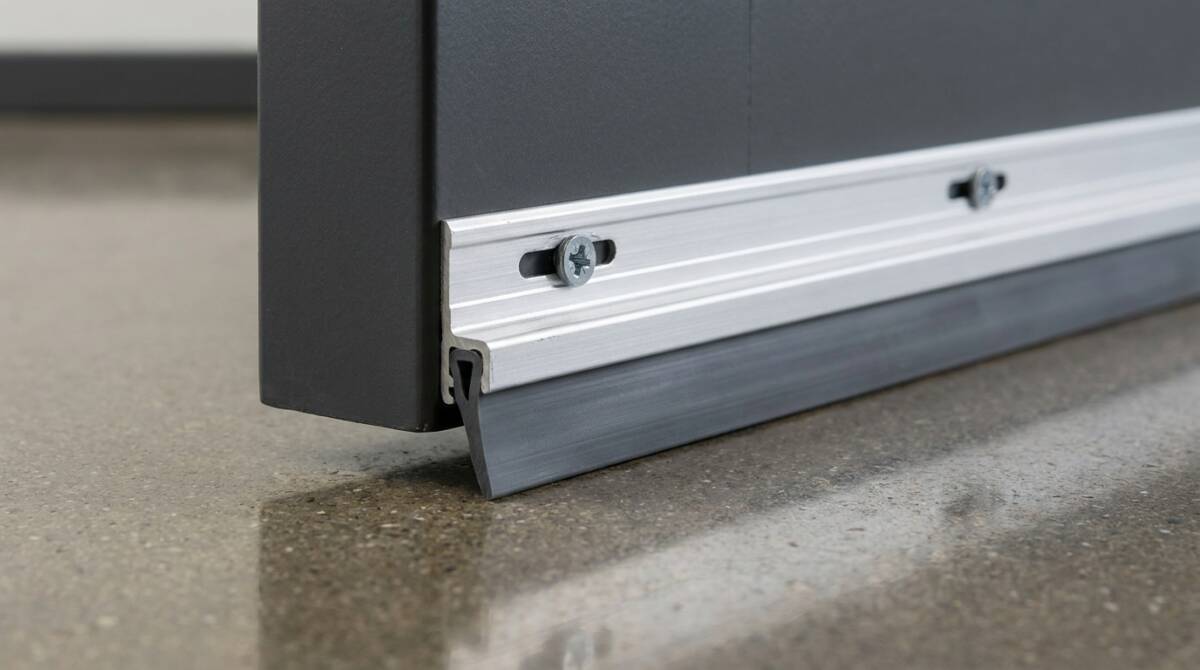
What is a commercial door sweep?
A commercial door sweep is a seal fitted along the bottom edge of a door to close the gap between the door and the threshold or floor. Most sweeps use a rigid carrier, usually aluminum, that holds a flexible insert made of vinyl, neoprene, silicone, or nylon brush. When the door closes, the flexible part presses against the floor or threshold and blocks air, water, light, and pests from passing underneath.
People use several names for this part, and the names overlap in confusing ways. A “door sweep” usually screws onto the face of the door near the bottom. A “door shoe” wraps around the bottom edge of the door. An “automatic door bottom” drops a seal only when the door is closed. A “door bottom” can mean any of these. For most business owners the distinction matters less than the job: all of them seal the bottom gap, and the right choice depends on the door, the floor, and what you are trying to keep out.
Sweeps sit within a larger family of door sealing hardware. The weatherstripping around the sides and top of the door handles the perimeter, the threshold handles the floor plate the door closes over, and the sweep handles the bottom edge of the leaf itself. The three work as a set. You can read more about the floor side in our guide to commercial door thresholds and about the side-and-top seals in our breakdown of commercial door weatherstripping.
Why the bottom gap matters more on commercial doors
Commercial entrances cycle far more than a house door. A busy café or retail unit can see a door open and close a thousand times a day. Every cycle flexes the sweep, drags grit across it, and wears the insert a little more. The doors are also heavier, the floors are rarely perfectly level, and the gap under the door is often wider to begin with because of accessibility thresholds or settling slabs. All of that means a commercial sweep works harder and fails faster than the residential version, which is exactly why it pays to pick the right type and keep an eye on it.
What a failing door sweep actually costs you
The sweep is cheap, so it is easy to ignore. The costs of ignoring it are not cheap, and they show up in four places.
Energy. A continuous gap under a standard commercial door is a steady air leak. Air sealing is one of the most cost effective ways to cut heating and cooling loss in a building, a point Natural Resources Canada makes in its guidance on energy efficient windows, doors, and skylights. A good sweep is a small part with an outsized effect on comfort near the entrance.
Pests. A mouse can get through a gap about the width of a pencil, and insects need far less. The space under a worn sweep is the most common pest entry point on a commercial building. Restaurants and food handlers in particular cannot afford that opening.
Water and ice. Wind driven rain and melting snow run under a bad sweep and pool on the interior floor, which creates a slip hazard and, over time, damages flooring and door frames. In winter the water can refreeze and jam the door.
Comfort and noise. Staff stationed near the door feel every draft, and street noise carries straight through the gap. For an office or a clinic that hurts the experience of everyone inside. Problems like these tend to get worse with the seasons, something we cover in our piece on commercial door problems that worsen with heat and humidity.
Types of commercial door sweeps
There is no single best sweep. The right one depends on the gap size, whether the door is interior or exterior, the floor surface, and the rating the door needs to carry. Here are the main types you will run into.
Surface mounted door sweep
This is the most common type: an aluminum bar with a vinyl or neoprene blade that screws onto the interior face of the door near the bottom. It is quick to install, easy to adjust up or down through slotted holes, and simple to replace when the blade wears. Surface sweeps handle a modest, even gap well and are the default choice for most storefront and office doors.
Door shoe
A door shoe wraps the bottom edge of the door in a U or L shaped aluminum channel that holds the seal. Because it grips the edge rather than the face, a shoe gives a cleaner look and better protects the bottom of the door from moisture. Shoes suit exterior doors and work well paired with a threshold that has a raised seal.
Brush door sweep
A brush sweep uses dense nylon bristles instead of a solid blade. Brushes glide over uneven floors, carpet transitions, and debris without binding, so they are popular where the floor is rough or the gap varies across the opening. They seal air and pests well, though a solid blade does better against driving water.
Automatic door bottom
An automatic door bottom, or ADB, is a seal mortised into or surface mounted on the bottom of the door that stays retracted while the door is open and drops down to seal only when the door closes. A plunger at the hinge side triggers the drop. ADBs give a tight seal without a raised threshold underfoot, which makes them a good fit for accessible openings and for doors that need acoustic or smoke control. They cost more and need occasional adjustment.
Drip cap and rain drip
A drip cap is an angled aluminum strip mounted above the sweep on the exterior face. It throws rain away from the door bottom so water does not run down into the sweep and threshold. On exposed exterior entrances in the GTA, a drip cap paired with a shoe or surface sweep makes a real difference during storms.
Retractable and specialty sweeps
Beyond the common types there are retractable sweeps for very uneven floors, heavy duty sweeps with reinforced carriers for high traffic industrial doors, and fire or smoke labeled seals for rated openings. Specialty choices usually come up when a standard sweep keeps failing or when the door carries a code requirement.
| Sweep type | Best for | Seals against | Notes |
|---|---|---|---|
| Surface mounted | Most interior and exterior doors | Air, light, pests, some water | Easiest to fit and adjust; replace the blade when worn |
| Door shoe | Exterior doors, wet locations | Water, air, pests | Protects the door edge; pairs with a sealed threshold |
| Brush | Uneven floors, carpet transitions | Air, pests, dust | Glides over debris; weaker against driving rain |
| Automatic door bottom | Accessible, acoustic, smoke doors | Air, sound, smoke | Seals only when closed; needs periodic adjustment |
| Drip cap | Exposed exterior entrances | Rain runoff | Used with a sweep or shoe, not on its own |
| Heavy duty / retractable | Industrial, very uneven floors | Air, pests, water | Reinforced carrier for high cycle traffic |
Sweep materials and what they do best
The carrier is almost always aluminum, sometimes stainless steel for harsh or coastal conditions. The part that matters for performance is the flexible insert, and each material has a job it does well.
- Vinyl: inexpensive and widely used, good general purpose sealing, but it stiffens in deep cold, which matters through a GTA winter.
- Neoprene: a synthetic rubber that stays flexible across a wide temperature range and resists oils and weather, a strong choice for exterior doors here.
- Silicone: the best cold weather flexibility and the longest life, used where a durable, high performing seal justifies the higher cost, including many fire and smoke applications.
- Nylon brush: dense bristles for uneven surfaces and high traffic, excellent for air and pests, commonly used on overhead and industrial doors.
If you are specifying hardware for a whole opening, the sweep material should match the demands of the rest of the assembly. Our overview of commercial door hardware grades and types puts the sweep in context alongside closers, hinges, and locks.
How to measure and size a commercial door sweep
Getting the size right is where most do it yourself sweep jobs go wrong. Two measurements matter.
Width. Measure the full width of the door, not the frame opening. Most sweeps come slightly oversized and are cut to length on site with a hacksaw. A standard 36 inch commercial door leaf takes a sweep cut to that width. If you are unsure of your door sizes, our guide to standard commercial door sizes explains the common dimensions.
Gap. Measure the distance from the bottom of the door to the finished floor or the top of the threshold. This tells you how much seal projection you need. Too little and the sweep never touches the floor. Too much and it drags, wears quickly, and can stop the door from latching. A sweep with a slotted carrier lets you fine tune the height after mounting, which is why adjustable surface sweeps are forgiving for a first fit.
On an uneven floor the gap will vary from the hinge side to the latch side. Measure at several points and size for the largest gap, then choose a flexible insert, a brush, or an automatic door bottom that can take up the difference without binding at the tight spots.
Fire rated doors and smoke control
The bottom of a door becomes a code issue the moment the door is rated. Fire rated door assemblies are tested and listed as a complete unit, and that includes any seal at the bottom. You cannot add just any sweep to a fire door and keep its rating. Where a bottom seal or gasketing is required, it has to be a labeled component compatible with the listed assembly.
Fire doors also have limits on the gap under the door. The clearance between the bottom of a fire door and the floor is capped, and swapping in the wrong sweep, or shimming a door to close a gap, can push the assembly out of compliance. Smoke control openings add another layer, because smoke seals are tested for air leakage and carry their own labels. The Ontario Building Code sets the framework for fire separations and door assemblies, and you can see the regulation itself at Ontario Regulation 332/12.
The practical takeaway is simple. If the door has a label on the hinge edge, treat the sweep as part of a rated system and have the seal specified to match. Our guides to fire rated doors and to hollow metal doors go deeper on what keeps a rated opening compliant.
Accessibility and the threshold connection
A door bottom seal and the threshold under it are closely linked, and both touch on barrier free access. Ontario’s accessibility requirements and the building code limit how high a threshold can be and call for bevelled edges so a raised plate does not become a trip hazard or an obstacle for a wheelchair. That is one reason automatic door bottoms are popular on accessible openings: they give a tight seal when the door is closed without leaving a raised strip underfoot the rest of the time.
If your entrance combines a sweep, a threshold, and a door closer or power operator, the parts have to work together so the door still opens with reasonable force. Our articles on thresholds and weather sealing and on automatic and powered doors cover how the floor side and the operator side fit with the sweep.
Signs your door sweep needs replacing
Door sweeps give plenty of warning before they fail completely. Watching for these signs lets you replace a worn blade for a few dollars instead of dealing with the water damage or pest problem that follows.
| Symptom | Likely cause | What to do |
|---|---|---|
| Visible daylight under the closed door | Worn, torn, or missing insert | Replace the blade or the full sweep |
| Draft along the floor near the door | Insert no longer contacts the floor | Adjust height or replace |
| Water or snow coming inside | Flattened seal, missing drip cap | Replace sweep, add a shoe or drip cap |
| Insects or rodents getting in | Gap at the corners or along the blade | Replace with a tighter seal, check corners |
| Sweep dragging or door hard to open | Insert set too low, floor settled | Raise the carrier or fit a shorter insert |
| Loud street noise near the entrance | Gap passing sound | Fit an automatic door bottom or acoustic seal |
| Insert cracked or brittle in winter | Vinyl stiffened by cold | Switch to neoprene or silicone |
Replace the insert, the sweep, or the whole bottom seal?
Not every sweep problem needs a full replacement. The right fix depends on what has actually worn out.
If the carrier is sound and only the blade or brush is worn, many sweeps let you slide out the old insert and slide in a new one. That is the cheapest fix and takes minutes. If the aluminum carrier is bent, corroded, or the mounting holes are stripped, replace the whole sweep. If the door bottom itself is damaged, swollen, or rotted, which happens on older wood and poorly sealed exterior doors, the sweep is a symptom and the door needs attention first. Deciding between a part swap and a larger repair is the same judgment we lay out in our guide to repair versus replacement for commercial doors and windows.
| Condition | Best fix | Rough effort |
|---|---|---|
| Insert worn, carrier fine | Replace the insert only | Minutes, low cost |
| Carrier bent or stripped | Replace the full sweep | Under an hour |
| Gap uneven across the opening | Fit a brush or automatic door bottom | Half a service visit |
| Door bottom damaged or rotted | Repair the door, then reseal | Larger repair |
| Rated door out of compliance | Fit a labeled seal to the listing | Specify to match assembly |
Installing a commercial door sweep
A straightforward surface sweep is a reasonable job for a capable maintenance person. The steps look simple on paper, and the details are where it goes right or wrong.
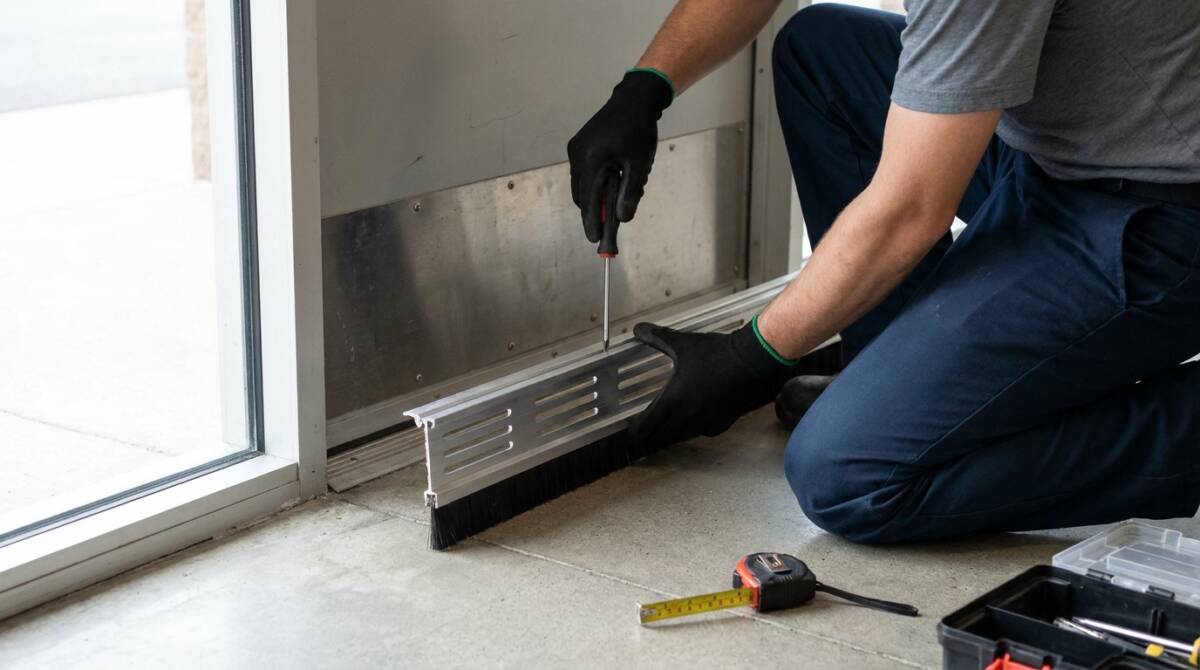
Measure the door width and cut the sweep to length, filing the cut edge smooth. Close the door and hold the sweep against the interior face so the insert just touches the floor across the whole width, then mark the slotted holes. Drill pilot holes, fasten loosely, and check the seal contact along the full width with the door closed. Adjust up or down in the slots until the insert meets the floor evenly without dragging, then tighten. Open and close the door several times to confirm it latches cleanly and the sweep does not catch.
The complications come from doors that are out of square, floors that slope, automatic door bottoms that need the plunger aligned to the frame, and rated doors where the wrong fastener or seal voids the label. When the opening is heavily used, carries a rating, or fights you on the first fit, a service call is usually faster and cheaper than three trips to the hardware store. You can see the broader range of what we handle on our commercial door services page, and we also handle commercial door installation when the whole opening needs work.
Door sweeps by door type
The door the sweep goes on changes the choice as much as anything else.
Aluminum storefront doors. These narrow stile glass doors usually take a surface sweep or a shoe sized to the stile, often paired with a threshold seal. Keeping the bottom sealed matters for both energy and appearance on a retail front. See our guide to aluminum storefront systems for how the sweep fits the rest of the framing, and our piece on commercial glass doors for entrance specifics.
Hollow metal and steel doors. Heavy exterior steel doors on warehouses, loading areas, and service entrances take a reinforced surface sweep, a shoe, or a heavy duty brush. Pair the sweep with a solid threshold and a drip cap on exposed sides.
Overhead and industrial doors. Sectional and rolling doors use bottom astragals and brush seals built for a much wider gap and rougher floor. These are a different animal from a standard swing door sweep, and we cover them in our guide to commercial overhead doors.
Fire and exit doors. Rated doors and doors with panic hardware need seals matched to the listing, as covered above. The sweep is part of the rated assembly, not an afterthought.
Seasonal maintenance in the GTA climate
Toronto area weather is hard on door bottom seals. Winter road salt and grit grind at the insert, freeze and thaw cycles stiffen vinyl and crack it, spring and fall storms drive rain at the bottom of exposed doors, and summer heat can soften and deform cheaper seals. A sweep that looked fine in September can be leaking by February.
Twice a year, ideally in spring and fall, walk every exterior door and check the bottom seal. Look for daylight with the door closed, feel for drafts, press the insert to confirm it still flexes rather than cracks, and clear grit from the carrier. Catching a worn sweep before the season turns keeps the building comfortable and keeps water and pests outside where they belong.
| When | Check | Why |
|---|---|---|
| Early spring | Winter wear, cracked inserts, salt in the carrier | Cold and grit damage show up now |
| Early fall | Seal contact, drafts, drip caps | Seal before heating season and storms |
| After any major storm | Water intrusion at exposed doors | Catch leaks before flooring damage |
| Monthly on high traffic doors | Dragging, loose fasteners, latch issues | Heavy cycling loosens hardware |
What drives the cost of a door sweep replacement
Costs vary with the hardware and the opening, so rather than quote a number that would be wrong for half of readers, here is what actually moves the price.
| Cost driver | Lower cost | Higher cost |
|---|---|---|
| Sweep type | Surface mounted insert swap | Automatic door bottom, labeled fire seal |
| Material | Vinyl | Silicone, stainless carrier |
| Door condition | Sound door, clean install | Damaged bottom needing repair first |
| Opening | Standard swing door | Rated door, double doors, uneven floor |
| Access and timing | Scheduled daytime visit | After hours or emergency call |
For a single worn insert the fix is small. For a rated door, a double door entrance, or a sweep that is leaking because the door or threshold underneath it has failed, the real work is in the door, and the sweep comes along at the end. A quick assessment tells you which situation you are in. If water is actively coming in or a door will not seal and secure, that moves into emergency commercial door repair territory.
When to call a commercial door specialist
Swapping a worn insert on a sound storefront door is well within reach for an in house maintenance team. Bring in a specialist when the door is fire or smoke rated, when an automatic door bottom needs fitting or adjustment, when the floor is uneven enough that no standard sweep seals, when the door bottom itself is damaged, or when the entrance is busy enough that downtime costs you customers. In those cases the right seal, fitted correctly the first time, pays for itself in energy, security, and avoided water damage.
Commercial Door Pros services door bottom seals, thresholds, and full entrances across the GTA. If you want an entrance checked before winter or a leaking door sorted now, get in touch for an assessment and we will tell you honestly whether it is a five minute insert swap or something more.
Frequently asked questions about commercial door sweeps
What is a commercial door sweep?
A commercial door sweep is a seal fitted along the bottom edge of a door that closes the gap between the door and the floor or threshold. It uses a rigid carrier, usually aluminum, holding a flexible vinyl, neoprene, silicone, or brush insert that blocks air, water, light, pests, and noise from passing underneath.
What is the difference between a door sweep and a door shoe?
A door sweep screws onto the face of the door near the bottom, while a door shoe wraps around the bottom edge in a U or L shaped channel. A shoe protects the door edge better and suits exterior doors, and a surface sweep is faster to fit and adjust.
What is an automatic door bottom?
An automatic door bottom is a seal that stays retracted while the door is open and drops down to seal only when the door closes, triggered by a plunger at the hinge side. It gives a tight seal without a raised threshold, which makes it a good fit for accessible, acoustic, and smoke control doors.
How do I measure a door sweep?
Measure the full width of the door leaf for the length, and measure the gap from the bottom of the door to the finished floor or threshold for the seal projection. On uneven floors, measure the gap at several points and size for the largest gap so the seal takes up the difference without dragging at the tight spots.
What size door sweep do I need for a 36 inch door?
A standard 36 inch commercial door leaf takes a sweep cut to about that width. Most sweeps ship slightly oversized and are cut to length on site with a hacksaw, so measure the actual leaf rather than the frame opening before cutting.
Can you put a door sweep on a fire rated door?
Only a labeled seal compatible with the door’s listing. A fire rated assembly is tested as a complete unit, so any bottom seal has to be a component approved for that listing. Adding a random sweep or shimming the door can void the rating, so rated doors should be sealed to match the assembly.
What is the maximum gap allowed under a fire door?
Fire doors have a capped clearance between the bottom of the door and the finished floor, set by the listing and the applicable code. Because the exact figure depends on the assembly and the edition of the code in force, confirm the allowed clearance for your specific door rather than assuming a general number.
How often should a commercial door sweep be replaced?
There is no fixed interval. A sweep on a busy exterior door may wear out in a year or two, while one on a sheltered low traffic door can last much longer. Inspect exterior door bottoms twice a year and replace the insert as soon as you see daylight, feel a draft, or find cracking.
Why is cold air coming in under my commercial door?
The sweep is worn, set too high, or missing, so the insert no longer contacts the floor. Adjusting the height or replacing the insert usually fixes it. If the gap is uneven across the opening, the floor may have settled, and a brush sweep or automatic door bottom seals better than a solid blade.
Can a door sweep keep out mice and insects?
Yes, a properly sized sweep in good condition is one of the most effective barriers at the bottom of a door, which is a common pest entry point. The seal has to contact the floor evenly across the full width, including the corners, since even a small gap is enough for mice and insects.
Will a door sweep stop water from coming in?
A solid blade sweep or a door shoe blocks most water, and adding an exterior drip cap above it to throw rain away from the door bottom improves the result on exposed entrances. Brush sweeps seal air and pests well but do less against driving rain.
Do door sweeps help with noise?
They do. The bottom gap is a direct path for street and corridor noise, and sealing it reduces sound transmission. For meaningful acoustic control, an automatic door bottom or an acoustic rated seal works better than a basic blade.
Can I replace just the rubber part of a door sweep?
Often yes. Many sweeps use a replaceable insert that slides out of the carrier, so if the aluminum carrier is still straight and the mounting holes are sound, a new insert is the quickest and cheapest fix. Replace the whole sweep when the carrier is bent, corroded, or stripped.
What is the best door sweep material for Canadian winters?
Neoprene and silicone stay flexible in deep cold, while cheaper vinyl can stiffen and crack over a hard winter. For exterior GTA doors, a neoprene or silicone insert is the more reliable choice through the freeze and thaw cycles.
Is a door sweep the same as weatherstripping?
They are related but not the same. A door sweep seals the bottom edge of the door, while weatherstripping seals the sides and top around the perimeter, and the threshold seals the floor plate. The three work together, so a building with a good sweep but failed perimeter weatherstripping will still leak air.
Can a door sweep stop my door from latching?
If the insert is set too low it can drag on the floor and keep the door from swinging fully closed, which stops it latching. Raising the carrier in its slots or fitting a shorter insert usually solves it. A door that still will not latch after adjusting the sweep may have a hinge, closer, or alignment issue instead.


