

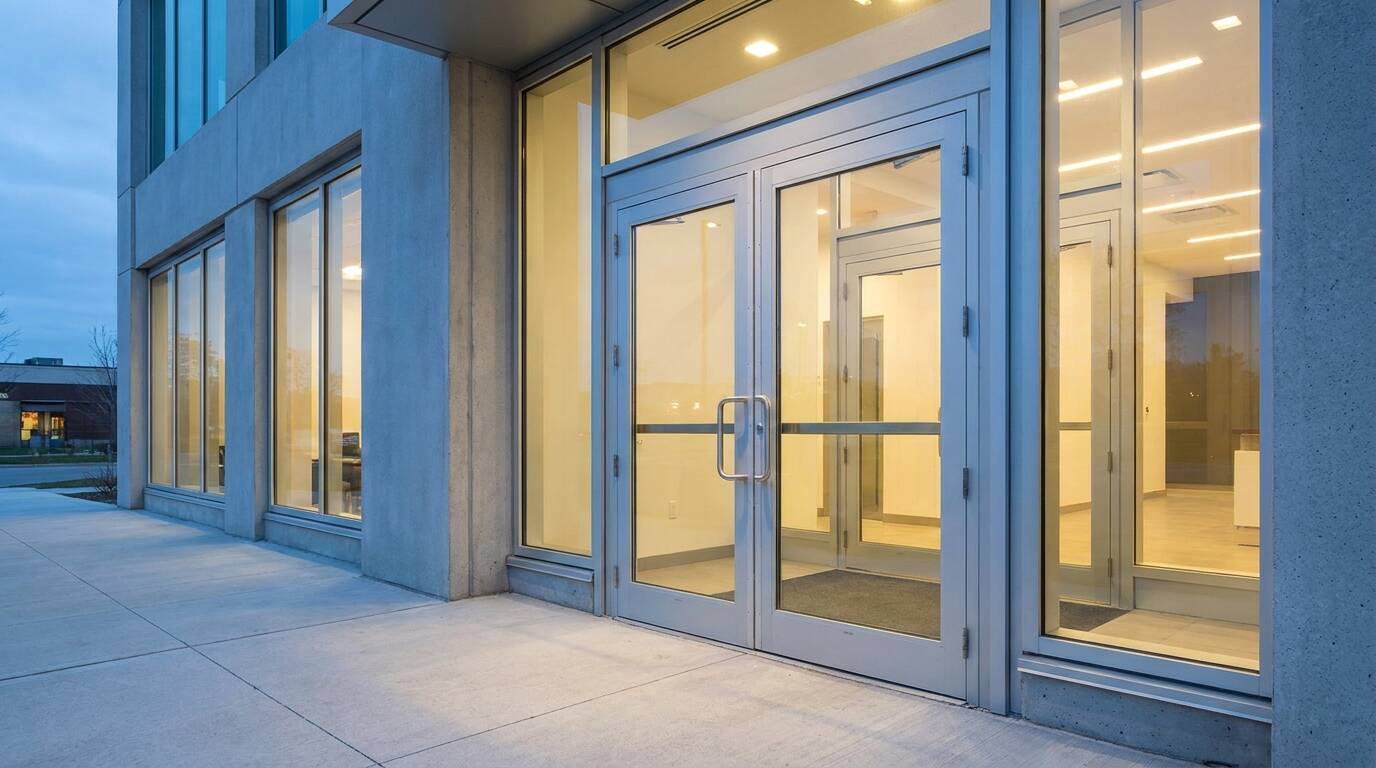
If your building has a pair of doors at the main entrance, a rear exit, or a corridor cross-door, there is a small piece of hardware doing a lot of quiet work on the door you rarely open. That door is the inactive leaf, and the bolts that hold it shut at the top and bottom are flush bolts. Most property managers never think about them until the leaf starts rattling, the pair stops latching, or a fire inspector flags the opening. This guide walks through what flush bolts do, how the rest of the double-door hardware works with them, where the fire code gets strict, and how to tell a quick fix from a full hardware replacement.
We install, adjust, and replace this hardware on commercial pairs across the Greater Toronto Area, so the examples below come from real openings in offices, retail units, warehouses, and institutional buildings, not a catalogue.
What is a flush bolt?
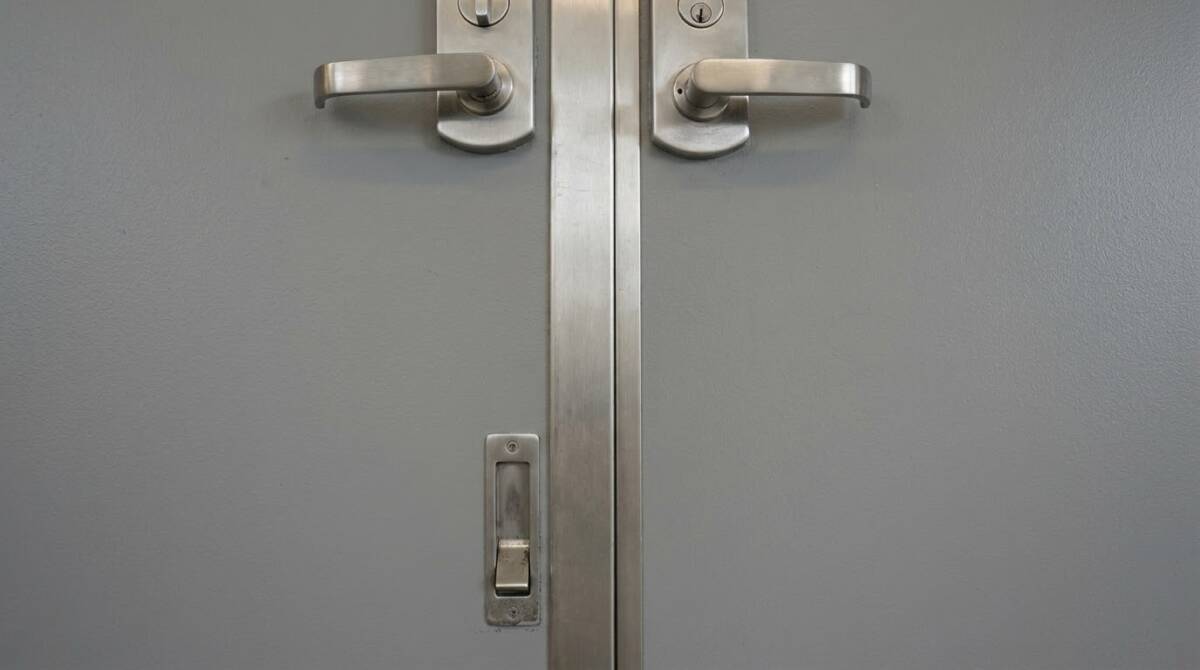
A flush bolt is a sliding rod set into the edge or face of a door that locks the inactive leaf of a pair of doors into the frame head and the floor. You throw the top and bottom bolts to hold that leaf fixed, which gives the active leaf a solid edge to latch against. The bolt sits flush with the door, so it stays out of the way and out of sight.
On a single door you never need one. Flush bolts exist because a pair of doors has no fixed mullion down the middle by default, so one leaf has to become the “post” the other leaf closes into. For a fuller picture of how the pieces fit together, our commercial door hardware guide maps every component on a commercial opening.
Active leaf, inactive leaf, and the meeting stile
On a standard pair, the active leaf is the one people use. It carries the lock or exit device and does the daily opening and closing. The inactive leaf stays shut most of the time and only opens when you need the full width, for a delivery, a stretcher, or a piece of equipment. The vertical edges where the two leaves meet are the meeting stiles. The flush bolts live on the inactive leaf’s meeting stile, top and bottom, and the active leaf latches into the inactive leaf or into a strike mounted on it.
The astragal: sealing and protecting the gap
Where the two leaves meet, there is a joint. An astragal is the strip, usually metal, that overlaps or fills that joint. It blocks drafts, light, sound, and in a fire-rated pair it keeps flame and smoke from passing between the leaves. An overlapping astragal is fixed to one leaf and laps over the other; a split astragal mounts to both. On exterior pairs the astragal also carries a weather seal, which is a separate job from the weatherstripping around the frame perimeter and the door sweep at the bottom. If you feel a cold draft straight down the centre of a pair, a worn or missing astragal is usually the reason.
The door coordinator: closing in the right order
A pair of doors has to close in sequence. The inactive leaf must shut first so the astragal and strike are in place, then the active leaf closes against it. If both leaves try to close at once, they jam at the meeting stiles and neither latches. A door coordinator is the bar hidden in the frame head that holds the active leaf open for a beat until the inactive leaf lands, then releases it. Coordinators matter most on fire-rated pairs, where both leaves have to latch every single time. They work alongside the door closers that pull each leaf shut.
| Component | Where it sits | What it does |
|---|---|---|
| Flush bolts (top and bottom) | Inactive leaf, meeting stile edge or face | Hold the inactive leaf fixed into frame head and floor |
| Dustproof strike | Floor, under the bottom flush bolt | Receives the bottom bolt and keeps debris out of the hole |
| Astragal | Between the two meeting stiles | Seals the centre joint against air, light, sound, flame, and smoke |
| Door coordinator | Hidden in the frame head | Sequences the leaves so the inactive one closes first |
| Carry (open) bar | Frame head, part of the coordinator | Holds the active leaf back until the inactive leaf lands |
| Active leaf lock or exit device | Active leaf | Latches the pair and controls daily entry and egress |
Types of flush bolts
Flush bolts are not all the same, and the type on your doors decides how much you have to think about them and whether they pass a fire inspection. Here are the main kinds you will meet on commercial pairs.
Manual flush bolts
A manual flush bolt is the simplest version. You slide a lever or flip a small handle by hand to throw the bolt up into the frame head and down into the floor, and you reverse it to release. Most are lever-action, where a small lever on the face of the door moves the rod. Manual bolts are common on non-rated pairs where the inactive leaf stays shut for weeks at a time. They are cheap and reliable, but they depend on a person remembering to throw them, which is exactly why the fire code limits where they can go.
Automatic flush bolts
An automatic flush bolt throws itself. When the inactive leaf closes, a trigger near the meeting stile is pressed by the active leaf or the frame and the bolts shoot into place on their own. Open the active leaf, press the trigger the other way, and the inactive leaf can swing free. Because nobody has to remember anything, automatic flush bolts are the standard choice on fire-rated pairs that have to self-latch.
Constant latching flush bolts
A constant latching flush bolt is a refinement of the automatic type. The bolt stays latched whenever the leaf is closed and only releases when the leaf is deliberately opened, which keeps the inactive leaf positively held at all times. This matters on fire assemblies, where a bolt that could be bumped out of position is a problem. If you have fire-rated pairs, a constant latching bolt paired with a coordinator is the combination inspectors expect to see.
Mortise versus surface-mounted
Flush bolts also differ by how they mount. A mortise (concealed) flush bolt is routed into the edge of the door so only the lever and the rod opening show. It looks clean and resists tampering, but it needs a pocket cut into the leaf, which suits hollow metal and solid-core doors. A surface-mounted flush bolt screws onto the face of the door. It is easier to retrofit and service, and it is the practical choice on aluminum storefront and narrow-stile doors where there is no room to mortise. The door material drives the decision, which is one more reason the construction of the leaf matters, whether it is a hollow metal door or a glass leaf.
| Flush bolt type | How it operates | Best for | Fire-rated pairs? |
|---|---|---|---|
| Manual (lever action) | Thrown and released by hand | Non-rated pairs, rarely used inactive leaf | Usually not permitted on self-latching fire pairs |
| Automatic | Throws itself when the leaf closes | Fire-rated and high-traffic pairs | Yes, with a coordinator |
| Constant latching | Stays latched when closed, releases on opening | Fire assemblies needing positive latching | Yes, preferred |
| Mortise (concealed) | Routed into the door edge | Hollow metal, solid-core leaves | Depends on the listed assembly |
| Surface-mounted | Screws onto the door face | Aluminum, narrow-stile, retrofit work | Depends on the listed assembly |
Flush bolts and the fire code
This is the part that gets buildings written up. A fire-rated pair of doors is tested and listed as a complete assembly, and the hardware on it has to match that listing. The core requirement is that both leaves latch on their own every time the doors close, because a fire door that does not latch cannot do its job of holding back flame and smoke. A manual flush bolt breaks that rule the moment someone forgets to throw it, so on most self-closing, self-latching fire pairs you need automatic or constant latching flush bolts, not manual ones.
Fire door assemblies in Canada are installed and maintained to the standard referenced by the building and fire codes, and the widely used reference is NFPA 80, Standard for Fire Doors and Other Opening Protectives. The requirement that fire doors be self-closing and positive-latching flows from there and from the Ontario rules. The specific provisions, ratings, and inspection intervals that apply to your building are set by the Ontario Building Code and enforced by your local authority having jurisdiction, so treat the points here as the principle and confirm the exact clause with your inspector. Our deeper write-up on Ontario Building Code fire door requirements goes further into ratings and labels.
Why a manual flush bolt fails a fire inspection
Picture a rear fire exit that is a pair of doors. Staff prop the inactive leaf open on a busy afternoon and never throw the manual bolts back at closing. Now the inactive leaf is not latched, the astragal gap is open, and the assembly no longer performs the way it was tested. An inspector who finds this will flag it. Automatic and constant latching bolts remove the human step, which is why they are the safe default on any pair that carries a fire rating. If your fire exits are pairs, our fire-rated doors guide explains how the whole assembly is rated and labelled.
Coordinators, exit devices, and egress
Fire-rated pairs almost always need a coordinator so the leaves latch in order, and many also carry panic or fire exit hardware. On a pair, that often means vertical rod exit devices rather than flush bolts on the egress side, because people have to get out by pushing, not by stopping to release a bolt. Flush bolts are for the inactive leaf that is not part of the daily egress path. Where a leaf is part of the required exit width, the hardware has to release under a single motion, which is the whole point of panic and exit devices. Accessibility rules under the Accessibility for Ontarians with Disabilities Act also shape how an opening has to operate, and our piece on accessible door width covers the clear-opening side of pairs.
Are flush bolts secure?
Flush bolts add security, with a limit worth understanding. When both top and bottom bolts are thrown, the inactive leaf is pinned into the frame head and the floor, which makes it far harder to force than a leaf held only by a latch. That is genuinely useful on back entrances and stockroom pairs. The limit is that a manual flush bolt is only as secure as the last person to throw it, and a flush bolt is not a locking system on its own. It holds the inactive leaf; the active leaf still needs a proper lock or exit device, and for access control you layer on an electric strike, a magnetic lock, or the right commercial door lock. On a high-risk rear pair, we often pair thrown flush bolts with a keyed removable mullion instead, which gives both leaves a solid post to latch into.
The removable mullion alternative
A removable mullion is a vertical post that drops into the centre of the opening between the two leaves. With a mullion in place, each leaf latches into it like a single door, so you can run standard rim exit devices on both and skip flush bolts entirely. When you need the full width, you unlock and lift out the mullion. Mullions are a strong choice for security and for simplifying the hardware, with the trade-off that someone has to remove and reset the post when the wide opening is needed.
Materials, sizes, and finishes
Flush bolts come in steel, stainless steel, and brass, with steel and stainless being the norm on commercial doors because they take abuse and resist corrosion. Standard rod lengths run around 6, 12, 18, and 24 inches, measured from the lever to the end of the rod. A longer top rod lets the lever sit at a reachable height while the bolt still throws into the frame head, which matters on tall openings. Finishes are specified to match the rest of the hinges, locks, and trim on the opening, commonly satin stainless or a powder-coated finish. The right rod length depends on the door height, so it ties back to standard commercial door sizes and the frame.
| Specification | Common commercial options | Notes |
|---|---|---|
| Material | Steel, stainless steel, brass | Stainless resists corrosion on exterior and wash-down areas |
| Rod length | 6, 12, 18, 24 inches | Longer top rods raise the lever to a reachable height |
| Mounting | Mortise or surface | Door material and stile width decide which fits |
| Finish | Satin stainless, powder coat, plated | Matched to the rest of the opening’s hardware |
| Bottom strike | Dustproof floor strike | Keeps grit out of the floor hole so the bolt seats |
Common double-door and flush bolt problems
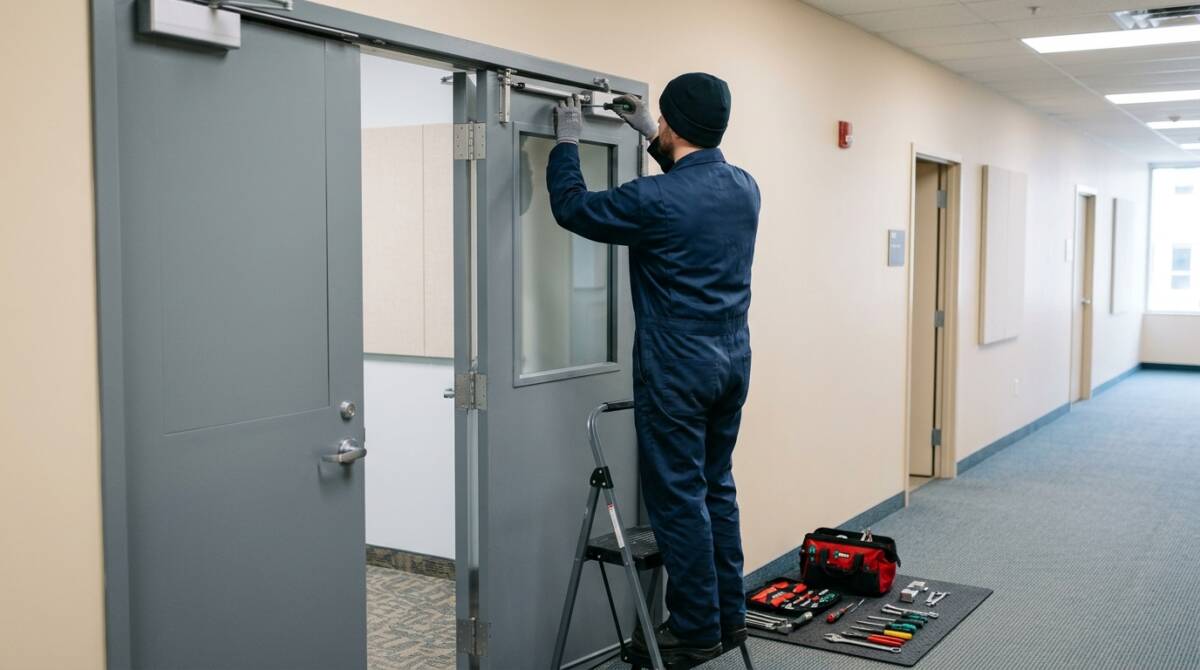
When a pair of doors starts misbehaving, the flush bolts and the coordinator are usually involved. Here is how the typical symptoms map to causes and fixes we see on GTA service calls.
| Symptom | Likely cause | Typical fix |
|---|---|---|
| Inactive leaf rattles or shifts | Flush bolts not thrown, or worn bolt and strike | Throw the bolts, adjust or replace the bolt and strike |
| Active leaf will not latch | Inactive leaf not fully closed or bolts not seated | Check the coordinator sequence and bolt engagement |
| Bottom bolt will not drop into the floor | Dirt in the strike hole or a misaligned strike | Clean or replace the dustproof strike, realign |
| Both leaves jam at the centre | Coordinator out of sequence or failed | Adjust or replace the coordinator and carry bar |
| Bolt is seized and will not move | Corrosion, bent rod, or paint fouling | Free and lubricate, or replace the flush bolt |
| Draft or noise down the centre seam | Worn, bent, or missing astragal | Replace the astragal and any centre weather seal |
| Automatic bolt does not self-throw | Trigger misaligned or mechanism worn | Adjust the trigger or replace the automatic bolt |
Removing a stuck or sheared flush bolt
A flush bolt that has seized or had its rod shear off is a common failure on older pairs, especially where road salt and moisture reach a rear door. The lever moves but the bolt does not, or the rod snaps and leaves part of it in the frame or floor. This is a replacement, not a cleanup. The old bolt has to come out of the mortise or off the face, the broken rod retrieved, and a new bolt fitted and aligned to the strikes. On a hollow metal leaf that can mean some careful work inside the door edge, which is a job for a technician rather than a facilities quick fix.
Repair or replace the hardware
Most flush bolt and coordinator trouble is a repair, not a reason to replace the doors. A bolt that is dirty, loose, or out of adjustment gets cleaned, tightened, or realigned. A worn or corroded bolt gets swapped for a new one of the same type. A coordinator that has lost its sequence gets adjusted or replaced. You move toward replacing more of the opening when the leaf itself is damaged, the frame is racked, or a non-rated pair has to become a rated assembly, in which case the bolts, astragal, coordinator, and sometimes the doors are specified together as a listed set. Our guide on repair versus replacement lays out how we weigh that call.
| Lean toward repair | Lean toward replacing hardware or the assembly |
|---|---|
| Bolt is dirty, loose, or misaligned | Rod is bent, sheared, or badly corroded |
| Coordinator just needs adjustment | Coordinator has failed or the pair never latches in order |
| Astragal is intact, seal is worn | Astragal is bent or missing on a rated pair |
| Doors and frame are sound | Leaf or frame is damaged, or the pair must become fire-rated |
Installation and retrofit
Fitting flush bolts well is mostly about alignment. The top bolt has to throw cleanly into a strike in the frame head, and the bottom bolt has to drop into a dustproof strike set accurately in the floor. If either strike is off by even a little, the bolt binds or fails to seat, and the pair will not latch reliably. On a retrofit, the door material decides the approach: hollow metal and solid-core leaves can take a mortised bolt, while aluminum and glass pairs usually get surface-mounted bolts or a different solution entirely. Converting a non-rated pair to a fire-rated one is not a parts swap you improvise, because the bolts, coordinator, astragal, closers, and sometimes the doors all have to belong to a tested, listed assembly. That work belongs with a commercial door installation team that fits the opening to code.
Maintenance that keeps a pair latching
Double-door hardware rewards a little routine attention. A pair that latches every time is a pair that passes inspection and keeps heat, noise, and intruders where they belong. A short seasonal check catches most problems before they become a service call or a code flag.
| Check | What to look for | How often |
|---|---|---|
| Throw and release both bolts | Smooth movement, full seating top and bottom | Quarterly |
| Clean the floor strike | No grit or debris blocking the bolt hole | Quarterly |
| Watch the closing sequence | Inactive leaf lands first, both leaves latch | Quarterly |
| Inspect the astragal and seals | No gaps, bends, or draft down the centre | Twice a year |
| Lubricate moving parts | Bolts and coordinator move freely | Twice a year |
| Fire-rated pair self-latch test | Both leaves close and latch from any open position | Per your fire maintenance schedule |
What double-door hardware work costs
There is no single price for flush bolt work, because the job ranges from a five-minute adjustment to a full hardware set on a converted fire pair. The drivers below are what move the number on a GTA service call. For an exact figure, the honest answer is that a technician has to see the opening, which is why we quote after an assessment rather than over the phone.
| Cost driver | Why it matters |
|---|---|
| Scope of work | Adjusting a bolt is minor; a full coordinator and bolt set is more |
| Flush bolt type | Manual bolts cost less than automatic or constant latching |
| Door material | Mortising a hollow metal leaf takes more labour than a surface mount |
| Fire rating | Listed assemblies require matched, tested components |
| Access and downtime | After-hours work on a busy entrance affects scheduling |
| Emergency response | A pair that will not secure overnight is a priority call |
How Commercial Door Pros helps with double doors
We service, adjust, install, and replace flush bolts, coordinators, astragals, and the rest of the hardware on commercial pairs across the Greater Toronto Area. That covers offices, retail, warehouses, restaurants, clinics, schools, and multi-tenant buildings, on hollow metal, aluminum, and glass doors. If a pair will not latch, a fire inspector has flagged your bolts, or you want a non-rated opening brought up to a fire-rated assembly, we can assess the opening and quote the fix. When a leaf will not secure and the building is exposed, our emergency commercial door repair team handles it. You can reach us through the commercial door services page or contact us for an assessment.
Frequently asked questions about flush bolts and double doors
What is a flush bolt?
A flush bolt is a sliding rod set into the inactive leaf of a pair of doors that locks that leaf into the frame head and the floor. With the top and bottom bolts thrown, the inactive leaf stays fixed and gives the active leaf something solid to latch against. The bolt sits flush with the door so it stays out of the way.
Do double doors need a flush bolt?
Most pairs need some way to hold the inactive leaf shut, and flush bolts are the usual answer unless you use a removable mullion instead. Without flush bolts or a mullion, the inactive leaf has nothing solid to anchor it, so the pair rattles and the active leaf struggles to latch. Fire-rated pairs in particular need the inactive leaf positively held.
Are flush bolts secure?
Thrown flush bolts pin the inactive leaf into the frame and floor, which is more secure than a latch alone, so they add real resistance on back and stockroom doors. The catch is that a manual bolt only works if someone throws it, and a flush bolt holds only the inactive leaf. The active leaf still needs its own lock or exit device.
How does an automatic flush bolt work?
An automatic flush bolt throws itself when the inactive leaf closes. A trigger near the meeting stile is pressed by the active leaf or frame, which drives the bolts into the head and floor without anyone touching a lever. Open the active leaf and release the trigger, and the inactive leaf is free to swing. This is why automatic bolts suit fire-rated pairs that must self-latch.
What is a constant latching flush bolt?
A constant latching flush bolt is an automatic bolt that stays latched the whole time the leaf is closed and releases only when the leaf is deliberately opened. It keeps the inactive leaf positively held at all times, which is what fire assemblies need. It is the type inspectors usually want to see on rated pairs, working with a coordinator.
What is a lever action flush bolt?
A lever action flush bolt is a manual bolt operated by a small lever on the face or edge of the door. You slide the lever to throw the rod and slide it back to release. It is simple and reliable on non-rated pairs where the inactive leaf is rarely opened, but it depends on a person remembering to use it.
Can you put manual flush bolts on a fire door?
Generally no, not on a pair that has to self-close and self-latch. A manual bolt can be left unthrown, which means the inactive leaf would not latch in a fire, so the assembly would not perform the way it was tested. Fire-rated pairs typically require automatic or constant latching bolts. Confirm the exact requirement for your opening with your authority having jurisdiction.
What is a door astragal?
An astragal is the strip, usually metal, that covers or fills the joint where the two leaves of a pair meet. It seals that centre gap against air, light, sound, and on a fire-rated pair against flame and smoke. An overlapping astragal is fixed to one leaf and laps the other; a split astragal mounts to both leaves.
What does a door coordinator do?
A door coordinator makes a pair close in the right order. It holds the active leaf back for a moment so the inactive leaf can shut first and get its astragal and bolts in place, then releases the active leaf to close and latch against it. Without a working coordinator, both leaves can jam at the centre and fail to latch.
Why will my double doors not latch?
The usual reasons are that the inactive leaf is not fully closed, the flush bolts are not seated, or the coordinator is letting the leaves close in the wrong order. Dirt in the floor strike can also stop the bottom bolt from dropping. A technician checks the sequence, the bolt engagement, and the strikes to find which one is at fault.
What is a dustproof strike?
A dustproof strike is the floor fitting that receives the bottom flush bolt. It has a spring-loaded cover that keeps grit, dust, and mop water out of the hole so the bolt can drop and seat cleanly. When a bottom bolt stops engaging, a dirty or damaged dustproof strike is a frequent cause.
What is the difference between a flush bolt and a surface bolt?
A flush bolt is mortised into or mounted on the door so it sits flush and is used specifically to hold the inactive leaf of a pair. A surface bolt, often a barrel bolt, simply screws onto the face of any door or gate. Flush bolts are the commercial standard on pairs; surface bolts are a simpler, more visible fitting.
Can I replace just the flush bolts without replacing the doors?
Yes, in most cases. Flush bolts, coordinators, and astragals are serviceable components, so a worn or seized bolt can be replaced on its own as long as the door and frame are sound. You move toward replacing more of the assembly only when the leaf or frame is damaged or when a non-rated pair has to become a listed fire assembly.
What size flush bolt do I need?
Rod length depends on the door height and where you want the lever to sit, with common lengths around 6, 12, 18, and 24 inches. A taller leaf often takes a longer top rod so the lever stays at a reachable height while the bolt still reaches the frame head. The material and mounting style are matched to the door, so sizing is best confirmed on site.
How do I remove a seized or sheared flush bolt?
A seized or snapped flush bolt is a replacement, not a repair you force. The old bolt is removed from its mortise or the door face, any broken rod is retrieved from the frame or floor, and a new bolt is fitted and aligned to the strikes. On hollow metal doors this is work for a technician, since it can mean opening up the door edge.
Do flush bolts need maintenance?
Yes. Throwing and releasing both bolts, cleaning the floor strike, lubricating the moving parts, and watching that a pair still latches in sequence are simple checks that prevent most failures. On fire-rated pairs, confirming that both leaves self-latch is part of keeping the assembly compliant with your fire maintenance schedule.
What is a removable mullion and when is it better than flush bolts?
A removable mullion is a vertical post that drops into the centre of a pair so each leaf latches into it like a single door. It is often better than flush bolts for security and for running standard exit devices on both leaves, with the trade-off that someone has to lift the post out when the full opening width is needed.


