


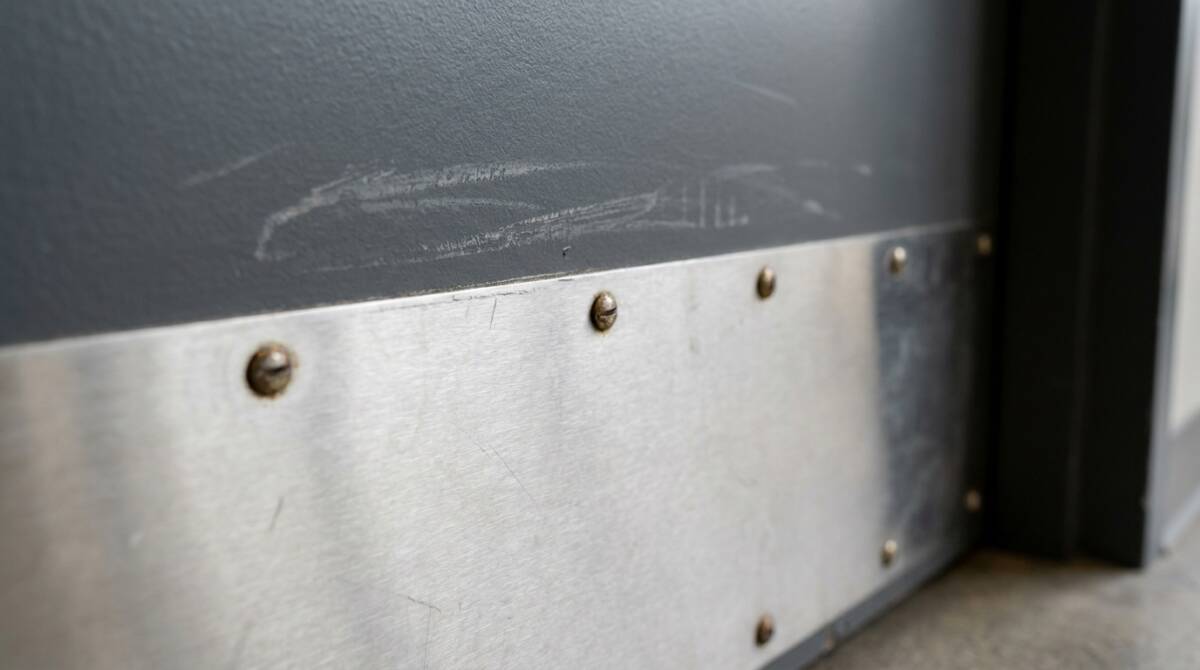
Walk up to almost any busy commercial entrance in the Greater Toronto Area and look down. The bottom of the door tells the real story of the building. Scuffed paint, dented metal, grey cart tracks, and a dull band of wear where thousands of shoes, boots, dollies, and hand trucks have pushed through. A kick plate is the simple piece of hardware that stops all of that from reaching the door itself.
For a business owner or property manager, a kick plate is one of the cheapest ways to protect a door that costs hundreds or thousands of dollars to replace. It also keeps an entrance looking cared for, which matters more than most people think when a customer forms a first impression at the threshold. This guide covers what kick plates are, the different protection plates you can choose from, how to size and mount them, where they matter most in commercial buildings, and how the accessibility and fire-door rules in Ontario shape your options.
What is a kick plate?
A kick plate is a flat metal or plastic panel fixed to the lower portion of a door to protect it from kicks, foot traffic, carts, and general abuse. On a commercial door it usually runs the full width of the leaf and stands 6 to 16 inches tall, fastened with screws or heavy adhesive. The plate takes the damage so the door face, paint, or veneer underneath stays intact.
That is the short version. The longer answer is that a kick plate is part of a family of door protection plates, each built for a different kind of wear, and choosing the right one depends on how the door gets used every day. A plate on a restaurant kitchen door faces different punishment than one on a quiet office suite, and the material, height, and gauge should reflect that.
Why commercial doors need kick plates
Doors in a commercial building take abuse that residential doors never see. Staff push through with full arms and use a foot. Delivery crews roll carts and dollies straight into the bottom rail. Cleaning teams drag mop buckets and floor scrubbers against the base. Over a year, that adds up to thousands of small impacts on the same few inches of door.
Without protection, the result is predictable. Paint chips and peels, hollow metal dents, wood doors splinter or gouge, and the whole entrance starts to look neglected. A dented door can also stop sitting square in its frame, which drags in other hardware like the hinges and the door closer. A kick plate absorbs the hits and spreads the load, so the door body stays flat and true. It is a wear part by design. When it gets beaten up, you replace a sheet of metal rather than the door.
There is a presentation side too. A clean, well-finished plate reads as a building that is maintained. A scuffed, flapping, or corroded one does the opposite. For retail, hospitality, and medical tenants whose customers judge the space at the front door, that detail carries weight.
Kick plates, mop plates, armor plates, and push plates
People use the phrase “kick plate” loosely, but the trade actually has several named protection plates, and they are not interchangeable. Picking the right one comes down to where the door gets hit and how hard. These plates are all part of the broader world of commercial door hardware, and many doors carry more than one.
| Plate type | Typical height | Where it mounts | What it protects against |
|---|---|---|---|
| Kick plate | 6 to 16 in | Push side, bottom of the door | Feet, carts, general daily wear |
| Mop plate | 3 to 6 in | Very bottom edge of the door | Mop water, floor scrubbers, cleaning carts |
| Armor plate | 36 to 48 in | Push side, covering most of the lower door | Heavy cart and equipment impact in rough service areas |
| Stretcher plate | 6 to 12 in, mounted at cart height | Mid-height on the push side | Gurney, bed, and wheeled-equipment strikes in healthcare |
| Push plate | Narrow, at hand height | Push side, near the lock stile | Hand soil and finger marks on doors with no handle |
| Pull plate | Narrow, with a handle | Pull side, near the lock stile | Hand soil while giving users something to grip |
On a single busy door you will often see a kick plate on the push side bottom paired with a push plate at hand height, and a matching pull plate on the other face. In a hospital or a loading corridor, an armor plate or a stretcher plate takes over where the hits land higher and harder. The standard that governs all of this architectural door trim is ANSI/BHMA A156.6, which sets the sizes, materials, and finishes manufacturers build to. You can read the scope of that standard through the Builders Hardware Manufacturers Association.
Materials and finishes
The material you choose sets the look, the toughness, and the price. Most commercial kick plates are metal, but the right metal depends on the setting.
Stainless steel
Stainless is the workhorse for commercial entrances. It resists corrosion, shrugs off scratches, and wipes clean, which makes it a strong fit for food service, healthcare, and anywhere that gets washed down. A brushed or satin finish hides fingerprints and small scuffs better than a mirror polish. Type 304 stainless is the common commercial grade, with 316 used where salt or harsh cleaning chemicals are a factor.
Aluminum
Aluminum is lighter and less expensive than stainless, and it pairs naturally with aluminum storefront systems. Anodized and powder-coated aluminum plates come in a range of colours, including black and bronze tones that match modern storefronts. Aluminum dents more easily than stainless under heavy cart impact, so it suits moderate-traffic entrances rather than loading areas.
Brass and bronze
Brass and bronze plates lean decorative. They look at home on heritage buildings, hotels, and upscale retail where the hardware is part of the design. They need occasional polishing unless you choose a lacquered or antique finish that is meant to patina. The cost sits above stainless and aluminum.
Plastic and acrylic
Clear acrylic and plastic plates are a budget option, often used on interior doors or where the owner wants protection without changing the door’s look. They scratch and yellow over time and do not stand up to the pounding a commercial exterior door takes, so they are best kept to light-duty interior use.
| Material | Durability | Best use | Relative cost |
|---|---|---|---|
| Stainless steel (304/316) | High | Food service, healthcare, high-traffic exteriors | Medium to high |
| Aluminum (anodized/powder-coated) | Medium | Storefronts, offices, moderate traffic | Low to medium |
| Brass or bronze | Medium to high | Hotels, heritage buildings, upscale retail | High |
| Acrylic or plastic | Low | Light-duty interior doors | Low |
Gauge and thickness
Metal thickness is measured in gauge, and a lower gauge number means a thicker, stronger plate. Commercial kick plates commonly run 16 gauge, around 0.060 inches, or 18 gauge, around 0.050 inches. Thinner residential plates can be 20 or 22 gauge, which is fine for a home but bends under commercial cart traffic.
For a busy GTA entrance, 16 gauge stainless is the safe default. It holds its shape under repeated impact and does not oil-can or flex when a cart rolls into it. On interior doors with lighter use, 18 gauge keeps the cost down without giving up much protection. Thicker plates weigh more, so very heavy armor plates need strong fasteners and sometimes added reinforcement so the weight does not strain the door or the hinges over time.
How to size a kick plate
Sizing is where a lot of first-time buyers go wrong, and a plate that is cut too wide will not clear the frame stop when the door closes. Two measurements matter: width and height.
Width
The trade convention is to make a kick plate narrower than the door so it tucks inside the stop. The usual rule is:
| Door configuration | Plate width rule | Example on a 36 in door |
|---|---|---|
| Single door | Door width minus 2 in | 34 in wide plate |
| Pair of doors with an astragal | Door width minus 1 in | 35 in wide plate |
| Door where the plate wraps to the edge | Full door width, special order | 36 in wide plate |
The 2-inch reduction, often written as “2 inches less door width” or 2 in LDW, gives the plate room to clear the hinge-side and strike-side stops. On a pair where the inactive leaf carries an astragal, 1 inch less works because the meeting edges behave differently. If you are not sure how your pair is set up, our guide to flush bolts and double-door hardware explains the active and inactive leaf layout.
Height
Height is a judgment call based on what hits the door. Common heights are 6, 8, 10, 12, and 16 inches. An 8-inch plate is the most common choice for a standard entrance because it covers the kick zone without looking heavy. Taller plates make sense where carts and equipment strike higher. If you are matching a plate to a standard commercial door size, measuring the existing opening first saves a return trip.
Where kick plates matter most
Every commercial door benefits from protection, but a few settings make a kick plate close to mandatory.
Retail and grocery. Carts, strollers, and constant foot traffic batter the entrance all day. Stainless or powder-coated plates keep a storefront looking sharp.
Restaurants and commercial kitchens. Staff push through swinging doors with both hands full, often with a foot or a hip. Kitchen doors almost always need kick plates on both faces, and a mop plate at the bottom handles the wash-down.
Healthcare and clinics. Gurneys, wheelchairs, supply carts, and bed frames strike doors at cart and stretcher height. This is where stretcher plates and taller armor plates earn their place.
Schools and institutions. High student traffic and heavy daily use call for tough 16-gauge plates that can take years of kicks.
Warehouses and industrial sites. Pallet jacks, dollies, and lift-truck traffic near hollow metal doors and overhead doors demand armor-grade protection.
Offices and lobbies. Lighter traffic, but the visible glass entry doors still benefit from a clean plate that protects the lower rail and lifts the look of the space.
Kick plates, accessibility, and fire doors
Two sets of rules shape what you can put on a commercial door in Ontario, and both are worth understanding before you order.
Barrier-free and accessible doors
Accessible entrances often call for a smooth, uninterrupted surface across the lower portion of the push side so that wheelchair footrests and mobility aids slide past without catching. A properly fitted kick plate supports that goal by giving the bottom of the door a flat, flush face. The Accessibility for Ontarians with Disabilities Act and the barrier-free provisions of the building code drive these expectations, and you can review the business obligations on the Government of Ontario’s page covering accessibility rules for businesses and non-profits. If you are checking whether your entrances meet current expectations, our overview of meeting accessibility rules for door width and access is a useful starting point.
Fire-rated doors
Protection plates on a fire-rated door are a different matter. Fire doors are tested and labelled as complete assemblies, so you cannot add any field hardware you like. Under the standard that governs fire door care, a protection plate whose top edge sits no more than 16 inches above the bottom of the door is generally accepted on a labelled fire door, while a taller plate usually has to be specifically listed for use on that assembly. The exact allowance belongs to the door’s listing and your local authority having jurisdiction, so confirm before you install anything on a rated opening. You can read the framework for fire door assemblies through the National Fire Protection Association, and our guide to Ontario building code fire door requirements covers the local picture. Getting this wrong can void a fire label, which turns a hardware choice into a code and insurance problem.
Mounting and installation
Kick plates attach one of two ways, and the choice affects how long the plate stays put.
Screw-mounted plates
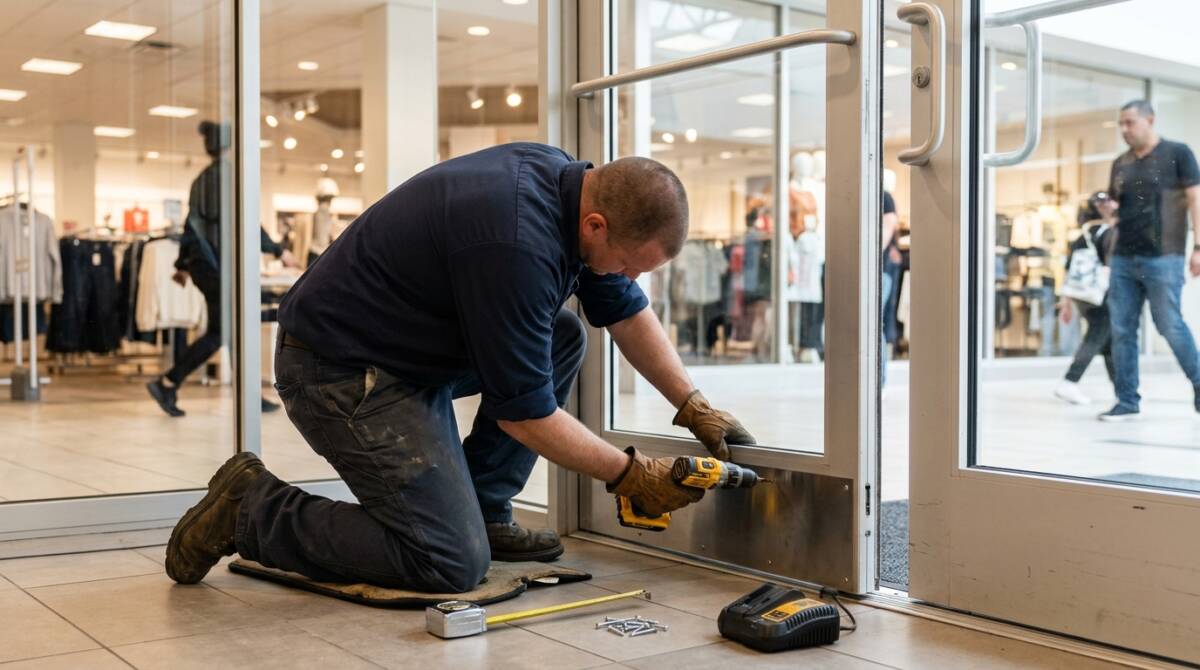
Screw mounting is the commercial standard. The plate is pre-drilled with countersunk holes, usually along the perimeter, and fastened with matching oval-head screws. On a hollow metal or steel door, the installer drills and often taps the holes, or uses self-drilling fasteners rated for the metal. On a wood door, wood screws bite directly. Screw mounting holds up to years of impact and is the only sensible choice on an exterior or high-traffic opening.
Adhesive-mounted plates
Self-adhesive plates use a strong double-sided tape and press on without tools. They work for light-duty interior doors and for tenants who cannot drill into a door, but the bond weakens over time, especially near heat or moisture, and the plate can peel at a corner and snag. For anything that takes real abuse, screws win.
| Mounting method | Holding strength | Best for | Watch out for |
|---|---|---|---|
| Screw mount | High, long term | Exterior and high-traffic commercial doors | Drilling into fire doors without checking the listing |
| Adhesive mount | Low to medium | Light interior doors, no-drill tenancies | Peeling corners, heat and moisture, snag hazard |
A clean install matters. The plate should sit flush, centred on the width, with the bottom edge just above the door sweep so the two do not fight each other. A plate installed too low can foul the sweep or the threshold and keep the door from closing fully, which then stops the latch and the weatherstripping from doing their jobs.
Common kick plate problems
Kick plates are simple, but they do fail, usually from the same handful of causes.
| Symptom | Likely cause | Fix |
|---|---|---|
| Plate rattles or lifts at a corner | Loose or stripped screws, failed adhesive | Reset fasteners, move to larger screws, or switch to screw mount |
| Plate is bent or dented | Heavy cart impact on an undersized gauge | Replace with 16-gauge or an armor plate |
| Rust streaks or pitting | Non-stainless plate or salt and chemical exposure | Replace with 304 or 316 stainless |
| Door will not close fully after install | Plate too wide for the stop or mounted too low | Refit to the correct width and height |
| Sharp or snagging edge | Bent corner or missing fastener | Re-secure or replace before it injures someone |
Repair or replace?
Because a kick plate is a wear part, the repair-or-replace decision is usually easy. A loose plate with sound metal just needs its fasteners reset. A dented, rusted, or bent plate is cheap enough that replacement almost always beats fussing with it. The one place to slow down is a fire-rated or accessible door, where the replacement has to keep the opening compliant. The same logic we use for whole doors in our repair versus replacement guide applies in miniature here.
| Situation | Recommended action |
|---|---|
| Plate sound, screws loose | Repair: reset or upgrade fasteners |
| Plate dented or bent | Replace with a heavier gauge |
| Corrosion on a non-stainless plate | Replace with stainless |
| Wrong size causing closing issues | Replace with a correctly sized plate |
| Plate on a fire or accessible door | Replace with a compliant plate, verify the listing |
Maintenance and cleaning
Kick plates need almost no upkeep, which is part of their appeal. A wipe with mild soap and water keeps stainless and aluminum looking clean. For stainless, wiping in the direction of the brush grain avoids swirl marks, and a stainless cleaner restores shine where needed. Avoid abrasive pads on finished or anodized surfaces, since they scratch the coating. Brass and bronze need occasional polishing unless they are lacquered or meant to patina. Twice a year, check that the fasteners are tight and the corners are not lifting, the same way you would check other door hardware during a maintenance round. Catching a loose plate early stops it from becoming a snag hazard or rattling itself off the door.
What a kick plate costs
Kick plates are inexpensive relative to the door they protect, but a few factors move the price.
| Cost driver | Effect on price |
|---|---|
| Material | Acrylic and aluminum are cheapest, stainless mid-range, brass and bronze highest |
| Gauge and thickness | Heavier 16-gauge and armor plates cost more than thin interior plates |
| Size | Taller and wider plates, and custom cuts, raise the price |
| Finish | Polished, anodized, and specialty finishes add cost over mill finish |
| Quantity and installation | Outfitting many doors lowers the per-door cost, labour adds to a per-visit minimum |
For most GTA businesses, the material and the plate itself are a small line item. The value is in protecting a door that is far more expensive to repair or replace, and in keeping the entrance presentable. Fitting plates during a planned hardware refresh, rather than as an emergency, keeps labour efficient.
When to call a commercial door specialist
Plenty of owners can screw a kick plate onto a simple interior door themselves. The reasons to bring in a specialist are the ones where a wrong move costs more than the plate. Fire-rated and accessible doors have to stay compliant. Hollow metal and aluminum doors need the right fasteners so the plate does not tear loose or damage the door. And if the plate is only one symptom of a door that is dragging, sagging, or not latching, a technician can address the real problem instead of dressing up the bottom of a failing door.
If you are already planning a commercial door installation or a hardware upgrade, adding kick plates at the same time is efficient. Commercial Door Pros installs, replaces, and services door protection plates and the full range of hardware across the Greater Toronto Area. You can contact our team to discuss your doors, or learn more about our commercial door services. If a door has already taken damage that goes beyond a plate, our emergency commercial door repair can get the opening working and secure again.
Frequently asked questions
What is the purpose of a door kick plate?
A kick plate protects the lower portion of a door from kicks, foot traffic, carts, and cleaning equipment. It takes the daily impact so the door face, paint, or veneer underneath stays intact, which extends the life of the door and keeps the entrance looking maintained.
How tall should a commercial kick plate be?
Eight inches is the most common height for a standard commercial entrance. It covers the kick zone without looking heavy. Taller plates of 10, 12, or 16 inches suit doors that take cart and equipment strikes higher up, such as healthcare and warehouse doors.
How wide should a kick plate be?
For a single door, make the plate 2 inches narrower than the door width so it clears the frame stop when the door closes. For a pair of doors with an astragal, 1 inch narrower is the usual rule. On a 36-inch single door, that means a 34-inch plate.
Does my door need a kick plate?
If the door sees regular foot traffic, carts, or cleaning equipment, a kick plate is worth fitting. Retail, restaurant, healthcare, school, and warehouse doors benefit the most. Low-traffic interior doors may not need one, though they are cheap insurance on any door you want to keep looking clean.
What is the difference between a kick plate and a mop plate?
A kick plate is taller, usually 6 to 16 inches, and protects the main kick zone on the push side. A mop plate is shorter, around 3 to 6 inches, and mounts at the very bottom edge to shield the door from mop water, floor scrubbers, and cleaning carts.
What is a stretcher plate?
A stretcher plate is a protection plate mounted at cart or stretcher height on the push side, used mainly in hospitals and clinics where gurneys, beds, and wheeled equipment strike the door above the normal kick zone.
What material is best for a commercial kick plate?
Type 304 stainless steel is the common choice for commercial entrances because it resists corrosion, scratches, and cleaning chemicals. Use 316 stainless where salt or harsh chemicals are present, aluminum for moderate-traffic storefronts, and brass or bronze where appearance matters most.
What gauge should a commercial kick plate be?
Sixteen gauge, around 0.060 inches, is the safe default for busy commercial doors because it holds its shape under cart impact. Eighteen gauge, around 0.050 inches, works for lighter interior use. Thinner residential plates bend under commercial traffic.
Can you put a kick plate on a fire-rated door?
Yes, within limits. A protection plate whose top edge sits no more than 16 inches above the bottom of the door is generally accepted on a labelled fire door, while taller plates usually need to be specifically listed for that assembly. Confirm with the door’s listing and your local authority before installing.
Do kick plates go on one side or both sides of the door?
The kick plate goes on the push side, where feet and carts strike. Doors that get pushed from both directions, such as restaurant kitchen doors, often carry a plate on each face. Pull-side protection usually comes from a pull plate at hand height instead.
How are kick plates attached?
Commercial kick plates are screw-mounted with countersunk oval-head screws through pre-drilled holes, which holds up to years of impact. Light-duty interior plates can use strong double-sided adhesive, but the bond weakens over time and is not suited to exterior or high-traffic doors.
Can I install a kick plate myself?
On a simple interior wood or hollow metal door, a careful owner can fit a screw-on plate with basic tools. Bring in a specialist for fire-rated and accessible doors, for aluminum and metal doors that need the right fasteners, and whenever the door itself is dragging or not latching properly.
Will a kick plate stop my door from closing?
Not if it is sized and placed correctly. A plate cut too wide can foul the frame stop, and one mounted too low can catch on the sweep or threshold. Both keep the door from closing and latching fully, which is why width and height matter.
Do kick plates help with accessibility?
They can. Accessible doors often call for a smooth, flush surface across the lower push side so mobility aids slide past without catching, and a properly fitted kick plate supports that. Confirm the specifics against Ontario’s barrier-free requirements for your building type.
How do I clean a stainless steel kick plate?
Wipe it with mild soap and water, working in the direction of the brushed grain to avoid swirl marks. A stainless cleaner restores shine where needed. Skip abrasive pads, which scratch the finish, and dry the plate to prevent water spotting.
How long do kick plates last?
A quality stainless or aluminum kick plate on a commercial door can last many years, often outliving several repaints of the door. Lifespan depends on the traffic, the material, and the gauge. Because the plate is a wear part, replacing it is routine and inexpensive when it finally gives out.
Are kick plates only for exterior doors?
No. Interior doors in high-traffic corridors, kitchens, stockrooms, and service areas take just as much abuse as exterior doors, sometimes more. Kick plates and mop plates are common on interior commercial doors wherever carts and foot traffic are heavy.
Protect your doors before the damage starts
A kick plate is a small investment that pays off every day a cart rolls through your entrance. The right plate, sized correctly and mounted the right way, keeps your doors flat, clean, and compliant for years. If you want help choosing and fitting kick plates, mop plates, or armor plates across your building, or you have a door that needs more than a plate, reach out to Commercial Door Pros for a commercial assessment anywhere in the Greater Toronto Area.


